The Pontiac Banshee is a line of concept cars designed by Pontiac, taking the place of the Firebird dream cars of the 1950s. Four were built through 1988 as design exercises, and the Banshee was also the leading candidate for Pontiac’s version of the Camaro before that car became the Firebird.
Pontiac Banshee at a glance
| Maker | Pontiac, General Motors |
|---|---|
| Cars built | four concepts, 1964–1988 |
| First car | XP-833, 1964, two-seater |
| XP-833 engines | straight-six in the coupe, V8 in the convertible |
| XP-851 | four-seater development of the XP-833 |
| 1966 car | XP-798, 421 V8, sliding doors |
| Banshee II | 1968, fibreglass over Firebird panels |
| Banshee III | 1974, 455 Super Duty V8 |
| Banshee IV | 1988, 230 hp V8 with head-up display |
History of the Pontiac Banshee
XP-833
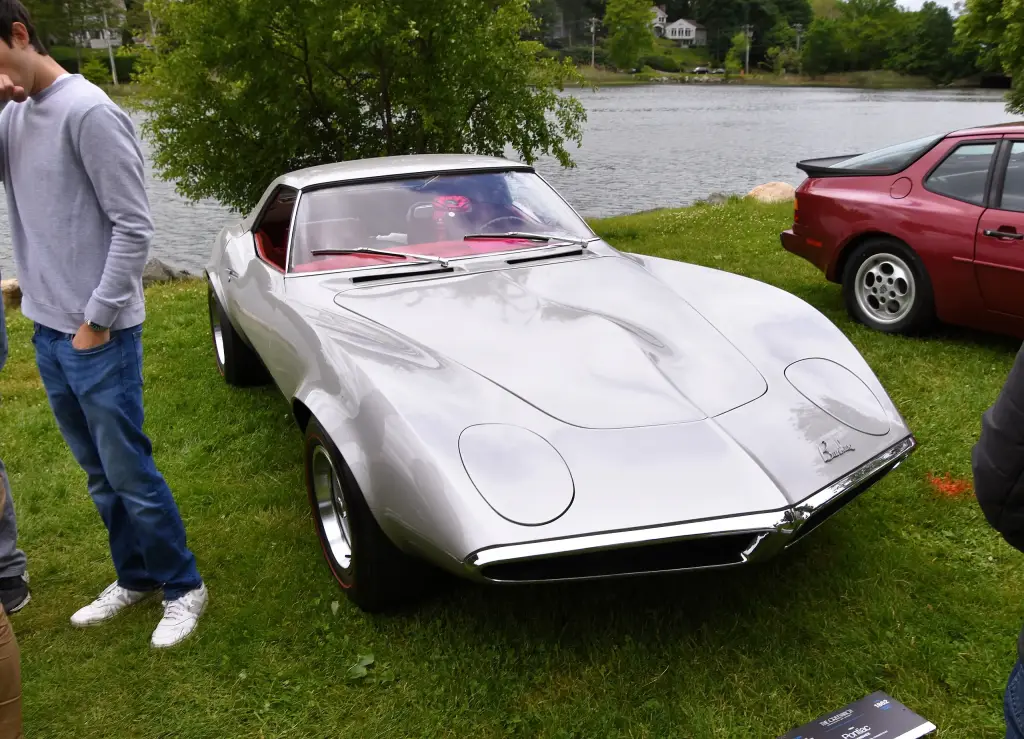
In 1964 Pontiac developed the XP-833, a small two-seater with a long sweeping bonnet and a short rear deck. Several versions were built but only two were drivable: a silver hardtop with a straight-six and a pearl-white convertible with a V8. A four-seater version, the XP-851, was also developed. The Banshee name was only attached in 1971, when the engineer Bill Collins fitted leftover badges from the later XP-798 project; during development the XP-833 was never called a Banshee.
The shape anticipated the third-generation Chevrolet Corvette of 1968 and the Opel GT, and its tail lights were almost identical to those of the first-generation Firebird. Pontiac’s head John DeLorean called it the “Mustang fighter” and is said to have intended to put it into production. GM management saw it differently: the car would have had the same power as the Corvette while weighing 500 lb less, reaching 60 mph in second gear, and DeLorean was told to stop development in 1964. In 1965 a memo instructed GM design chief Bill Mitchell to update the XP-833 clay “reflecting a Chevrolet design for the two-passenger version coupe”, and the project became the C3 Corvette it had been forbidden to compete with.
XP-798
The 1966 Banshee, codenamed XP-798, was a concept inspired by European grand tourers and grew out of a four-seater Corvette rival study, the XP-778. It had a Pontiac 421 V8, four-wheel independent suspension, sliding hinged doors and hinged roof panels for access to the rear seats. Development began in 1962 under the name Scorpion, and DeLorean renamed it after the fighter plane. It was to be shown at the 1966 New York Auto Show, with the press release already written, but James Roche pulled it at the last minute. The prototype was eventually crushed, though its badges went to the XP-833 cars.
Banshee II and III
The 1968 Banshee II wore aerodynamic fibreglass skins over stock Firebird inner panels with a near-standard black interior, and was repainted white with graphics in 1969. It had flush wheel covers, a louvered bonnet, cut-down glass, brake cooling vents and a 400 cu in V8.
The 1974 Banshee III was developed from the Firebird platform with a long sloping nose, covered headlamps and a soft face bumper of body-coloured urethane over foam. It had fixed flush side glass with an electrically operated toll window, red leather upholstery and a hatchback with folding rear seats, and was powered by a 455 cu in Super Duty V8. Its four slit tail lights became twenty round ones when the car was updated in 1976.
Banshee IV
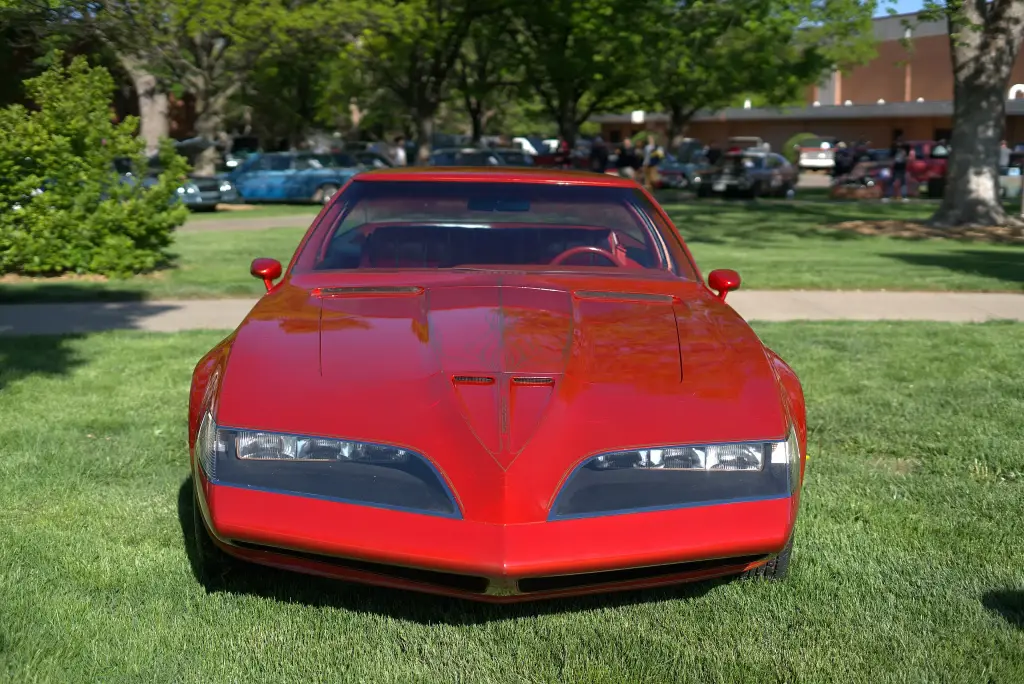
The last car, known inside GM as Banshee IV, appeared in 1988: a two-door four-seater with a fibreglass body painted bright red and a matte black triangular bonnet, powered by a 230 hp fuel-injected single-overhead-cam V8 driving the rear wheels. It had a head-up display projecting speed and engine information.
Design and features
- Corvette rival: the XP-833 was lighter and as powerful as the Corvette, which is why GM stopped it.
- Design source: its shape fed into the C3 Corvette and its tail lights into the first Firebird.
- Show-car technology: sliding doors and hinged roof panels on the XP-798, a head-up display on the 1988 car.
- Four generations: 1964, 1966, 1968–1976 and 1988, each a fresh design study.
Pontiac Banshee versions
- XP-833 (1964): two-seater, silver six-cylinder coupe and white V8 convertible.
- XP-851: the four-seater development.
- XP-798 (1966): 421 V8 grand tourer, never shown.
- Banshee II (1968): fibreglass-bodied Firebird study.
- Banshee III (1974): 455 Super Duty V8, restyled in 1976.
- Banshee IV (1988): 230 hp V8 coupe with a head-up display.
The Banshee’s tail lights and platform links point to the Firebird, and the 1988 car looked forward to the Solstice. More models are in the Pontiac collection.
Video: Pontiac Banshee A Longer Look
Video by King Rose Archives on YouTube.
Sources
- Pontiac Banshee, English Wikipedia: all four cars, dates, engines, DeLorean