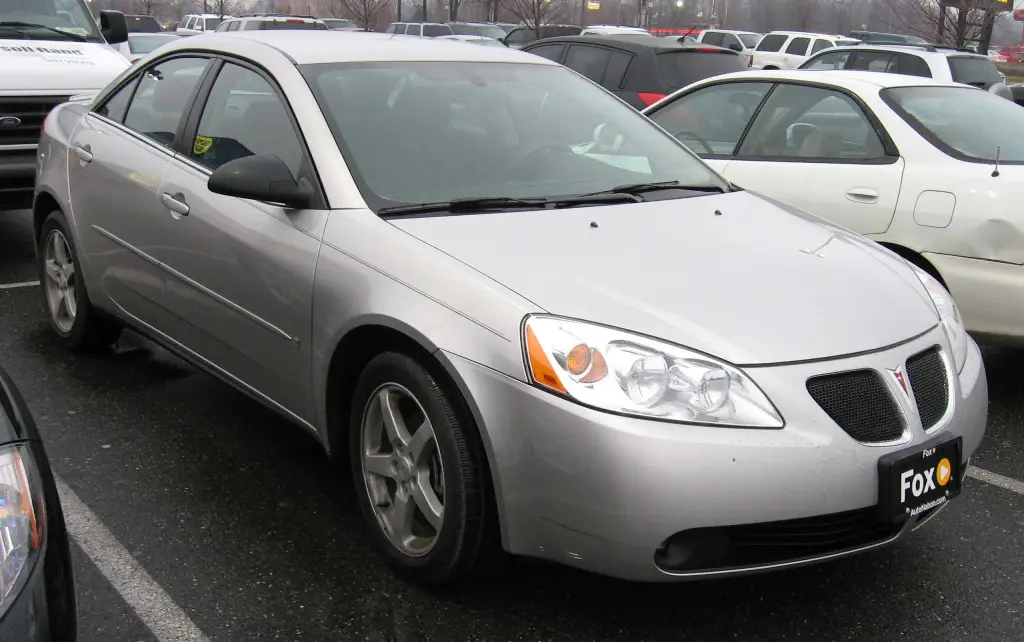
The Pontiac G6 was a mid-size car introduced in 2004 for the 2005 model year to replace the Grand Am. It shared the GM Epsilon platform with the Chevrolet Malibu and Saab 9-3, and the final Pontiac-badged vehicle ever built was a white G6.
Pontiac G6 at a glance
| Maker | Pontiac, General Motors |
|---|---|
| Model years | 2005–2010 |
| Replaced | Pontiac Grand Am |
| Platform | GM Epsilon, shared with Chevrolet Malibu and Saab 9-3 |
| Body styles | sedan, coupé (2006), retractable-hardtop convertible (2006–2009) |
| Engine, 2005 | 3.5 L pushrod V6, 200 hp |
| Engine, 2006 base | 2.4 L DOHC four, 169 hp |
| GTP, 2007 | 3.6 L DOHC V6, 252 hp |
| Transmission | four-speed automatic; six-speed manual on GTP |
| Roof | two-piece hydraulic hardtop by Karmann |
| Production ended | 2010 |
Based on one source: the English Wikipedia article on the G6.
History of the Pontiac G6
From concept to showroom
The G6 was first shown as a concept at the 2003 North American International Auto Show with a 285 hp supercharged 3.5 litre V6. The production car arrived for 2005 with two trim levels, base V6 and sportier GT, both using a 3.5 litre pushrod V6 of 200 hp and 220 lb·ft through a four-speed automatic; the GT added TAPshift manual control. Base cars were well equipped with power locks, windows and mirrors, keyless entry, a six-speaker CD stereo, a power driver’s seat and air conditioning, while GTs added an eight-speaker Monsoon stereo, premium cloth seats, remote start, ABS and traction control. With the G6, Pontiac introduced two-digit names, the G8 a class above and the G5 a class below.
Coupé, convertible and more power
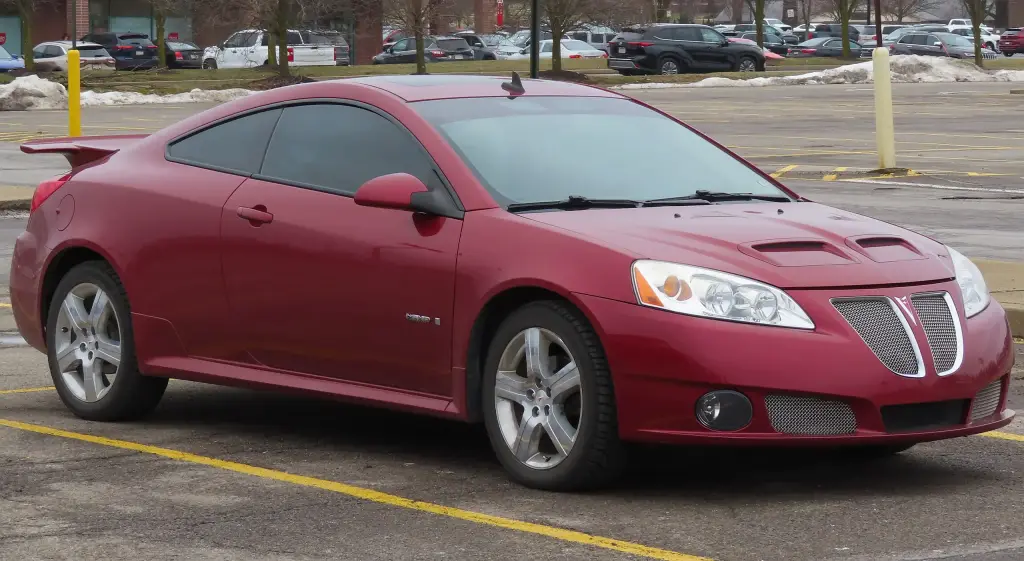
For 2006 the range grew a coupé and a retractable-hardtop convertible, and two new trim levels: a base four-cylinder car with a 169 hp 2.4 litre engine, and the high-performance GTP with a 3.9 litre V6 of 240 hp, a six-speed manual available at no cost and standard stability control. The convertible’s roof was engineered by Karmann Technical Development in Pontiac, Michigan and built as a module for GM’s Orion Assembly plant. Early prototypes failed durability testing after fewer than 10,000 cycles against a target of 16,000–20,000, and the deck lid fitted poorly to the rear fenders, which delayed the launch. For 2007 the GT’s 3.5 gained variable valve timing and 224 hp, and the GTP received a 3.6 litre DOHC V6 of 252 hp with a six-speed automatic.
GXP and the end
For 2008 the GTP became the GXP with more dramatic styling, and the 3.9 litre V6 became a convertible-only option. A 2009.5 revision brought new front and rear fascias and a dashboard with Bluetooth, but the coupé and convertible stopped at the end of 2009. GM entered bankruptcy, and although most Pontiacs were dropped, the G6 sedan stayed in production for fleet orders while the brand was closed, ending in 2010 with white back-lit instruments instead of Pontiac’s traditional red. The G6 was effectively replaced by the Buick Regal.
Design and features
- Epsilon platform: shared with the Chevrolet Malibu and Saab 9-3.
- Folding hardtop: a two-piece hydraulic roof by Karmann, offered from 2006.
- Two-digit naming: the first Pontiac named on the new G-series system.
- Equipment: remote start, stability control and a panoramic sunroof option.
- The last Pontiac: a white G6 closed the brand’s production in 2010.
Pontiac G6 versions
- Base and GT (2005): the original sedan pair with the 3.5 litre V6.
- SE four-cylinder (2006): the 2.4 litre entry model.
- GTP (2006–2007): 3.9 then 3.6 litre V6, up to 252 hp.
- Coupé and convertible (2006–2009): GT and GTP only.
- GXP (2008–2009): the GTP renamed with bolder styling.
The G6 replaced the Grand Am and sat below the G8; it also took over part of the ground once held by the Grand Prix. More Pontiacs are in the Pontiac collection.
Sources
- Pontiac G6, English Wikipedia: trim levels, engines, roof, end of production