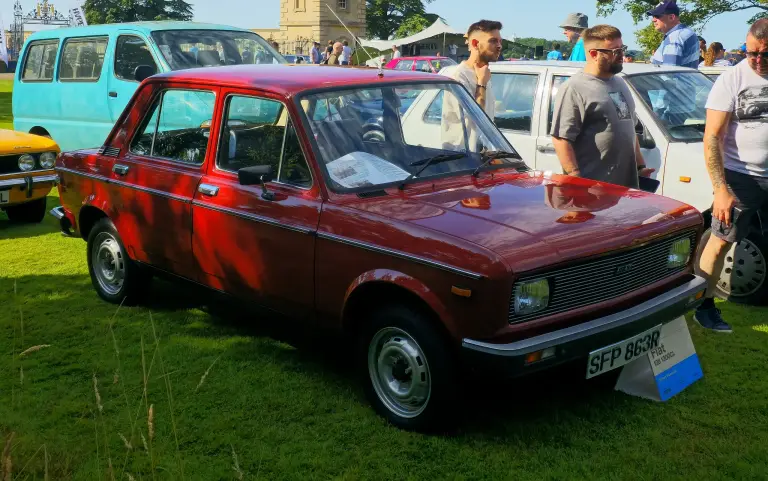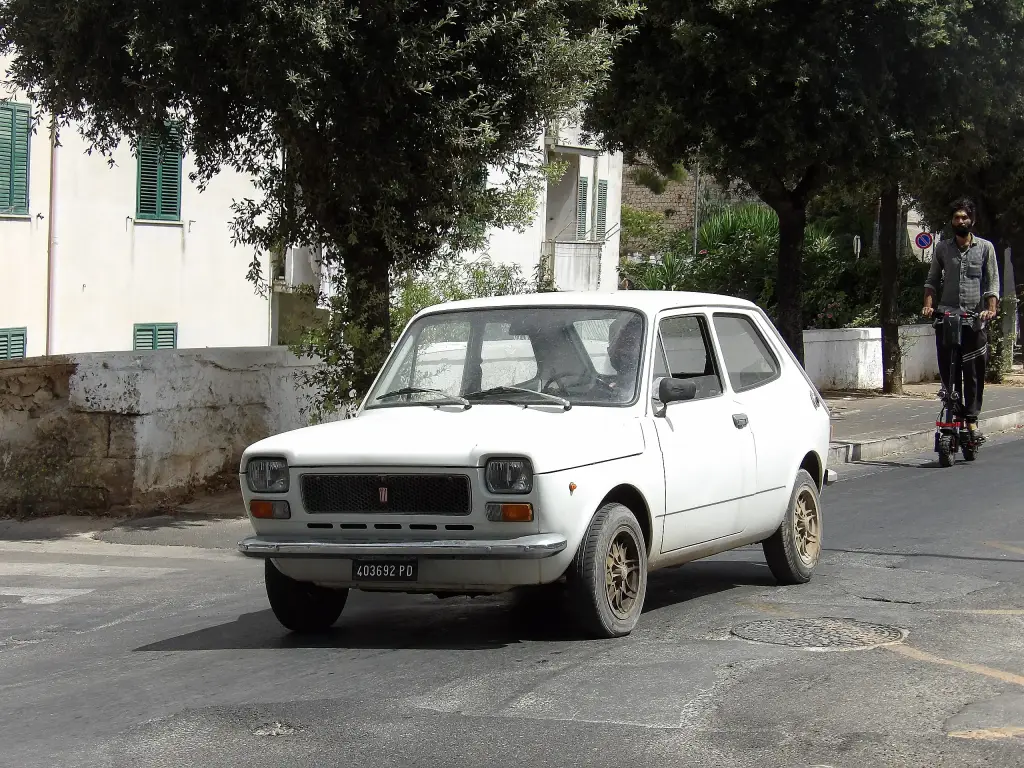
The Polski Fiat 127p takes its name from the Fiat 127, the small car Fiat launched in 1971 to replace the 850. With its transverse engine, front-wheel drive and hatchback body it defined the modern supermini, and it won the European Car of the Year award for 1972. Italian production ended in 1983.
Polski Fiat 127p at a glance
| Maker | Fiat, Turin |
|---|---|
| Production | 1971–1983 in Italy |
| Designer | Pio Manzù |
| Launched | April 1971, as a two-door saloon |
| Hatchback | three-door, from March 1972 |
| Engine | 903 cc overhead-valve four, from the Fiat 100 series |
| Layout | transverse engine, front-wheel drive, gearbox on the end of the engine |
| Rear suspension | transverse leaf spring |
| Award | European Car of the Year 1972 |
| Series 2 | May 1977, with a 1,049 cc 50 PS engine |
| Sport | June 1978, 70 PS from the 1,049 cc engine |
| Millionth car | June 1974, at Mirafiori |
based on one source: the English Wikipedia article on the Fiat 127. The record is named for the Polish-assembled 127p, but the sources describe the Italian model and give no details of Polish assembly.
History of the Polski Fiat 127p
A new kind of small car
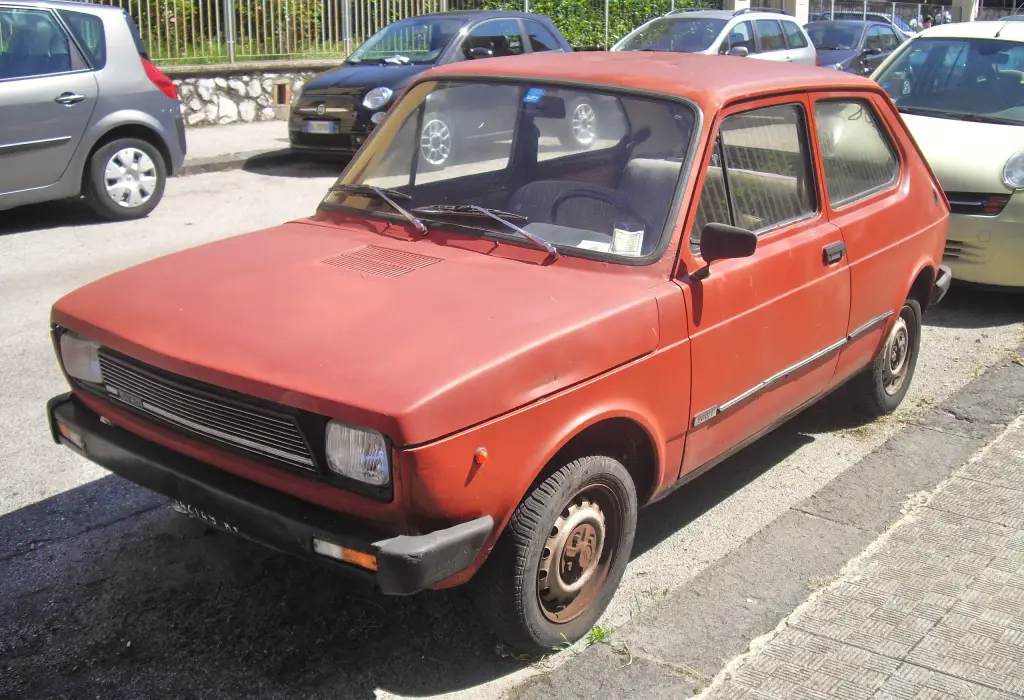
The 127 was developed towards the end of the 1960s and launched in April 1971 as a two-door saloon, with a three-door hatchback following in March 1972. The hatchback, which shared the body profile but had a full-depth rear door and a folding rear seat, became the most popular version. It was Fiat’s first hatchback of supermini size.
The engineering followed the pattern Fiat had proved on its Autobianchi subsidiary with the Primula of 1964 and the A112 of 1969: the engine sat across the car with the gearbox on its end, driving the front wheels. The larger Fiat 128 of 1969 had been the first Fiat-badged car with that layout; the 127 used a shortened version of the 128 platform and the rugged 903 cc overhead-valve engine of the Fiat 100 series. At the rear there was a transverse leaf spring, unusual for the class. The car also had an articulated steering column and crumple zones, both novelties in a small car.
The result was praised for the use of space — 80 per cent of the floor area was available for passengers and luggage — and for its roadholding. It was also the first car with an all-polypropylene bumper on a steel support. It won the European Car of the Year award for 1972, the third Fiat in six years to do so, and became one of the best-selling cars in Europe. In the United Kingdom it was one of the most popular imports, peaking at more than 20,000 sales in 1978. In June 1974, a little over three years after the launch, the millionth 127 was finished at Mirafiori; the Fiat 600 had needed seven years to reach the same figure.
Series 1 changes
The first series changed little. In May 1973 saloons became available in standard and, in Britain, deluxe form. In the autumn of 1974 came the 127 Special, with a restyled grille, extra chrome, a new dashboard, carpet instead of rubber mats, better seats with reclining backs, opening rear side windows and more equipment as standard. In early 1976 the engine was modified for new emissions rules: a new carburettor and revised valve timing cost two horsepower but gained about ten per cent in fuel economy.
Series 2 and the Sport
The Series 2 arrived in May 1977. The shell was fundamentally the same, but the front and rear were restyled, the rear side windows grew and the upswept belt line of the first series went, replaced by a kink in the C-pillar of the kind BMW used. The new rear quarter pressings came from the Brazilian Fiat 147. A larger 1,049 cc engine of 50 PS joined the range; unusually for the 127 it was the five-bearing overhead-camshaft unit from the 147 rather than the Fiat engine of the 128. The tailgate was extended down almost to the rear bumper, answering complaints about the high sill over which luggage had to be lifted. The interior was revised with a plainer dashboard that lost the wood of the first series, and there were three equipment levels, L, C and CL.
A Sport model appeared in June 1978 with 70 PS from the 1,049 cc engine, obtained with an Abarth-modified cylinder head, larger valves, an Abarth exhaust and a twin-choke Weber carburettor, backed by a shorter final drive. It had high-backed cloth seats with blue or orange piping, racing mirrors, a rev counter, sports wheels and a leather steering wheel.
Design and features
- Transverse engine, front drive: the layout that almost every European supermini copied.
- Hatchback body: a full-depth rear door and folding seat, from March 1972.
- Space efficiency: 80 per cent of the floor area for people and luggage.
- Safety details: articulated steering column and crumple zones.
- Sport version: the 70 PS Abarth-assisted 127 Sport of 1978.
Polski Fiat 127p versions
- 127 two-door saloon (1971): the original body.
- 127 three-door hatchback (1972): the version most buyers chose.
- 127 Special (1974): extra chrome, better seats and more standard equipment.
- Series 2 (1977): restyled body, 1,049 cc engine and equipment levels L, C and CL.
- 127 Sport (1978): 70 PS, sports seats, rev counter and special wheels.
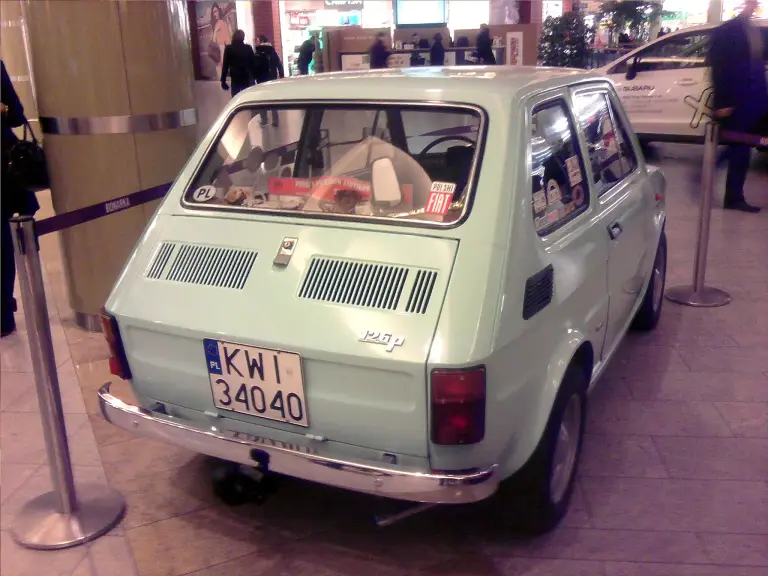
The bigger car built on the same idea was the Polski Fiat 128p, and the Polish-built small Fiat of the same years was the Polski Fiat 126p. More cars are in the Polski Fiat collection.
Sources
- Fiat 127, English Wikipedia: launch, engineering, Series 1 and 2, Special and Sport, sales