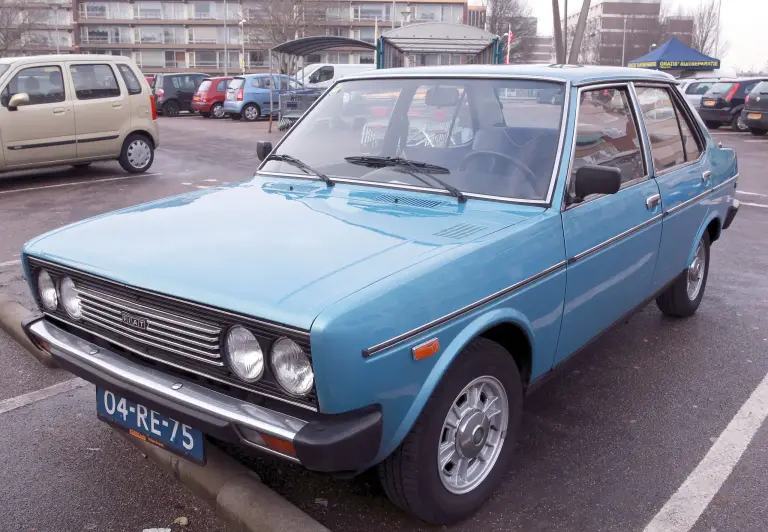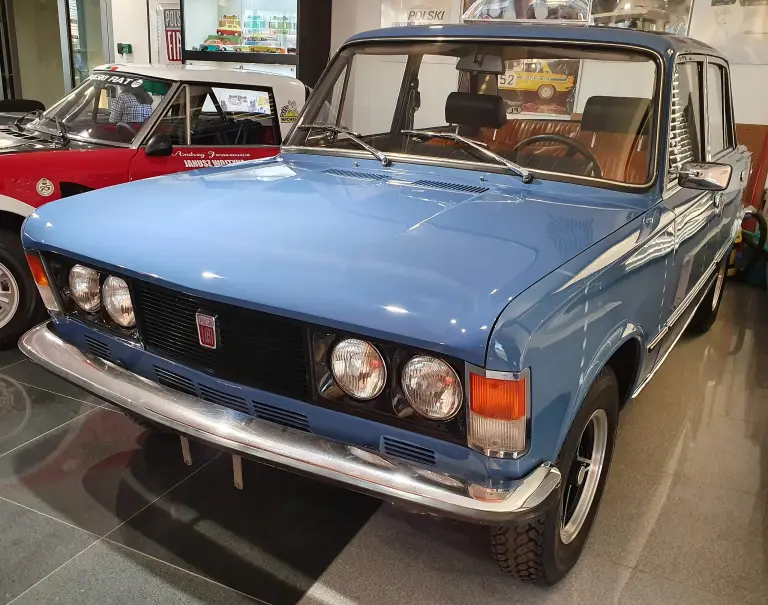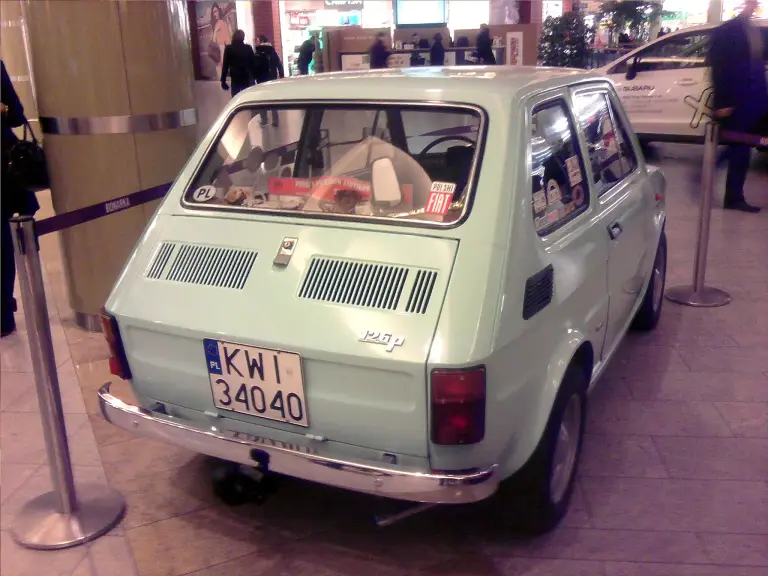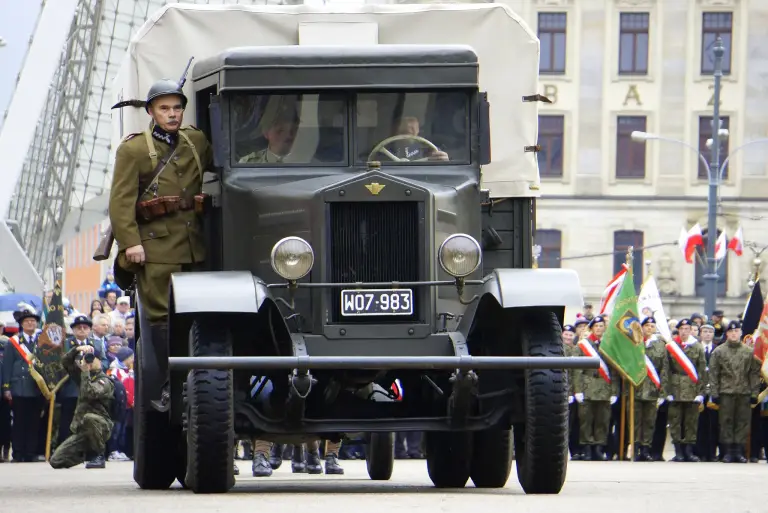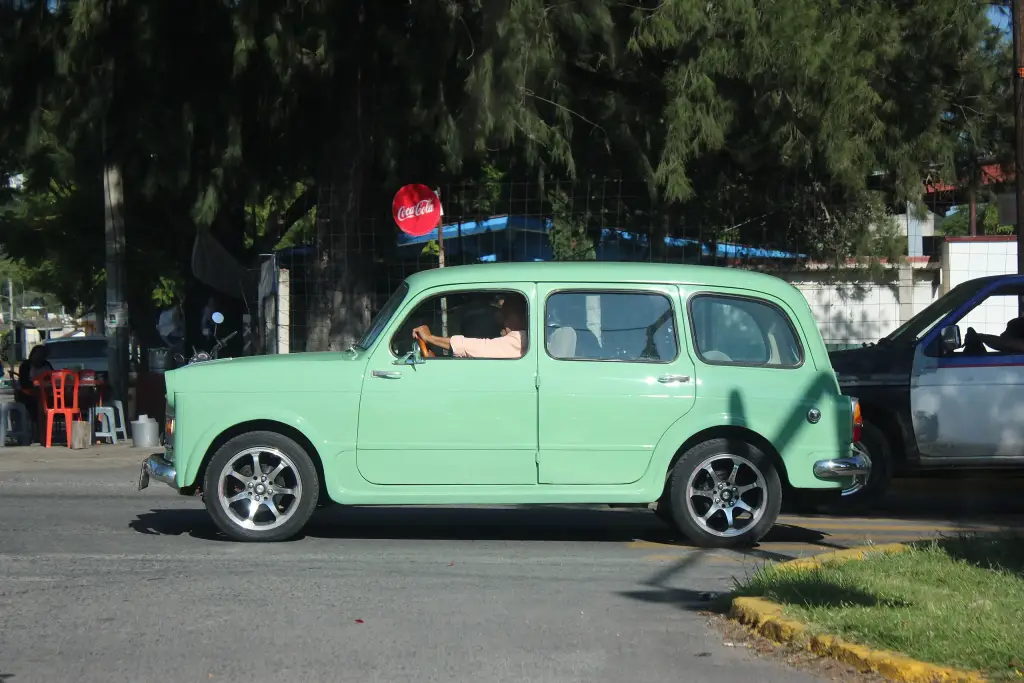
The Polski Fiat 1100 name belongs to the Fiat 1100, the small family car that Fiat built in Italy from 1939 to 1969. It went through four series: the pre-war car that was still called 508C, the 1100/103 of 1953 with its new pontoon body, the Granluce and 1100 D, and the square 1100 R that gave way to the Fiat 128.
Polski Fiat 1100 at a glance
| Maker | Fiat, Turin |
|---|---|
| Production | 1939–1969, in four series |
| First series | 508C type of 1939, known as the 1100 from its engine size |
| Second series | 1100/103, introduced in April 1953 at the Geneva show |
| Engine | 1,089 cc four-cylinder, overhead valve, single carburettor |
| Power | 36 PS (26 kW) at 4,400 rpm |
| Gearbox | four-speed manual, synchromesh on the top three, column shifter |
| Top speed | 116 km/h (72 mph) |
| Body | four-door saloon with centre-hinged doors until 1960 |
| Trim levels | Tipo A, spartan, and Tipo B |
| Sporting version | 1100 TV, 48 PS, 135 km/h |
| Later series | Granluce 1959, 1100 D 1962, 1100 R 1966 |
The sources describe the Italian Fiat 1100, which is the car the Polish records are named after; the Polish Wikipedia article on Fiat lists the Polish licence models as the 508, 621, 125p and 126p and does not describe a separate Polish 1100.
History of the Polski Fiat 1100
From the 508C to the 1100 E, 1939–1952
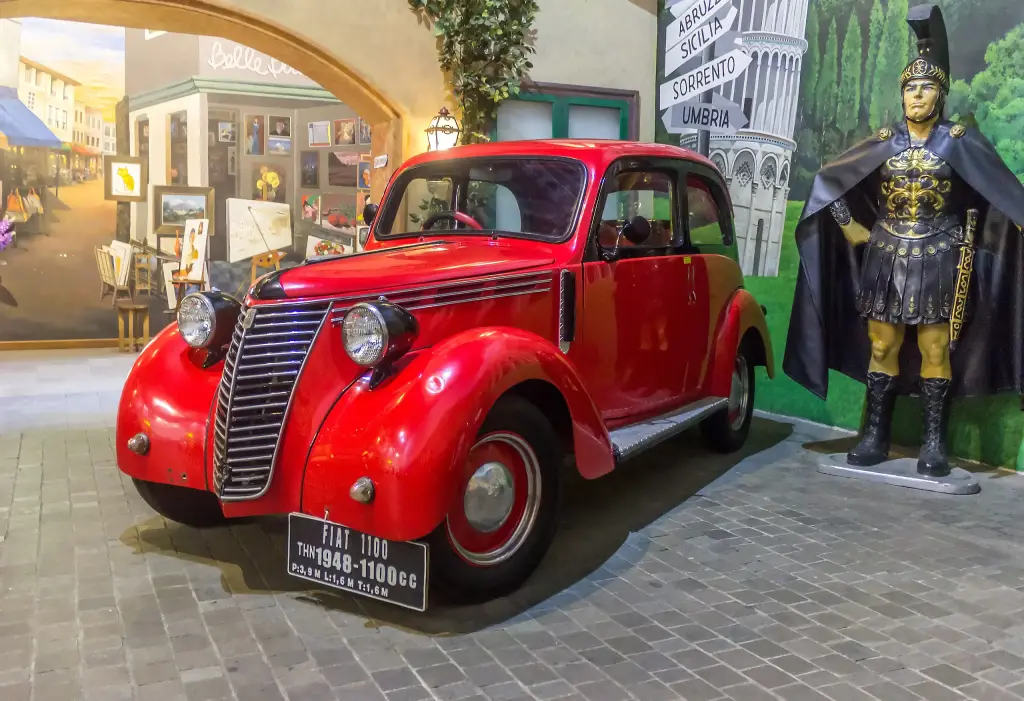
The first series appeared in 1939 under the designation Fiat 508C, but buyers knew it as the 1100 after the size of its engine. The pre-war styling was partly changed in the 1100 B and again in the 1100 E, which was built on after the Second World War; the first series lasted until 1952. The 1100 E was the last evolution of the 508C Nuova Balilla 1100 of 1937, and the car was popular as a taxi and as a light commercial vehicle. The commercial line, later called the 1100 T, stayed in production until 1971.
The 1100/103 of 1953
The new car was shown at the Geneva Motor Show in April 1953 and was known internally as the 103. Unlike the 1100 E it replaced, it had a modern four-door pontoon body on a unitary chassis, both of which Fiat had pioneered in its range with the 1400 of 1950. The engine was the well-tried 1,089 cc overhead-valve four, here as type 103.000 with a single Solex or Weber carburettor, giving 36 PS CUNA (26 kW) at 4,400 rpm — one horsepower more than in the 1100 E. The four-speed gearbox had synchromesh on the top three ratios and a column-mounted lever, and the car reached 116 km/h.
Two versions were offered. The Tipo A was the spartan one: it came only in a grey-brown colour, had separate front seats instead of a bench, reduced and unchromed exterior trim, and no heater or ventilation. The Tipo B came in a choice of paints and interior fabrics and could be ordered with factory whitewall tyres and a radio. In Italy the Tipo A cost 945,000 lire and the Tipo B 975,000. A feature of all 103s of the 1950s was that both doors were hinged on the centre pillar; that lasted until 1960, when the car took on the body of the Fiat 1200 Granluce.
The 1100 TV
In October 1953, at the Paris Motor Show, Fiat added a sporting version, the 1100 TV — Turismo Veloce, fast touring. Its type 103.006 engine had a twin-choke Weber carburettor and a compression ratio of 7.4:1 instead of 6.7:1, which raised output to 48 PS (35 kW) at 5,400 rpm; later in 1954 the ratio went up again, to 7.6:1, and power to 50 PS. Top speed was 135 km/h. The propeller shaft was made in two pieces to damp the torsional vibrations that came with the extra power.
The TV was finished by Fiat’s Carrozzerie Speciali department with a larger curved rear window, prominent rear wings and a single fog lamp set into the grille between two chrome whiskers. It was normally painted in two colours, with the roof and wheel rims in a contrasting shade, and had a tortoiseshell two-spoke steering wheel. At 1,225,000 lire it cost far more than the saloons. Owners raced it: the TV took class wins in the Mille Miglia of 1954 and 1955 and won the 1954 Cape Town to Algiers rally outright.
Familiare and the last series
A five-door estate, the 1100 Familiare, joined the range at the 1954 Geneva show. Its side-hinged rear door and folding rear bench made a flat load floor able to take 300 kg, and a third row of two jump seats was available. Through the late 1950s the car was changed in small steps: a new grille, more angular lines and small rear fins. In 1959 came the 1100 Granluce with larger windows and fins, offered with an optional 1,200 cc engine, and in 1962 the 1100 D, which kept the old name but had its engine enlarged to 1,221 cc and 50 PS. The last series, the 1100 R of 1966, had a boxy body modelled on the new Fiat 124 and stayed in production until 1969, when the Fiat 128 replaced it. The 1100 D had a long separate life in India, where Premier Automobiles built it until the end of 2000.
Design and features
- One engine family for thirty years: the overhead-valve four of 1937 was still under the bonnet of the 1953 car.
- Unitary body: the 1953 103 was the second Fiat after the 1400 to use a frameless unitary shell.
- Column gear lever: fashionable in the early 1950s and kept on the 103 through the decade.
- Centre-hinged doors: both front doors opened on the middle pillar until the 1960 change of body.
- A racing reputation: the TV took class wins at the Mille Miglia and an outright win in Africa.
Polski Fiat 1100 versions
- 508C / 1100 (1939–1952): the pre-war car, developed into the 1100 B and 1100 E.
- 1100/103 Tipo A (1953): the stripped version in one colour, without heater.
- 1100/103 Tipo B (1953): the better-equipped saloon, with a choice of colours and trim.
- 1100 TV (1953): the 48 PS sporting model with special body details.
- 1100 Familiare (1954): five-door estate with a 300 kg payload.
- 1100 Granluce, 1100 D and 1100 R: the later series of 1959, 1962 and 1966.
The next step in the same story is the Polski Fiat 128p, which replaced this car, and the earlier Polish-built model is the Polski Fiat 508. More cars of the marque are in the Polski Fiat collection.
Video: Polskie prototypy samochodów, odc. 7: Polski Fiat 1100p Coupé / FSO 1300 Coupé
Video on YouTube.
Sources
- Fiat 1100, English Wikipedia: 1953 1100/103, TV, Familiare, commercial versions, Indian production
- Fiat 1100, Polish Wikipedia: four series, 1100 B and E, Granluce, 1100 D and 1100 R, technical data