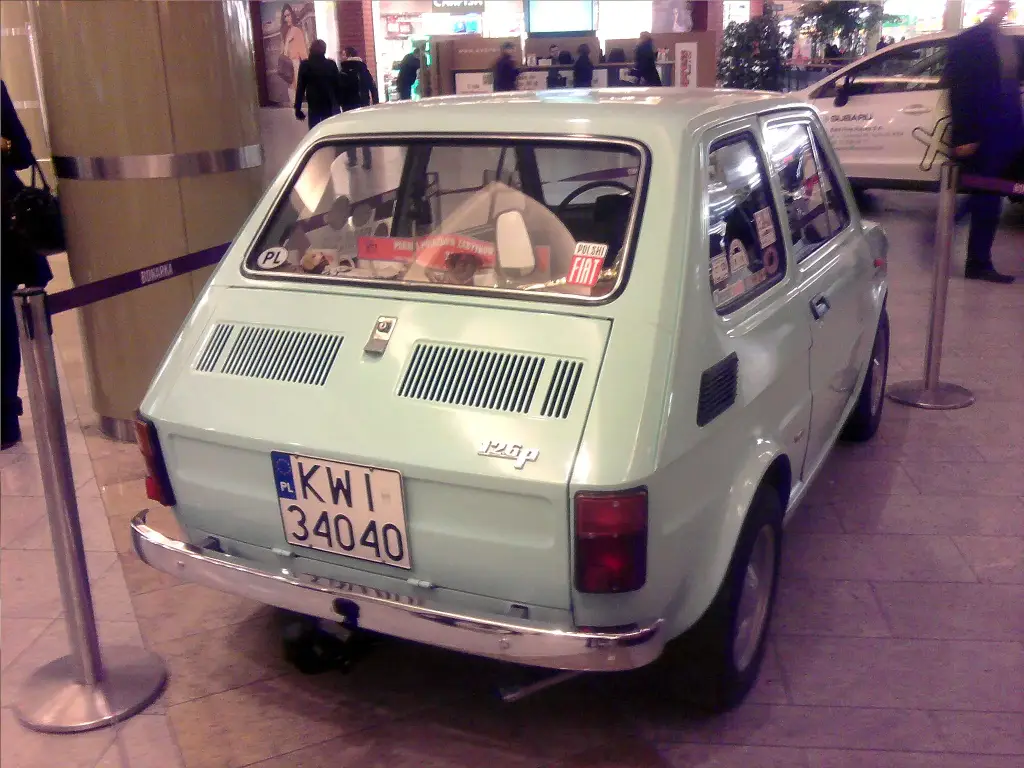
The Polski Fiat 126p was the Polish version of the Fiat 126, built under licence by Fabryka Samochodów Małolitrażowych in Bielsko-Biała and Tychy between 1973 and 2000. Its low price made it the most common car in Poland in the 1980s, and its small size earned it the nickname Maluch, the little one, which the maker adopted as the official name in 1997.
Polski Fiat 126p at a glance
| Maker | Fabryka Samochodów Małolitrażowych (FSM), Bielsko-Biała and Tychy |
|---|---|
| Polish production | 1973–2000 |
| Based on | Fiat 126, introduced in October 1972 at Turin |
| Layout | rear engine, rear-wheel drive, four seats |
| Displacement | 594 cc, enlarged to 652 cc at the end of 1977 |
| Power | 23 hp (17 kW), unchanged by the enlargement |
| Torque | 39 N·m, 43 N·m after 1977 |
| Nickname | Maluch, official from 1997 |
| Facelift | 126p FL in 1984, 126 EL in 1994, ELX with catalytic converter |
| Water-cooled version | 126 BIS, 704 cc, 26 hp, from 1987 |
| Built in Poland | about 3.3 million |
| Total 126 production | about 4.7 million |
The Polish Wikipedia material used here is the section on Fiat in Poland in the article on the company; the technical detail comes from the English article on the 126.
History of the Polski Fiat 126p
The Italian original
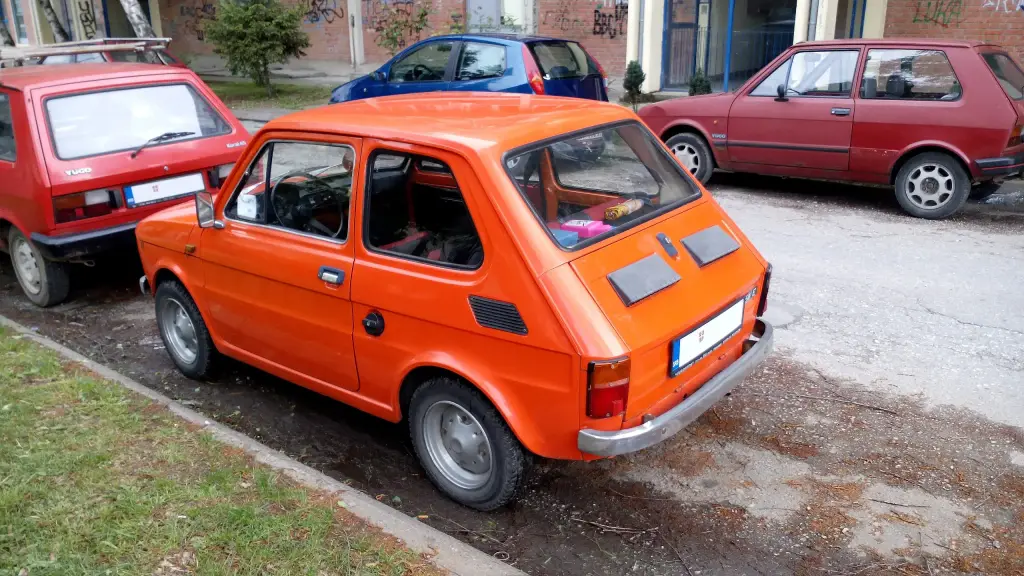
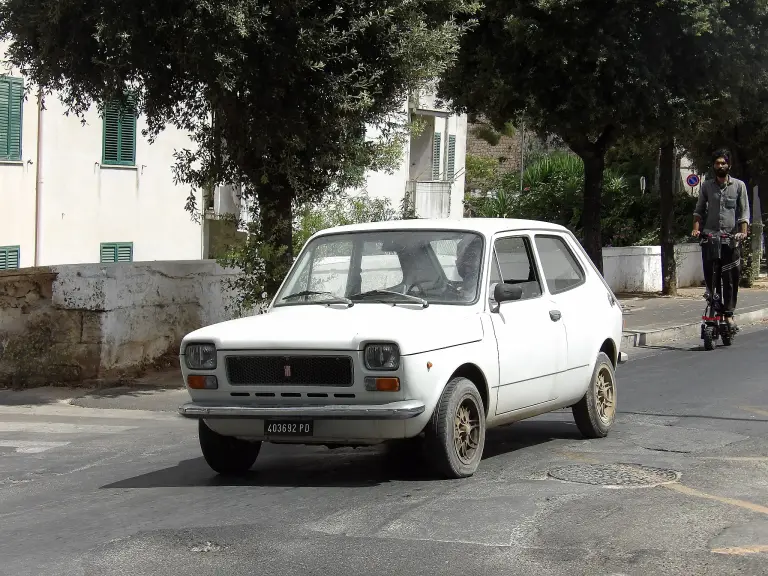
The Fiat 126 was shown at the Turin show in October 1972 and replaced the Fiat 500, whose wheelbase and much of whose mechanical layout it kept. The body, slightly larger and drawn by Sergio Sartorelli, gained interior space partly by moving the starter from the top of the engine bellhousing to its side, which allowed the bulkhead and rear seat to move back about 10 cm, and by lengthening the roof over the rear seats. Fiat built the car at Cassino and Termini Imerese until 1979, making 1,352,912 in Italy, and it was also built under licence by Zastava in Yugoslavia and briefly assembled by Steyr Puch in Austria, which built 2,069 up to 1975 as a successor to the Puch 500.
At the end of 1977 the engine grew from 594 to 652 cc when the bore went from 73.5 to 77 mm. Claimed power stayed at 23 hp, but torque rose from 39 to 43 N·m, and 594 cc engines were still being fitted in early 1983. The 126 was one of the last rear-engined small cars built in Europe, outlived only by the Volkswagen Beetle, and remained so until the Smart Fortwo.
Polish production
In Poland the car was built by FSM from 1973. At first it was almost identical to the Italian model; the differences were a higher chassis, a modified grille at the back and front indicator lenses that were orange rather than the clear white used in Italy. The letter p was added to the name to tell it apart from the Italian car. Because it was cheap, the 126p spread through the country and became arguably the most common Polish car of the 1980s. It was exported to many Eastern Bloc countries, was one of the most popular cars in Hungary for several years, and was sold in Australia between 1989 and 1992 as the FSM Niki.
Changes through the 1980s and 1990s
The car was modified continuously. It received uprated brakes and new wheels from Fiat, and hazard warning lights to meet new lighting rules. In 1984 came a facelift with plastic bumpers on all versions and a new dashboard, sold as the 126p FL. In 1985 a single rear fog light and a reversing light were built into opposite sides of the rear bumper; electronic ignition arrived, and around 1987 an alternator replaced the undersized generator. That generator had been the reason for the 35 Ah factory battery only charging fully on long runs: fitting the 45 Ah battery of the 1.5-litre Fiat 125p improved cold starting. In 1994 the car was facelifted again with some parts from the Fiat Cinquecento and called the 126 EL, and the 126 ELX added a catalytic converter.
A separate line, the 126 BIS, was built from 1987 with a horizontally mounted, water-cooled 704 cc flat-twin of 26 hp built in Poland. The layout allowed a rear hatchback and extra load space, but the original air-cooled car stayed in production for the Polish market at the same time. The BIS was made until 1991, and for a short period in the early 1990s a German firm, POP, offered convertible versions called the POP 650 and POP 2000.
The end
Fiat stopped selling the 126 in 1993 in favour of the front-engined Cinquecento, but Polish production went on. The last car was built in Bielsko-Biała on 22 September 2000, when more than a thousand final cars were finished with a Maluch Happy End sticker. In early 2020 the 28-year run of the model was counted by Autocar as the twenty-sixth most long-lived single-generation car in history.
Design and features
- Rear engine, rear drive: the layout of the Fiat 500 carried over into a slightly larger body.
- Air-cooled twin: 594 cc at first, 652 cc from the end of 1977, always 23 hp.
- Polish details: a higher chassis, a modified rear grille and orange indicator lenses.
- Long development: plastic bumpers and a new dashboard in 1984, electronic ignition, an alternator and later a catalytic converter.
- Water-cooled BIS: the 704 cc flat-twin of 1987 that allowed a rear hatchback.
Polski Fiat 126p versions
- 126p (1973): the original Polish car, almost identical to the Italian model.
- 126p FL (1984): plastic bumpers and a new dashboard.
- 126 BIS (1987–1991): water-cooled 704 cc engine and a rear hatchback.
- 126 EL (1994): second facelift, with parts from the Cinquecento.
- 126 ELX: the version with a catalytic converter.
- FSM Niki: the name used for the car sold in Australia between 1989 and 1992.
The bigger Polish Fiat of the same years was the Polski Fiat 125p, and the model the 126 replaced in Italy was described on the page of the Polski Fiat 1100 family. More cars are in the Polski Fiat collection.
Video: Polski FIAT 126p drift and crash, Polish version
Video on YouTube.
Sources
- Fiat 126, English Wikipedia: launch, body, engines, Italian and licensed production, Polish section, BIS, facelifts
- FIAT, Polish Wikipedia: start of 126p production in 1973, end of production on 22 September 2000