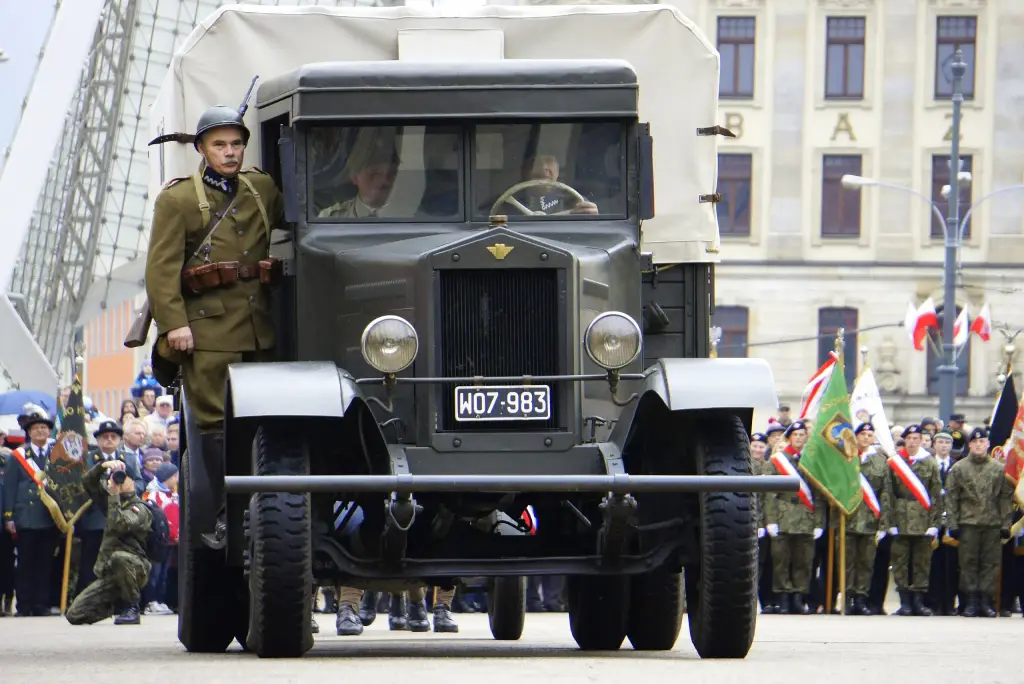
The Polski Fiat 621 was a Polish 2.5-tonne truck and the basic lorry of the Polish Army during the 1930s. It was built under an agreement between Fiat and Państwowe Zakłady Inżynierii from 1935 to 1939, and the Polish version differed considerably from the Italian original.
Polski Fiat 621 at a glance
| Maker | Państwowe Zakłady Inżynieryjne (PZInż), Warsaw |
|---|---|
| Agreement | between Fiat and PZInż, licence of 1931 |
| Production | 1935–1939 |
| Payload class | 2.5 tonnes |
| Main versions | 621 L for general bodies, 621 R for buses and 3-tonne lorries |
| Chassis | strengthened frame, front and rear axles |
| Springs | new leaf springs, joints and shock absorbers |
| Carburettor | Solex instead of the Weber of the Fiat design |
| Fuel tank | enlarged, for petrol and diesel versions |
| Cylinder block | redesigned and cast in high-quality steel |
| Planned successor | PZInż 703 family, for 1940 |
The main source is the English article on the 621, which gives no production figures; the Polish article on Fiat supplies the licence date.
History of the Polski Fiat 621
Polish conditions, Polish changes
The 621 was built under an agreement between Fiat and PZInż, and the Polish version of the Fiat 621 was heavily modified to suit Polish needs and to cope with the harsh weather and bad roads of the country. The undercarriage was strengthened, with a stronger frame and stronger front and rear axles, and new leaf springs, joints and shock absorbers were specified. The wheelbase was made wider, the mounting of the cab doors was redesigned, and a larger fuel tank was fitted to both the petrol and the diesel versions.
The engine was changed as well. The cylinder block was redesigned and produced in high-quality steel, and the Weber carburettor of the Italian design was replaced by a Solex unit that was simpler and easier to maintain.
Two chassis, many bodies
The undercarriage was produced in two variants. The Polski Fiat 621 L was the basic version, able to take a number of superstructures. The Polski Fiat 621 R was used as the basis for a line of successful buses for the civilian market and for heavier 3-tonne lorries for the army.
Production and the war
Serial production started in 1935 at the Państwowe Zakłady Inżynieryjne works and lasted until 1939. In 1940 the type was to be replaced by the PZInż 703 family of trucks. When the Second World War broke out and Poland was invaded, all production stopped; the 621s that were not destroyed in the fighting were taken over by Nazi Germany or by the Soviet Union as the two countries occupied Poland. An unspecified number were also used by the Romanian Army during the war.
Place in Polish motoring
The truck belongs to the same licence story as the cars of the period. The 1931 agreement with Fiat had allowed PZInż to assemble the 508 car and the 621 truck in Warsaw, and the agreement was widened in 1937 to cover the 518 Mazur and the light 618 Grom. The 621 remained the standard military lorry of the Polish army until the country was overrun.
Design and features
- Built for Polish roads: a stronger frame, axles, springs and joints than the Italian original.
- Simpler carburettor: a Solex replaced the Weber of the Fiat design.
- Two chassis: the 621 L for general bodies and the 621 R for buses and heavy lorries.
- Army standard: the basic lorry of the Polish Army in the 1930s.
- Short life: production ran only from 1935 to 1939.
Polski Fiat 621 versions
- 621 L: the basic chassis, used with a variety of superstructures.
- 621 R: the chassis for buses and for 3-tonne army lorries.
- Civilian bus: a successful line built on the 621 R chassis.
- Army lorry: the 3-tonne version on the 621 R chassis.
The car assembled beside the 621 was the Polski Fiat 508, and the later light truck of the same works was the Polski Fiat 618 Grom. More vehicles are in the Polski Fiat collection.
Sources
- Polski Fiat 621, English Wikipedia: role, modifications, 621 L and 621 R, production, wartime fate
- FIAT, Polish Wikipedia: 1931 licence agreement covering the 508 and 621