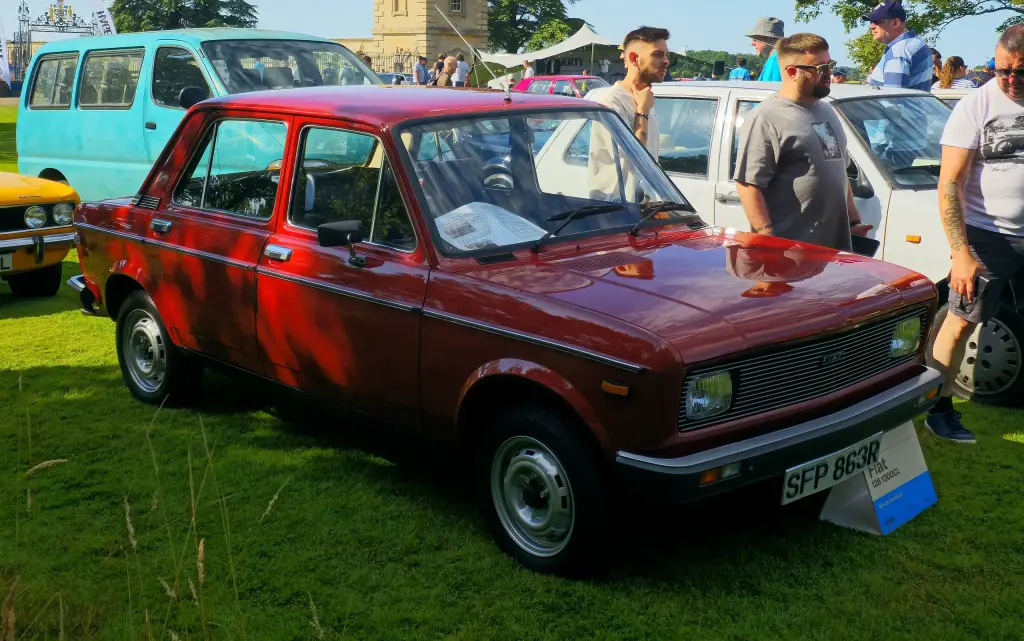
The Polski Fiat 128p is named after the Fiat 128, the small family car Fiat built from 1969 to 1985. Engineered by Dante Giacosa with an engine by Aurelio Lampredi, it was the car that made transverse front-wheel drive the standard layout of the industry, and it was named European Car of the Year in 1970.
Polski Fiat 128p at a glance
| Maker | Fiat, built at a new plant in Rivalta di Torino |
|---|---|
| Production | 1969–1985 |
| Engineering | Dante Giacosa |
| Engine design | Aurelio Lampredi |
| Layout | transverse engine, front-wheel drive, unequal-length driveshafts |
| Launch engine | 1,116 cc overhead-camshaft four, 55 PS (40 kW) |
| Bodies | two- and four-door saloon, Familiare estate, coupé |
| Award | European Car of the Year 1970 |
| Special | 1974, with a 1,290 cc engine of 60 PS |
| Facelift | 1976, estate renamed Panorama |
| Built in Italy | 2,776,000 saloons and estates, plus 330,800 coupés |
| Production ended | 1985 |
based on one source: the English Wikipedia article on the Fiat 128. The record is named for the Polish-assembled 128p, but the source describes the Italian model and gives no details of Polish assembly.
History of the Polski Fiat 128p
The front-drive problem
Front-wheel drive had been brought to small, cheap cars by BMC, first with the Mini in 1959 and then with the larger 1100/1300 of 1962. In the mid-1960s Fiat set out to design a car to compete with the latter. Alec Issigonis had given his cars an engine and gearbox sharing one oil sump, despite their different lubricating needs, with the radiator set beside the engine where it drew heated air, and a layout that often required the engine to come out for a clutch change.
Fiat’s answer, worked out by Dante Giacosa, put the engine across the car with unequal-length driveshafts and a compact clutch release mechanism designed by Ettore Cordiano. Engine and gearbox sat side by side without sharing oil, and an electrically driven cooling fan faced the fresh airflow. Fiat had tested the idea for five years on the Primula from its Autobianchi subsidiary, which was not critical to the market, and so had time to deal with its weaknesses: uneven power transmission from side to side, uneven tyre wear and torque steer.
The layout became the industry standard, and Fiat itself turned it round for the mid-engined X1/9 sports car. Giorgetto Giugiaro noted that in 1970 Volkswagen took a Fiat 128 completely apart, treating it as the reference for the forthcoming Golf. The advertising claimed that mechanical parts took up only 20 per cent of the car’s volume, and Fiat said that Enzo Ferrari drove a 128 himself.
The car
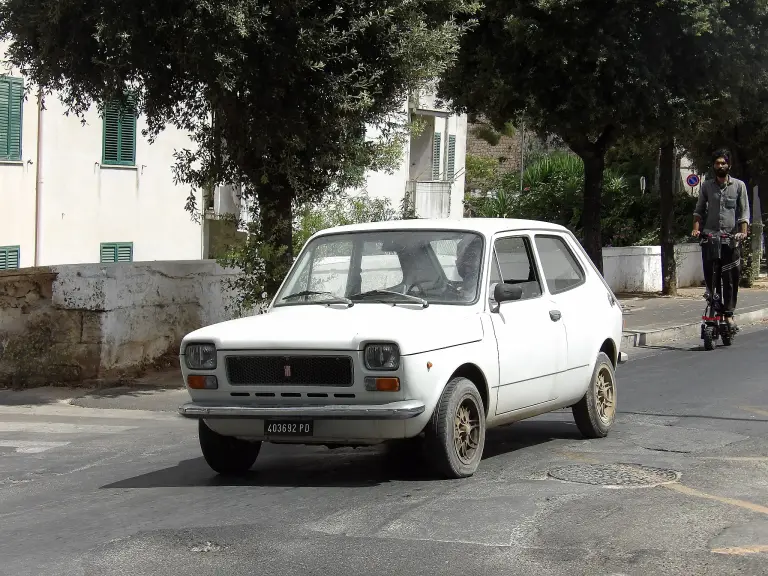
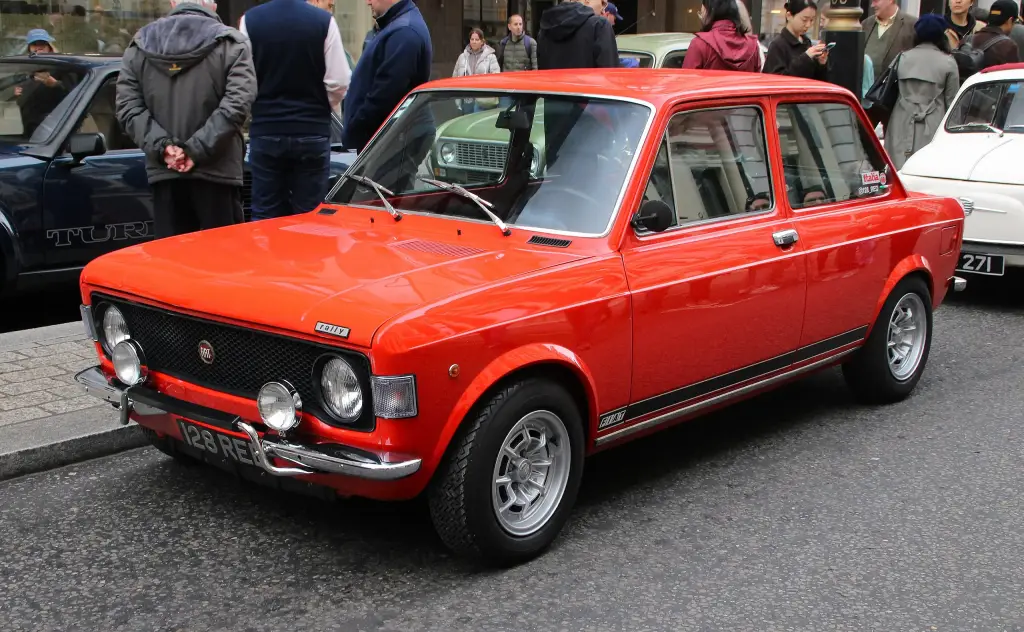
The engine was an all-new 1.1-litre overhead-camshaft unit with an iron block and an aluminium head, designed by Aurelio Lampredi. The 128 was styled like the 124 and 125 and had rack-and-pinion steering, front disc brakes, independent rear suspension with a transverse leaf spring and MacPherson struts at the front with an integrated anti-roll bar. At first it came as a two- or four-door saloon with the 1,116 cc engine of 55 PS, or 49 hp in the United States. A three-door estate, the Familiare, was added at the Turin show in 1970.
In 1972 the saloon and estate were refreshed with changes to the grille, bumpers, dashboard and steering wheel and the addition of a brake servo. The 128 Special of 1974 brought rectangular headlights, chrome trim, better seats and an optional 1,290 cc engine of 60 PS. In 1976 came a proper facelift with a new front, rectangular headlights on all versions, bumpers with built-in indicators, redesigned tail lights and a new dashboard, together with engine and gearbox changes to cut fuel consumption. The estate was renamed Panorama and given a single rear side window instead of the earlier split unit.
Production of everything except the base 1,100 cc model ended in 1979, after the Fiat Ritmo of 1978 took over, and the Panorama went in 1980. The last 128 was built in 1985. In all 2,776,000 saloons and estates were made in Italy, plus 330,800 coupés, and more than three million cars were built in total.
On the road
The British magazine Motor tested a 128 in April 1970, soon after its British launch. It recorded a top speed of 85.4 mph (137.4 km/h) and 0 to 60 mph in 15.5 seconds, with overall fuel consumption of 27.5 miles per imperial gallon (10.3 L/100 km). That put the car fractionally behind the Morris 1300 on top speed but usefully ahead on economy. In 2012 the journalist Jamie Kitman called the 128 a pioneer of the small cars people drive today.
Design and features
- Transverse engine with unequal driveshafts: the arrangement that became the industry standard.
- Room inside: a compact mechanical package left 80 per cent of the volume for people and luggage.
- Lampredi engine: an all-new overhead-camshaft four with an aluminium head.
- Chassis: rack-and-pinion steering, front discs and independent rear suspension with a transverse leaf spring.
- Influence: Volkswagen bought and dismantled a 128 as the reference for the Golf.
Polski Fiat 128p versions
- 128 saloon (1969): two- and four-door, with the 1,116 cc engine.
- 128 Familiare (1970): the three-door estate.
- 128 Special (1974): rectangular headlights, more equipment and an optional 1,290 cc engine.
- 128 facelift (1976): new front, bumpers with built-in indicators and a revised dashboard.
- 128 Panorama (1976): the renamed estate with a single rear side window.
- 128 coupé: the two-door version, of which 330,800 were built in Italy.
The smaller Fiat of the same period is the Polski Fiat 127p, and the car the 128 replaced was the Polski Fiat 1100. More cars are in the Polski Fiat collection.
Video: Fiat 128
Video on YouTube.
Sources
- Fiat 128, English Wikipedia: development, front-drive layout, design, model history, road test, production numbers