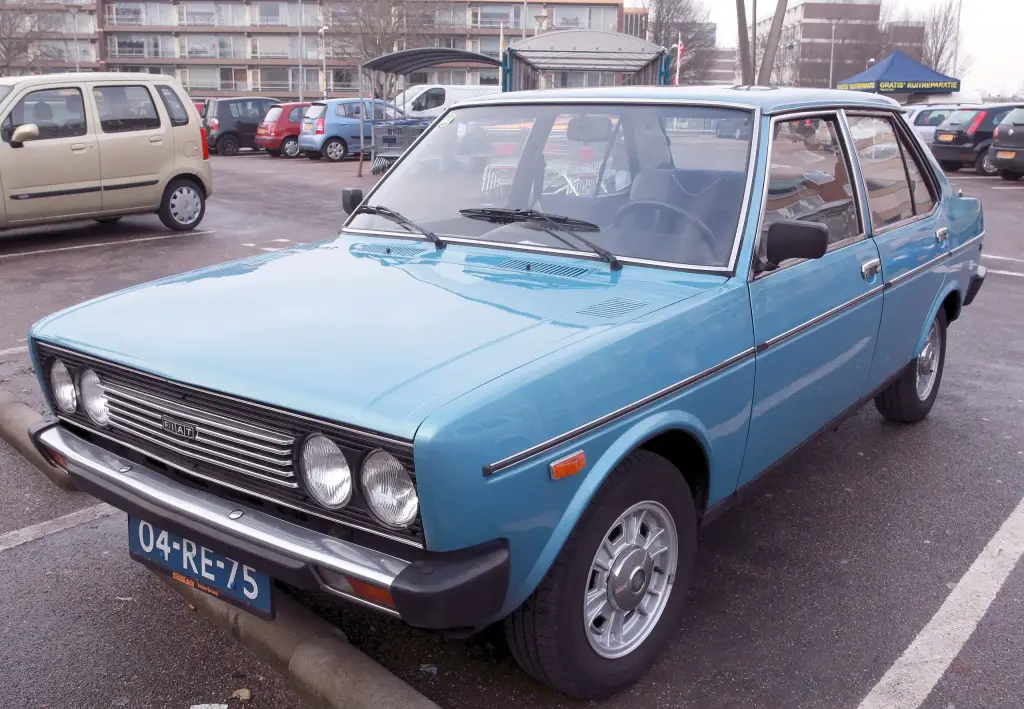
The Polski Fiat 131p is named after the Fiat 131, the mid-size family car Fiat launched at the Turin show in October 1974 as the successor to the 124. It was known as the Mirafiori, after the Turin district where it was built, and it stayed in production until 1984 in saloon and estate forms.
Polski Fiat 131p at a glance
| Maker | Fiat, Mirafiori works, Turin |
|---|---|
| Production | 1974–1984 |
| Launched | Turin Motor Show, October 1974 |
| Bodies | two-door saloon, four-door saloon, Familiare estate |
| Engines | 1,297 cc and 1,585 cc overhead-valve fours |
| Carburettor | single twin-choke Weber 32 ADF |
| Gearbox | four-speed, with five-speed and automatic options on the 1.6 |
| Front suspension | MacPherson struts, track control arms, anti-roll bar |
| Rear suspension | live axle on unequal trailing arms with a Panhard rod |
| Brakes | discs at the front, drums at the rear |
| Rally version | 131 Abarth Rally, 400 built in 1976 |
| Total production | 1,513,800 |
based on one source: the English Wikipedia article on the Fiat 131. The record is named for the Polish-assembled 131p, but the source describes the Italian model and gives no details of Polish assembly.
History of the Polski Fiat 131p
Launch and range
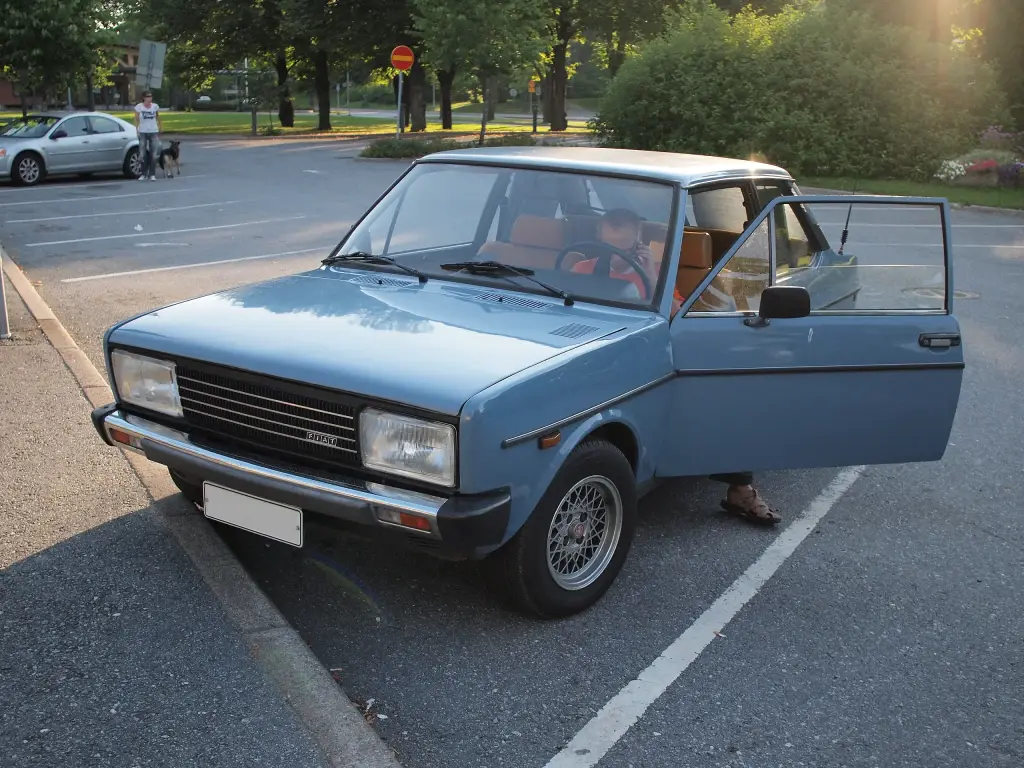
The 131 Mirafiori was presented at the 55th Turin Motor Show in late October 1974. It used a steel monocoque body of three-box design with a front-mounted engine driving the rear wheels through a gearbox placed directly behind it and a tubular propeller shaft to a solid rear axle.
Two overhead-valve engines were offered, of 1,297 cc and 1,585 cc, both from the family first used in the Fiat 124, each with a single twin-choke Weber 32 ADF carburettor. A four-speed gearbox was standard, with a five-speed manual and a three-speed automatic available on the 1,600. The initial range had eleven models across three body styles — two-door saloon, four-door saloon and Familiare estate — and two trim levels. The entry-level Mirafiori, also called Normale or Standard, had single square headlamps, wheels and dished hubcaps from the 124 and a simplified interior. The Mirafiori Special was identified by four round headlamps, its own grille, side rubbing strips, chrome window surrounds and rubber inserts in the bumpers, with triple square dials, a padded adjustable steering wheel, cloth upholstery and reclining seats inside. Air conditioning, a tachometer, a limited-slip differential and a vinyl roof were reserved for the Special. The Special estate came only with the larger engine.
Sales started slowly: the car arrived at the height of the oil crisis, during strikes and high inflation at home, while the cost of parts was rising. They built up gradually, and the car sold well in export markets. In 1975 it went on sale in the United States with a 1.8-litre double-overhead-camshaft engine carried over from the 124 but with more emission equipment, and a three-speed automatic gearbox from GM.
The engineering
The engines were inline fours with cast-iron blocks and aluminium heads. The early pushrod units had the distinction of being the first in the world with overhead valves and a belt-driven camshaft; the double-overhead-camshaft engines with toothed belts came later in the model’s life. Fuel came from a single Weber ADF twin-choke carburettor fed by a tank in the boot, and ignition was by contact breaker, usually with Marelli distributors.
The front suspension used MacPherson struts, track control arms and an anti-roll bar. At the back the live axle was located by double unequal-length trailing arms and a Panhard rod, with coil springs and direct-acting dampers — a design that gave better stability and handling than many rivals. The front brakes were discs with single-piston sliding calipers; the rear drums were a step back from the all-disc 124. A load-sensing valve varied the rear braking effort according to load, and the handbrake was floor-mounted and worked on the rear axle through cables. Inside, the secondary switches were lit by a single bulb with fibre-optic distribution.
The Abarth Rally
In 1976 Fiat built 400 examples of the 131 Abarth Rally for homologation, in cooperation with Bertone and Abarth. Bertone took partly finished two-door shells from the Mirafiori line, fitted plastic mudguards, bonnet and boot lid, and altered the structure to take independent rear suspension, then painted and trimmed the cars before sending them to the Rivalta plant for the Abarth mechanicals. A limousine conversion, the nearly five-metre 131 Diplomatic, was offered by Salvatore Diomante’s Autocostruzioni S.D. near Turin.
Design and features
- Mirafiori name: the car was marketed after the Turin district where it was built.
- Two trim levels: the plain Mirafiori with square headlamps and the Special with four round ones.
- Advanced rear axle: trailing arms and a Panhard rod instead of a simple leaf-sprung axle.
- Belt-driven camshaft: the pushrod engines were the first in the world with overhead valves and a belt-driven cam.
- Rally pedigree: the 131 Abarth Rally was built in 400 examples in 1976.
Polski Fiat 131p versions
- 131 Mirafiori (1974): the standard model with square headlamps and simple trim.
- 131 Mirafiori Special: four round headlamps, better trim and the extra options.
- 131 Familiare: the five-door estate.
- US 1.8 (1975): double-overhead-camshaft engine with emission equipment and an automatic gearbox.
- 131 Abarth Rally (1976): 400 homologation cars with plastic panels and independent rear suspension.
- 131 Diplomatic: a limousine conversion by Autocostruzioni S.D.
The car the 131 replaced was the Polski Fiat 125p, and its larger relative was the Polski Fiat 132p. More cars are in the Polski Fiat collection.
Video: Fiat 131 1.3 TC Supermirafiori
Video on YouTube.
Sources
- Fiat 131, English Wikipedia: launch, range, engines, suspension and brakes, US market, Abarth Rally, production total