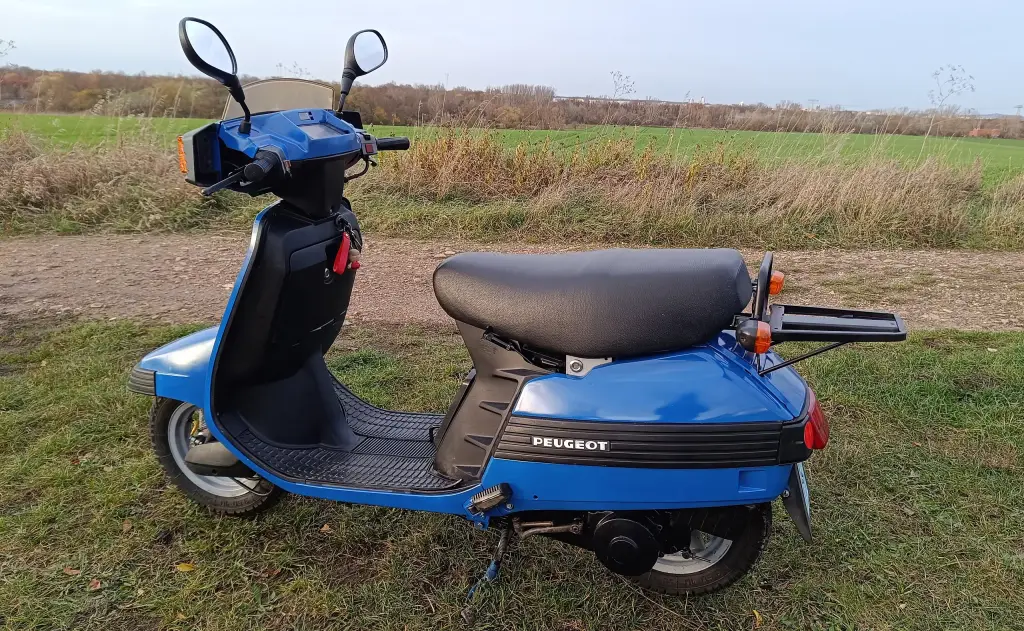
The Peugeot ST was a light French scooter of the 1980s, part of the SC family that also included the larger SC 50 and SC 80. It was sold only with a 50 cc engine and was produced until the early 1990s.
Peugeot ST at a glance
| Type | 50 cc scooter |
|---|---|
| Period | 1980s to the early 1990s |
| Engine | single-cylinder two-stroke, 49.4 cc, 41 × 37.4 mm |
| Power | 3.6 hp at 6,000 rpm |
| Cooling | forced air |
| Transmission | automatic with double variator, gear final drive |
| Frame | single-tube |
| Brakes | drums front and rear |
| Tyres | 3.00 × 10 |
| Weight | 55 to 59 kg |
| Top speed | 45 km/h |
| Fuel system | Keihin 12 mm carburettor with automatic choke |
based on one source (French Wikipedia); no free photographs of the model were found, the existing thumbnail stays
History of the Peugeot ST
The SC family
The SC and ST were French scooters produced in Europe in the 1980s. The SC came with two engines, 50 and 80 cc, while the ST and the Rapido, lighter models, existed only with 50 cc. Production ended in the early 1990s. The largest model, the SC 80, did much to develop the scooter market: at the beginning of the 1980s Peugeot, the last major French two-wheeler maker, obtained a reform of the driving licence rules so that 80 cc machines with automatic transmission could be ridden by holders of a car licence.
Honda engines
Peugeot had no engine suited to the new rules and turned to Honda, extending agreements under which the Japanese firm already built many engines for Peugeot mopeds made in Belgium. Honda supplied the engine and transmission of its Lead scooter, which Peugeot installed in its own frame and bodywork, and some electrical components were also imported from Japan. The low weight of these machines, from 55 to 78 kg, together with the double variator transmission, gave good acceleration for town use.
What the ST offered
The ST’s equipment was minimal but did include a speedometer, a fuel gauge, indicator and oil warning lights, and on the last models an electric starter and a glovebox. The Rapido differed from the ST in its leading-link front fork, its profiled lower body and its decoration. The ST and Rapido were often preferred to a moped because they were more comfortable and practical, with separate lubrication, and to the Yamaha Chappy because they were cheaper; they gave a generation of young riders its entry to scooter ownership.
Replacement
In 1992, after almost ten years, Peugeot stopped production of the SC and ST range to launch a new line of scooters, notably the SV, Zénith and Buxy, which looked more contemporary against the MBK Booster and Yamaha BW’S that had just arrived on the French market.
Design and features
- Honda engine: the engine and transmission came from the Honda Lead.
- Light: 55 to 59 kg, with a single-tube frame.
- Double variator: automatic transmission with gear final drive.
- Economical luxury: cheaper than the SC 50 but more comfortable than a moped.
- Separate lubrication: no need to mix oil with petrol.
Peugeot ST versions
- ST 50: the standard light scooter.
- Rapido: the related model, distinguished by its leading-link fork and body trim.
- SC 50 and SC 80: the larger scooters of the same family.
The ST sat below the Peugeot SV that replaced it, and its related model was the Rapido. More in the Peugeot collection.
Sources
- Peugeot ST/SC, French Wikipedia: family, Honda engines, ST specifications, replacement