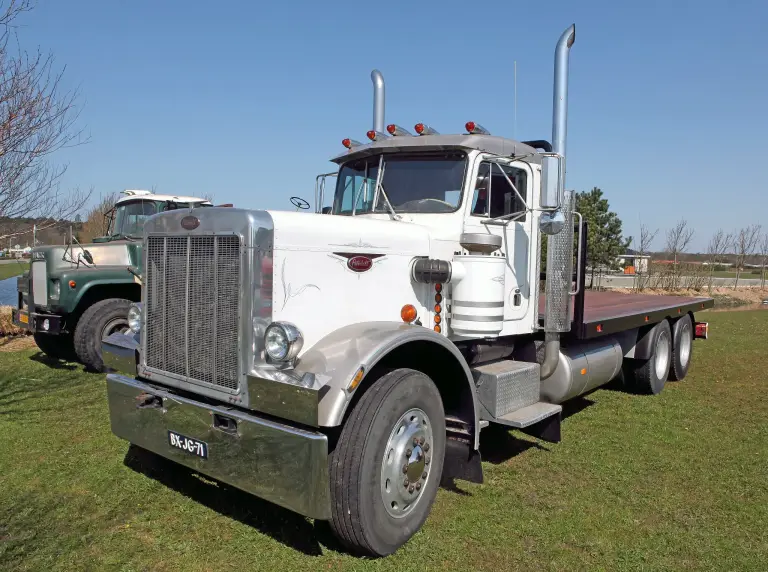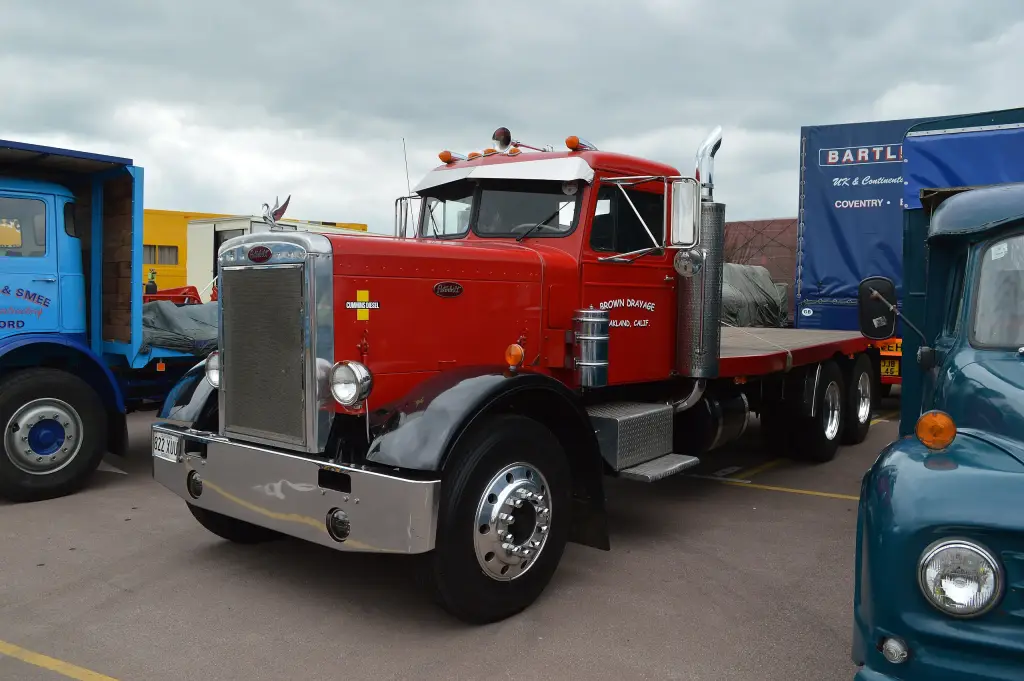
The Peterbilt 281 and its tandem-axle twin, the 351, were Peterbilt’s standard highway conventionals from 1954 to 1976. Their narrow bonnet and butterfly hood earned them the name needle-nose, and a 281 became one of the most famous trucks in film as the tanker that pursues a Plymouth Valiant in Duel.
Peterbilt 281 at a glance
| Maker | Peterbilt Motors Company |
|---|---|
| Production | 1954–1976 |
| Layout | conventional cab, bonneted |
| Models | 281 with a single drive axle, 351 with tandem drive |
| Nickname | needle-nose or narrow-nose |
| Hood | butterfly type with cycle-style fenders |
| Grille | horizontal shutters |
| Headlamps | two small round lamps |
| Engine quoted | Cummins NTC350, 350 hp |
| Emblem | first Peterbilt line launched with the red emblem |
| Cabover sister | 281/351 COE, 1954–1958 |
| Replaced by | 358 and 359 |
History of the Peterbilt 281
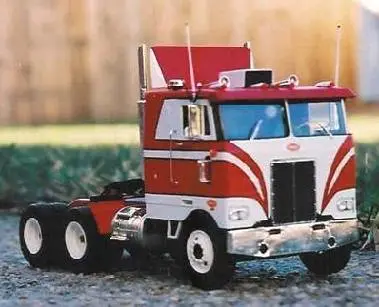
The 281/351 arrived in 1954 as a redesign of the 280/350, and came out of the Oakland, California, plant. Where the earlier truck had a tall, narrow grille with vertical shutters, the new model went to horizontal shutters and a narrower bonnet, hence the needle-nose name. The 281 carried a single drive axle and the 351 two, following the Peterbilt rule that single-drive trucks took a 2 prefix and tandem-drive trucks a 3. The same year Peterbilt added a cabover version of the line, which shared only its doors with the conventional.
The narrow nose was not only a matter of looks. The butterfly hood opened in two halves for quick access to the engine, and the slim bonnet gave the driver a good view forward, two qualities that made the model popular with owner-operators. In 1954 the 281/351 was the first Peterbilt line to be launched with the red oval emblem that the company had adopted in 1953, and in 1965 the company added the bird-shaped hood ornament on its conventionals.
The 358 of 1965 largely replaced the 351, but the 351 stayed in production for vocational work and its cycle fenders were exchanged for flat steel fenders in the early 1970s. After a 22-year run the line was retired in 1976, by then outsold by the 358 and 359. NASA owned four of these trucks and retired two of them, R-13 and R-15, because of problems with their cryogenic tanks.
The film connection came in 1971, when a 281 appeared in the television movie Duel, directed by a 23-year-old Steven Spielberg. When the film was released in cinemas abroad, extra scenes were shot with a 351 modified to match the original 281 as closely as possible.
Design and features
- Needle nose: a narrow bonnet that gave excellent forward visibility and gave the truck its nickname.
- Butterfly hood: the two-part hood opened wide for easy engine access, a favourite with drivers who serviced their own trucks.
- Two round headlamps: the simplest lighting of any Peterbilt conventional of the period.
- Red emblem: the 281/351 was the first model line to appear with the red oval badge from the start.
- Cinema fame: the 281 tanker of Duel made the model recognisable far beyond the truck business.
Peterbilt 281 versions
- 281: single drive axle, the model used in Duel.
- 351: tandem drive axle, the heavier and longer-lived of the pair.
- 281/351 COE (1954–1958): cabover version sharing the doors of the conventional.
- 341: short-hood vocational version of the 351, built until 1972.
- 351L: severe-service logging variant with flat diamond-plate fenders.
The line was succeeded by the Peterbilt 358 and the 359. Earlier and later conventionals are collected under Peterbilt.
Video: 1966 Peterbilt 281, Walkaround/Startup, VT 555 Non T
Video by Matthew Jones on YouTube.
Sources
- Peterbilt 281, English Wikipedia: Duel, needle-nose, engine, end of production
- Peterbilt, English Wikipedia: 1954 redesign, cabover sister, 358 and 359, emblem and ornament
- List of Peterbilt vehicles, English Wikipedia: production years, NASA trucks, variants
- Peterbilt, French Wikipedia: place of the 281/351 in the model range