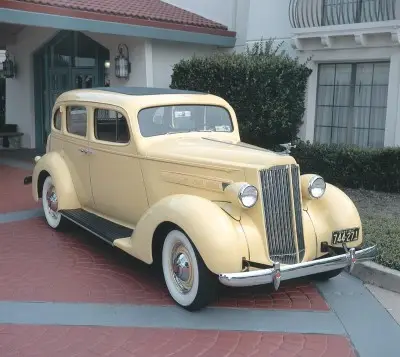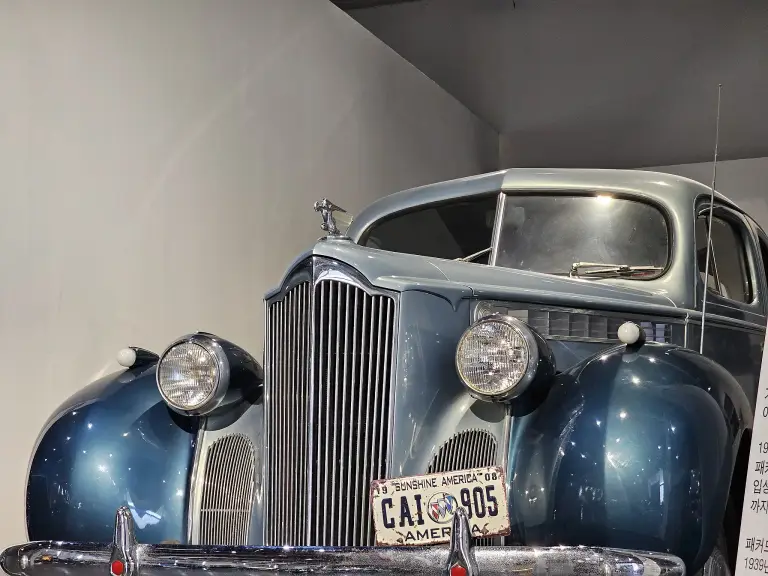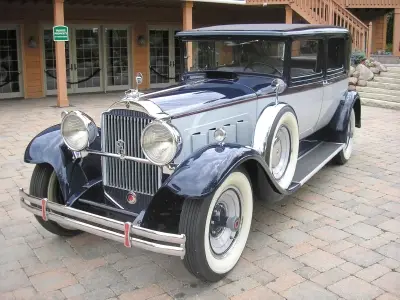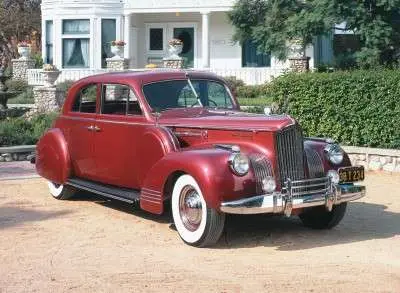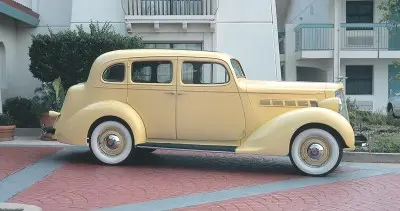
The 18th Series is Packard’s designation for its 1940 model year, and the Touring Sedan (model 1804) is the four-door version of that car. It belongs to the long-running eight-cylinder Packard line: a large, quietly engineered automobile with adjustable shock absorbers, automatic chassis lubrication and a choice of bodies that ran from a roadster to a limousine.
Packard 18th Series at a glance
| Maker | Packard Motor Car Company, Detroit |
|---|---|
| Model year | 1940 |
| Series | 18th Series |
| Body | four-door Touring Sedan, model 1804 |
| Line | senior eight-cylinder Packard |
| Suspension | Ride Control, dash-adjustable hydraulic shock absorbers |
| Transmission | four-speed synchromesh, optional at no extra cost |
| Chassis | automatic chassis lubrication |
| Glass | “shatterproof” glass |
| Bodies in the line | roadster, convertible, phaeton, coupé, sedan, landau, town car, limousine |
Based on one source, the English Wikipedia article on the Packard Eight, which describes the line as a whole rather than the 1940 cars in detail; the article is therefore shorter than usual.
History of the Packard 18th Series
The 18th Series
Packard counted its model years in series: the 18th Series was the 1940 line. The four-door Touring Sedan was the practical body in a range that also offered open cars and formal limousines, and it is the version most often seen today. The car sat at the top of Packard’s range, in the position the eight-cylinder Packard had held since the 1920s.
Engineering of the eight-cylinder Packard
The senior Packard of this period was built around comfort and silence rather than outright speed. Ride Control let the driver soften or firm the hydraulic shock absorbers from the dashboard, a feature no cheaper marque offered. The optional four-speed synchromesh gearbox cost nothing extra, and the chassis lubricated itself automatically, which removed a regular chore from owners of the day. The bodies were large and the wheelbases long: in the 1930s the same line was sold on wheelbases from 127.5 in (3,238 mm) to 145.5 in (3,696 mm), depending on the series and the body.
A line with many bodies
Packard advertised the eight-cylinder car as a two-door roadster, two-door convertible and convertible Victoria, phaeton and dual-cowl phaeton, coupé, four-door sedan, landau, town car and limousine. In the early 1930s prices ran from about US$2,425 for the Standard Eight to US$5,350 for a long-wheelbase custom body, and the five-passenger sedan was for years Packard’s best-selling model. That breadth is what made the marque the best-selling luxury brand in the United States between 1924 and 1930, and it sold nearly twice as many cars abroad as any other make priced above US$2,000.
The last of the line
The 1930s were hard on Packard’s senior cars: the Depression cut demand for custom-bodied limousines, and the company’s future came to rest on cheaper models such as the One-Twenty and the One-Ten. The 1940 cars were among the last of the traditional senior Packards before the war stopped civilian production, and after 1946 the name was carried by the new Clipper shape.
Design and features
- Ride Control: hydraulic shock absorbers adjustable from the dashboard.
- Free four-speed: a synchromesh gearbox with an extra ratio at no extra cost.
- Self-lubricating chassis: automatic chassis lubrication as standard.
- Body choice: from open roadster and phaeton to town car and limousine.
Packard 18th Series versions
- Touring Sedan (1804): the four-door closed body.
- Convertible and convertible Victoria: the open two-door cars.
- Phaeton and dual-cowl phaeton: four-door open bodies for touring.
- Landau, town car and limousine: formal bodies on the longest wheelbases.
The 18th Series belongs to the Packard Eight family, and its most exclusive relatives were the One Eighty cars. More Packards are in the Packard collection.
Sources
- Packard Eight, English Wikipedia: line history, engineering, bodies, prices