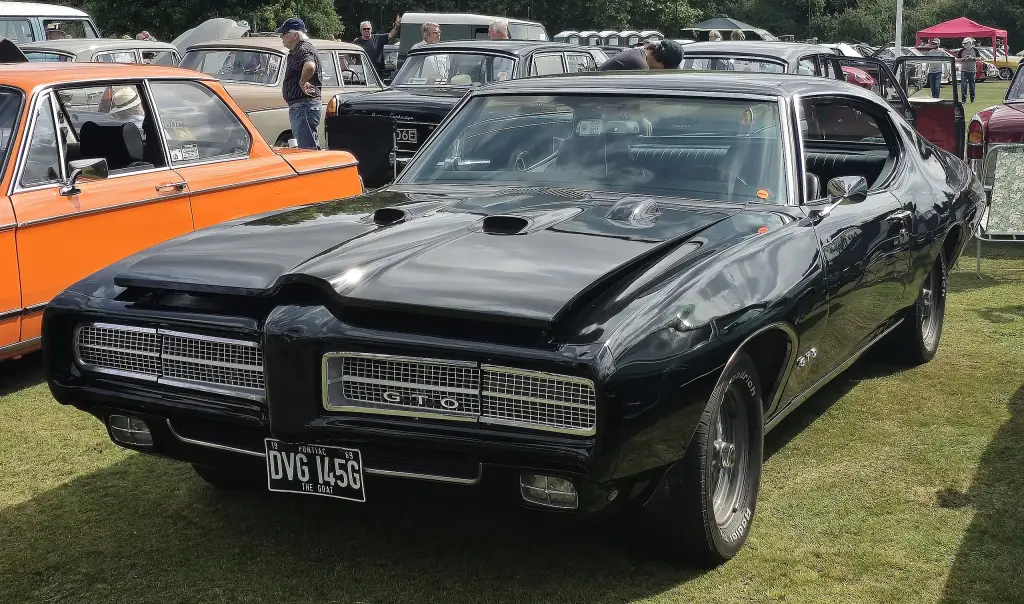
The Pontiac GTO was a rear-drive, four-passenger two-door built over four generations from 1963 to 1974, with a fifth generation imported from Holden for 2004–2006. The first GTO is credited with popularising the American muscle car.
Pontiac GTO at a glance
| Maker | Pontiac, General Motors |
|---|---|
| Generations | four, 1964–1974; fifth, 2004–2006 |
| 1964 package price | $295 |
| 1964 engine | 389 cu in (6.4 L) V8, 325 hp |
| Optional engine | Tri-Power 389, 348 bhp |
| Transmission | three-speed manual with Hurst shifter; four-speed optional |
| Body styles, 1964 | coupé, hardtop, convertible |
| 1964 sales | 32,450 |
| 1964 VIN prefix | 22 |
| Name origin | Ferrari 250 GTO, Gran Turismo Omologato |
| Fifth generation | Holden Monaro, 2004–2006 |
Based on one source: the English Wikipedia article on the GTO.
History of the Pontiac GTO
The 1964 option package
In early 1963 GM banned its divisions from factory racing, so Pontiac’s performance marketing moved to the street. John DeLorean, Bill Collins and Russ Gee turned the upcoming second-generation Tempest into a sporty car by fitting the 389 cu in V8 from the Grand Prix hardtop in place of the standard 326. That broke GM’s rule limiting A-body intermediates to 330 cu in, but the team found a loophole because the policy did not restrict large engines offered as an option. General manager Pete Estes approved the model, and sales manager Frank Bridge limited initial production to 5,000 cars. The name came from the Ferrari 250 GTO, Gran Turismo Omologato. Unusually for a marketing exercise, a Pontiac employee had the car homologated by the FIA in 1964 so it could race in Europe.
1964–1965
The first GTO went into production on 3 September 1963 as an option package on the Tempest-based LeMans, in coupé, hardtop and convertible form. For $295 buyers got the 325 hp 389 with a single four-barrel carburettor, chromed valve covers, a seven-blade fan, a floor-shifted three-speed manual with Hurst shifter, stiffer springs, a larger front anti-roll bar, wider wheels with redline tyres, bonnet scoops and GTO badges. Options included a four-speed manual, a two-speed automatic, the 348 bhp Tri-Power engine with three two-barrel carburettors, limited-slip differential and a tachometer. Fully optioned, the car cost about $4,500 and weighed around 3,500 lb. Road tests criticised slow steering and the standard drum brakes. Bridge’s forecast of 5,000 cars was badly wrong: 32,450 were sold.
1965 and the later generations
The 1965 cars were restyled, 3.1 inches longer, with stacked quad headlights and about 100 lb more weight. Brake lining area grew by nearly 15 percent, heavy-duty shock absorbers and a stronger anti-roll bar were standard, and the 389 gained revised heads and a high-rise manifold, raising the base engine to 335 hp and the Tri-Power to 360 hp. From 1966 to 1971 the GTO was a separate model, then an option on the LeMans again for 1972–1973 and on the compact Ventura for 1974. The name returned for 2004 as a left-hand-drive Holden Monaro imported as a captive import, and ended in 2006.
Design and features
- Big engine in a mid-size body: the 389 V8 in the LeMans, a loophole in GM policy.
- Tri-Power: three two-barrel carburettors for 348 bhp.
- Hurst shifter: a floor-shifted three-speed as standard, four-speed optional.
- FIA homologation: the car was actually certified for grand-touring racing.
- Muscle-car template: affordable performance that every US maker soon copied.
Pontiac GTO versions
- 1964 option package: $295 on the LeMans, 32,450 sold.
- Tri-Power cars: the three-carburettor engine option.
- 1966–1971 separate model: the GTO with its own VIN series, 242.
- 1972–1973 LeMans option and 1974 Ventura option: the name demoted to a trim.
- 2004–2006 Holden Monaro: the fifth generation.
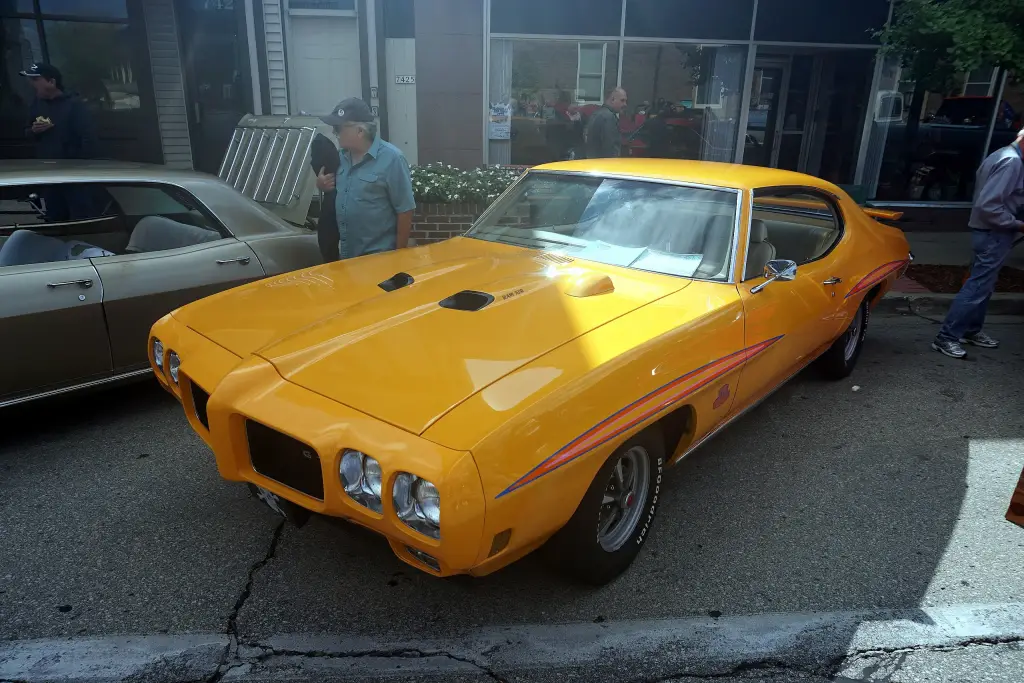
The GTO grew out of the Tempest and the LeMans; its 1970 Judge version is covered in the GTO Judge article. More Pontiacs are in the Pontiac collection.
Sources
- Pontiac GTO, English Wikipedia: origins, 1964–1965 cars, generations