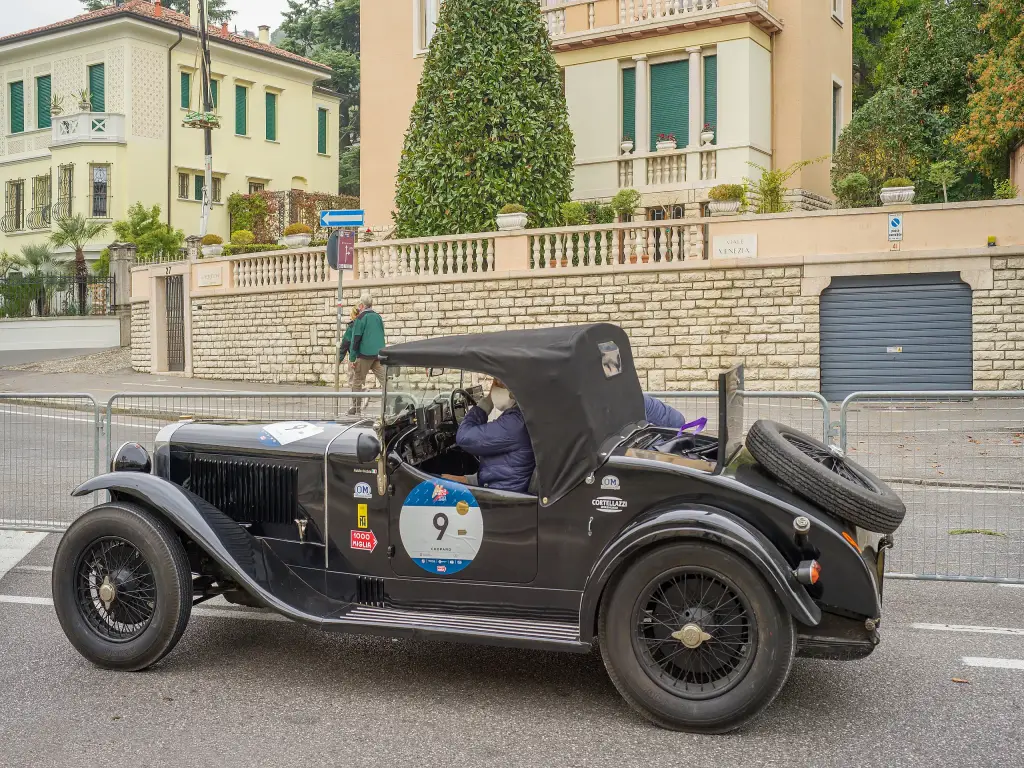
The OM 665 Superba was the car that made Officine Meccaniche’s name as a maker of fast, dependable six-cylinders. Introduced at the 1923 Milan show, a year after the 469, it stayed in production until 1934.
OM 665 Superba at a glance
| Maker | Officine Meccaniche (OM), Brescia |
|---|---|
| Production | 1923–1934 |
| Engine | 1,991 cc straight-six, side valves |
| Bore × stroke | 65 × 100 mm |
| Power | 40 CV at 3,000 rpm |
| Chassis | N with 3,100 mm wheelbase, S with 2,800 mm |
| Top speed | 100 km/h (N), 120 km/h (S) |
| 1925 update | N2 and S2: coil ignition, water pump on the S |
| 1927 update | N3/4 and S3/4: larger tyres, wider tracks |
| 1929 update | N5 2.0 and S5 2.2 with 2,221 cc and 55 CV |
| Built | about 3,150 |
The English Wikipedia has no article on the Superba; this page is based on the Italian article, the only source used.
History of the OM 665 Superba
Derived from the 469
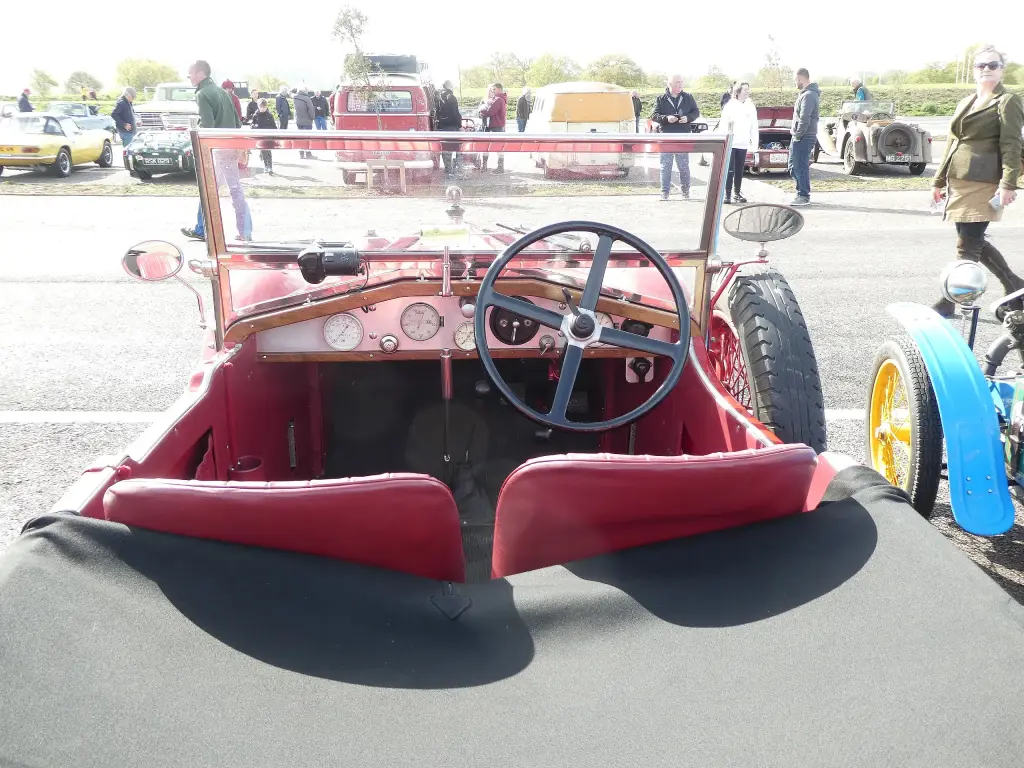
The 665 was presented at the Milan motor show in 1923 as the top of OM’s range. The name gives the recipe away: six cylinders, 65 mm bore. The engine, designed by Ottavio Fuscaldo, was essentially the 1.5-litre four of the 469 with two more cylinders added, giving 1,991 cc from a 65 × 100 mm bore and stroke. It kept the side-valve layout with a single camshaft in the crankcase, but the monobloc and the crankshaft, now on four main bearings, were new.
The chassis followed the 469 and used pressed-steel side members with rigid axles, semi-elliptic leaf springs and friction dampers front and rear. Two wheelbases were offered: the short S at 2,800 mm for sporting bodies, and the long N at 3,100 mm for saloons and torpedoes seating up to six. The N used a single 36 mm Zenith carburettor and the S a pair of 30 mm Zeniths, but both were rated at 40 CV at 3,000 rpm. Aluminium was used for the sump, clutch housing and bulkhead to save weight.
Updates through the 1920s
For 1925 the cars became the N2 and S2, with coil ignition replacing the magneto, a water pump on the S, Hartford friction dampers and a wider rear track of 1,430 mm. The 1927 N3/4 and S3/4 brought bigger 810 × 145 tyres and wider tracks again. The last revision came in 1929 with the N5 2.0, which gained a gearbox with bevel gears, and the S5 2.2, whose engine grew to 2,221 cc with a 67 × 105 mm bore and stroke, a 35 mm Memini carburettor and 55 CV, on a wheelbase shortened to 2,790 mm.
The English connection
In 1926 the British OM importer L. C. Rawlence & Company enlisted the racing driver and engineer Richard F. Oats to develop the Superba for British tracks. The result was a special cast-iron block with two spark plugs per cylinder, a finned overhead-valve head and a Roots supercharger that eventually produced 95 CV. OM adopted the British modifications for its works cars in 1929. Production of all OM cars ended when Fiat took over the company; total output of the 665 is estimated at about 3,150, with deliveries continuing into early 1934.
Design and features
- Straight-six smoothness: a 1,991 cc side-valve six on four main bearings, enlarged later to 2,221 cc.
- Two chassis: short S for sports bodies, long N for six-seat saloons and torpedoes.
- Light build: aluminium sump, clutch housing and bulkhead, and careful assembly.
- Proven in Britain: supercharged Rawlence–Oats cars reached 95 CV.
OM 665 Superba versions
- 665 N: long-wheelbase car with a single carburettor and 100 km/h.
- 665 S: short-wheelbase sports chassis with twin carburettors and 120 km/h.
- N2/S2 and N3/4/S3/4: the 1925 and 1927 updates.
- N5 2.0 and S5 2.2: the 1929 cars, the S5 with 55 CV.
- Rawlence–Oats specials: British supercharged development cars with up to 95 CV.
The Superba grew out of the four-cylinder OM 469; OM’s later work for the army is covered by the OM Autocarretta. More vehicles are in the OM collection.
Sources
- OM 665 Superba, Italian Wikipedia: engine, chassis, updates, English development, production