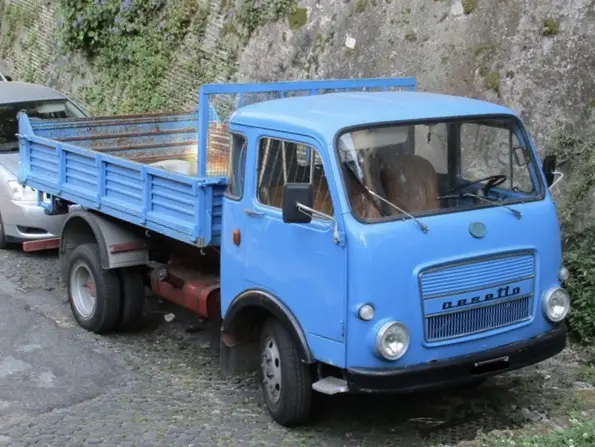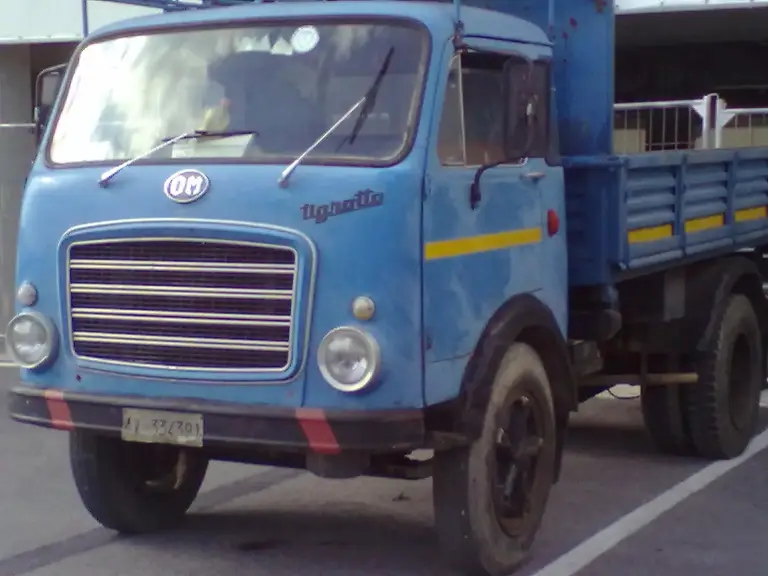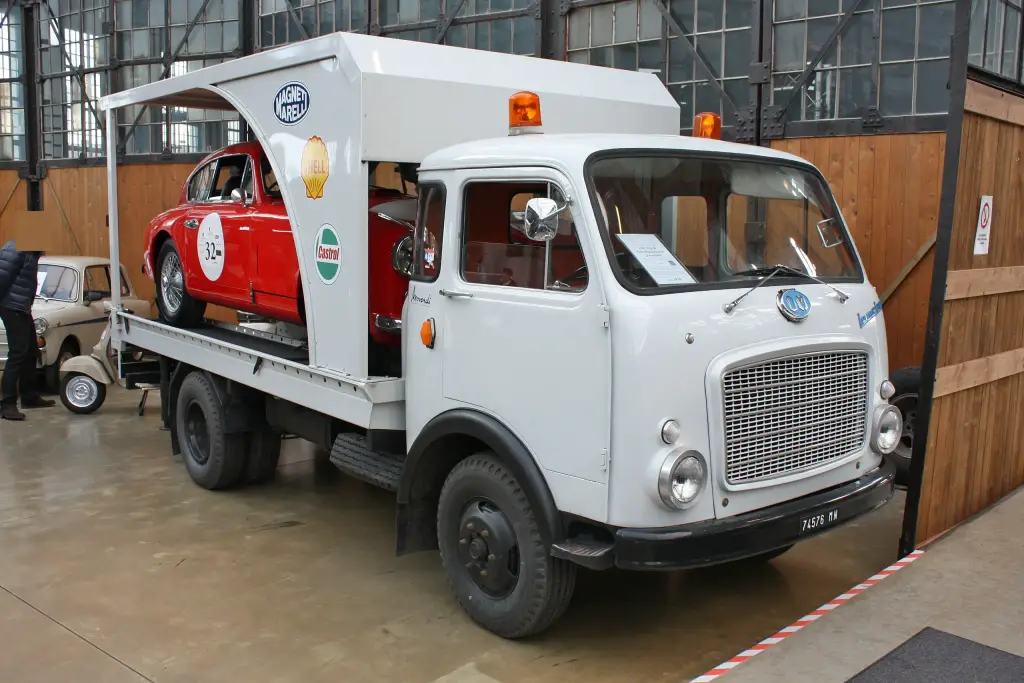
The OM Leoncino replaced the Loc in 1950 and became the backbone of OM’s truck range. Its high, forward-mounted cab and a simple 3,770 cc diesel made it a favourite with Italian hauliers, and it stayed in production for eighteen years.
OM Leoncino at a glance
| Maker | Officine Meccaniche (OM), Brescia |
|---|---|
| Production | 1950–1968 |
| Class | light/medium truck |
| Cab | forward control, 2 m wide, three seats |
| First engine | 3,770 cc diesel, 54 CV at 2,100 rpm |
| 1954 engine | 4,156 cc diesel, 67 CV at 2,400 rpm |
| Last engine | 4,561 cc diesel, 92 CV |
| Top speed | 77 km/h |
| Gradient at full load | 28 per cent |
| Gross weight | about 6.5 tonnes |
| Payload | 34 quintals |
| Replaced by | OM 65 |
The English Wikipedia has no article on the Leoncino; this page is based on the Italian article, the only source used.
History of the OM Leoncino
The Leoncino was launched in 1950 to replace the Loc. Its cab sat above the engine, was two metres wide and held three people, which was very modern for the period. The truck soon proved versatile and robust, and became OM’s best seller. It was built as a bus, a 4×4, a camper, an ambulance and a fire engine as well as a goods vehicle.
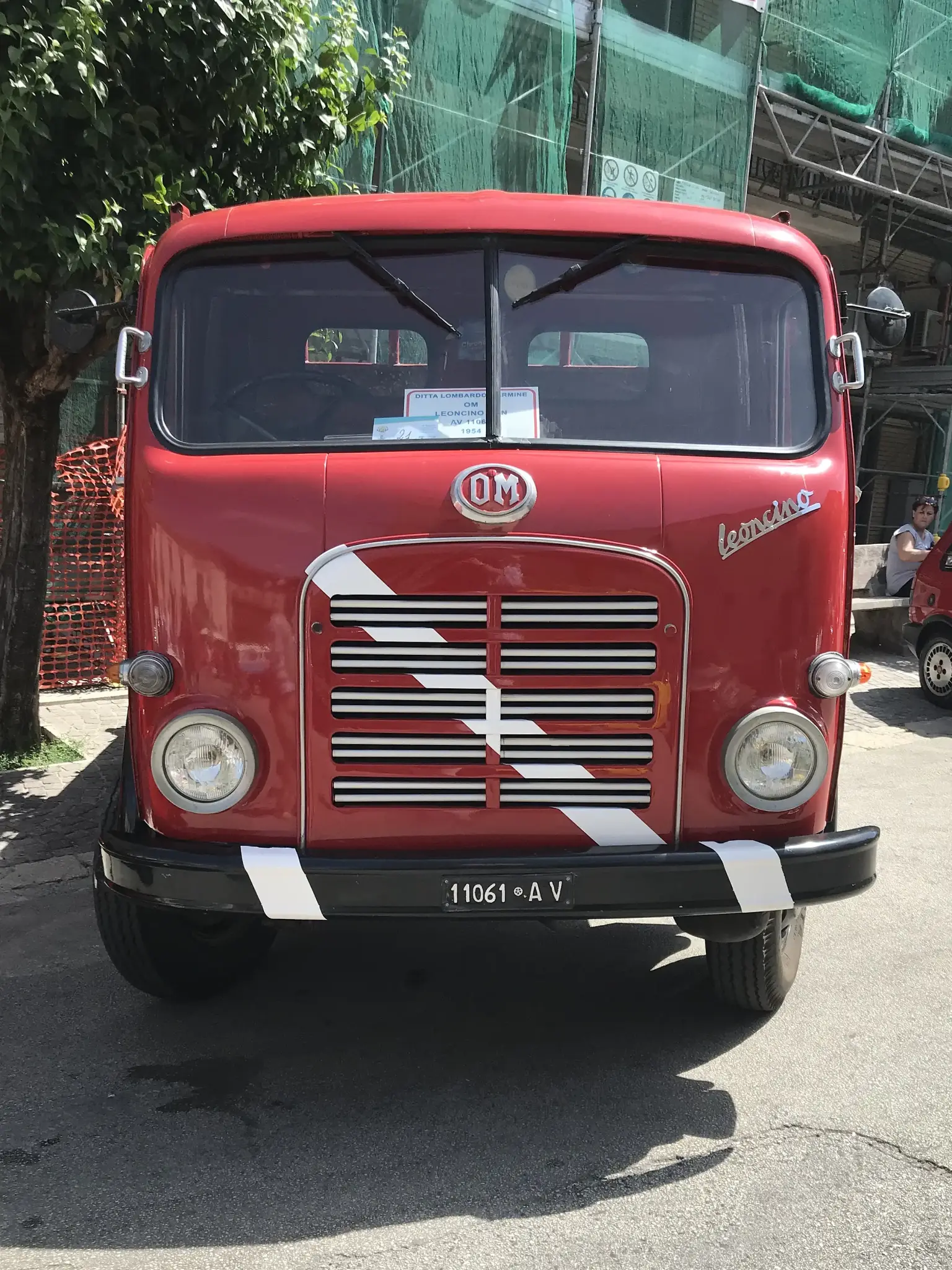
The first engine was a 3,770 cc direct-injection four-cylinder diesel giving 54 CV (40 kW) at 2,100 rpm. That was enough for 77 km/h and a 28 per cent gradient at full load. In 1954 the engine grew to 4,156 cc and 67 CV (49 kW) at 2,400 rpm; the last version used a 4,561 cc diesel of 92 CV (68 kW). An unusual front-wheel-drive version was also offered, which lowered the load floor for airport work and other jobs needing a low loading threshold.
The zoological family
The Leoncino was the head of a family of trucks with gross weights between three and eight tonnes: the smaller Orsetto, Cerbiatto and Lupetto, and the larger Daino and Tigrotto. All shared many parts, starting with the cab, and none was normally intended for trailer work, since they were designed for short and medium-distance haulage. The Leoncino sat in the middle at about 6.5 tonnes gross and 34 quintals of payload.
Production ended in 1968, when the whole zoological family gave way to the numeric series sold under both OM and Fiat badges; the Leoncino’s direct successor was the OM 65. The truck was also assembled abroad to avoid import duties, notably in France by Unic, which sold it as the Unic 34C, and in Switzerland by Saurer.
Design and features
- Modern cab: forward control, two metres wide and seating three, a novelty in 1950.
- Simple diesel: 3,770 cc at first, growing to 4,561 cc and 92 CV by the end.
- Front-wheel-drive option: a low-floor version for airports and special work.
- Many bodies: bus, 4×4, camper, ambulance and fire engine conversions.
OM Leoncino versions
- Leoncino 1950: 3,770 cc, 54 CV.
- 1954 model: 4,156 cc, 67 CV.
- Late model: 4,561 cc, 92 CV.
- Front-wheel-drive version: low load floor for special uses.
- Unic 34C: the French licence-built version.
- Saurer-built: Swiss assembly of the same truck.
The Leoncino headed a family that included the OM Lupetto, the OM Cerbiatto and the OM Tigrotto. Its successor, the OM 65, belongs to the OM numeric series.
Sources
- OM Leoncino, Italian Wikipedia: history, engines, family, licence production