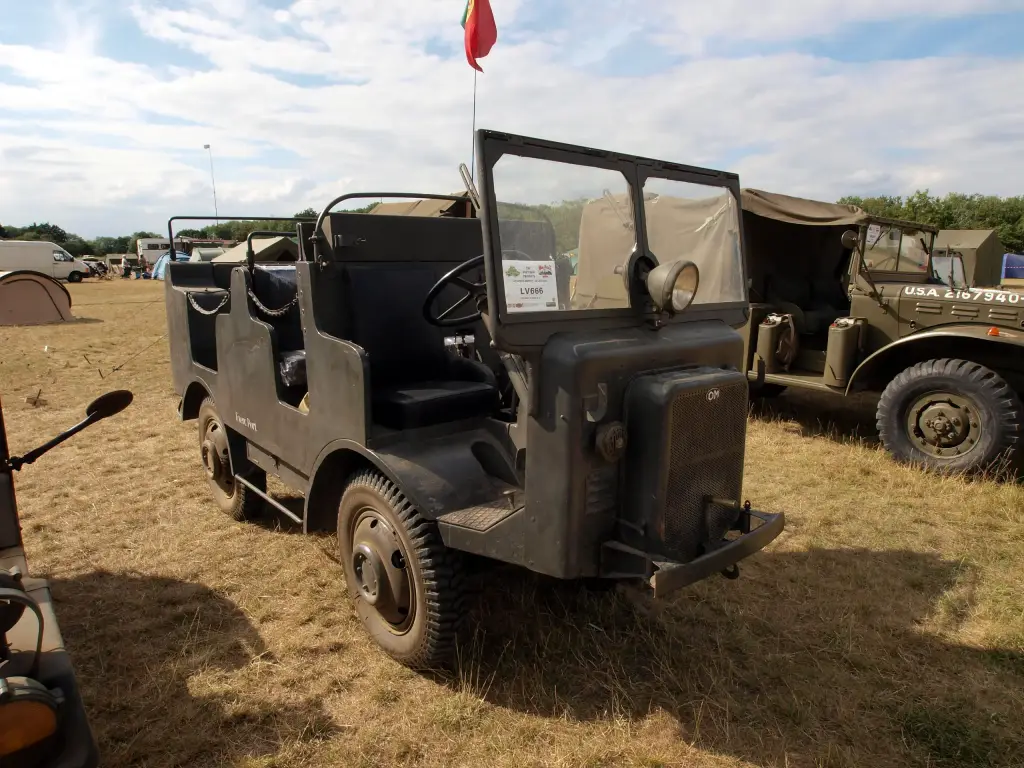
The OM Autocarretta was designed to do one job: carry men and supplies up military mule tracks in the Alps. Adopted in 1932, the little four-wheel-drive truck became the Italian Army’s standard mountain vehicle and served into the Second World War.
OM Autocarretta at a glance
| Maker | OM, Brescia, from an Ansaldo design |
|---|---|
| Type | light mountain truck, four-wheel drive |
| Prototype tested | December 1929, Pinerolo valleys |
| Adopted | 1932, as autocarretta 32 |
| Engine | 1,615 cc, 20 CV (model 32), 23 CV later |
| Top speed | 20 km/h (32), 40 km/h (later models) |
| Suspension | double transverse leaf springs |
| Versions | 32, 35, 36mt, 36 P/DM, 37 |
| East Africa | 1,337 model 32 and 35 sent to Eritrea by May 1936 |
| Crew | up to a rifle squad on the 36 P/DM |
The English Wikipedia has no article on the Autocarretta; this page is based on the Italian article, the only source used.
History of the OM Autocarretta
In 1927 the Italian Army’s new technical inspectorate opened a competition for a small truck able to work on mountain mule tracks. Ansaldo, Ceirano, Fiat and Lancia were invited; Ansaldo gave the project to the engineer Giulio Cesare Cappa, who had recently left Fiat. His prototype was tested in the Pinerolo valleys in December 1929 and reached Ruata di Pramollo along a very narrow mule track. Ansaldo’s financial troubles then led to the project being passed to OM of Brescia, which enlarged the engine from 1,350 to 1,615 cc.
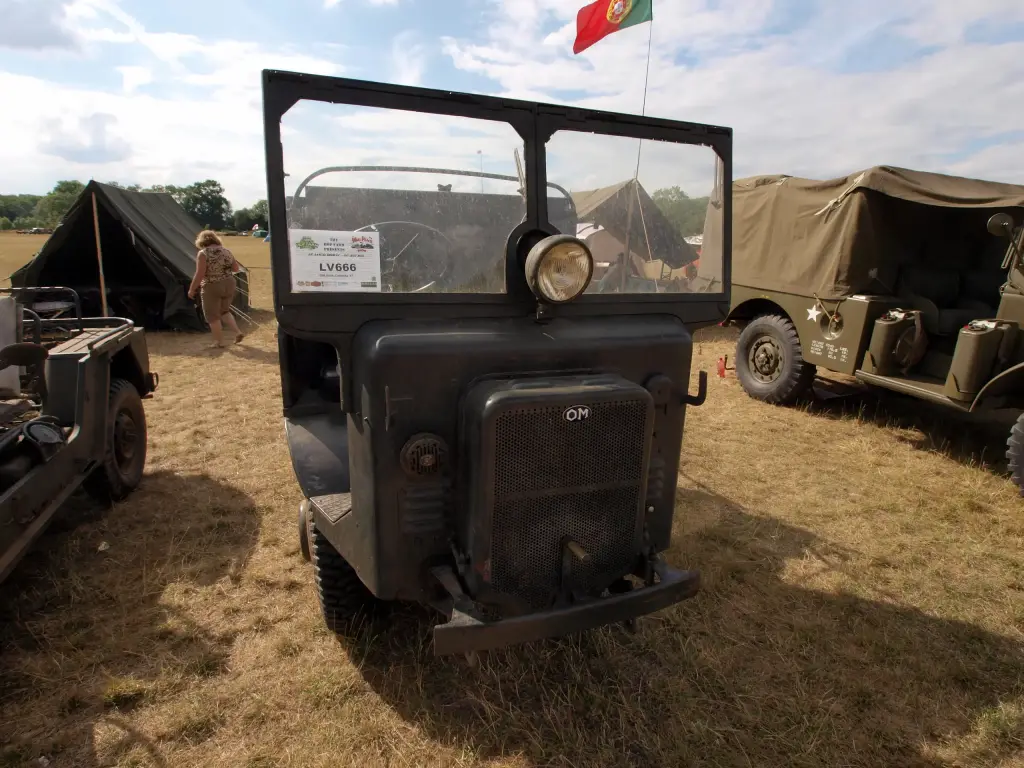
Three prototypes were submitted for type approval in the second half of 1931, but a production order had already been placed. Approval came in the first half of 1932 and the vehicle was designated autocarretta 32; all the competing designs were dropped. When OM joined the Fiat group in 1933, a personnel carrier and a water tanker version were tried. In 1934 a Bosch dynamo replaced acetylene lighting, the track was widened to 1.10 m and the suspension and steering were revised, producing the autocarretta 35; the changes were later applied to the 32 as well.
Later versions
Pneumatic tyres and a reduction gear produced the autocarretta 36mt, from which the 36 P and DM were derived, with a torpedo body for a rifle squad and two Breda Mod. 30 machine guns on Chiappi-Soriani mounts. In 1937 the 36mt was revised again, dropping the pneumatic tyres but keeping hydraulic dampers, as the autocarretta 37. A Wilson preselector gearbox and twin anti-aircraft machine-gun mounts remained experimental.
The first wartime use came in the Ethiopian war: by May 1936, 1,337 model 32 and 35 vehicles had been sent to Eritrea and another 78 to Somalia. Service in East Africa exposed problems with the engine, suspension and transmission, and led to recommendations for a larger engine, lower engine speed, an air filter and better suspension, as well as the option of replacing the wheels with tracks.
Design and features
- Four driven, steering wheels: all four wheels pulled and steered, with semi-pneumatic tyres or tracks on early models.
- Mountain gearing: low gearing and 20 CV let it climb the steepest military roads, such as the 72 hairpins up to the Chaberton battery.
- Simple maintenance: a 1,615 cc engine and leaf springs that could be repaired in the field.
- Many roles: cargo, personnel carrier, water tanker and machine-gun carrier.
OM Autocarretta versions
- Autocarretta 32: the original production model with acetylene lighting.
- Autocarretta 35: dynamo lighting, wider track and revised suspension.
- Autocarretta 36mt: pneumatic tyres and a reduction gear.
- 36 P and 36 DM: torpedo-bodied squad carriers with two machine guns.
- Autocarretta 37: the 1937 revision without pneumatic tyres.
OM’s civilian trucks of the same years are covered by the OM Taurus, and the company’s pre-war cars by the OM 665 Superba. More vehicles are in the OM collection.
Sources
- OM Autocarretta, Italian Wikipedia: competition, development, versions, East Africa