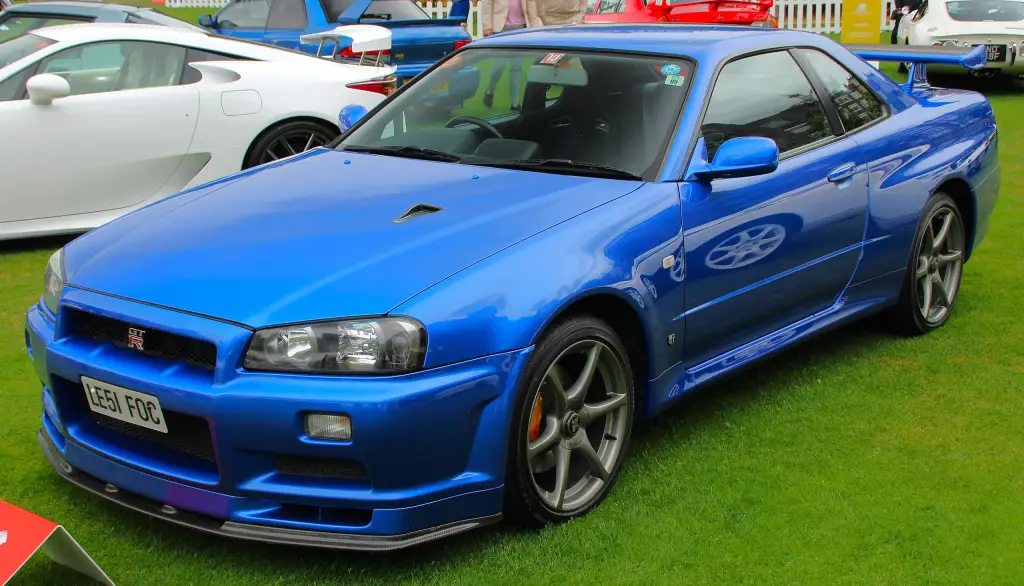
The GF-BNR34 (R34) Skyline GT-R was introduced on 8 January 1999 as the fifth generation of the Skyline GT-R, together with the GT-R V·spec and the V·spec N1. Production of the Skyline GT-R ended in August 2002, and the car was replaced by the all-new GT-R (R35).
Nissan Skyline GT-R R34 at a glance
| Introduced | 8 January 1999 |
|---|---|
| Production ended | August 2002 |
| Engine | RB26DETT, twin-turbo straight-six |
| Rated output | 206 kW (280 PS), but actually over 246 kW (334 PS) at the factory |
| Drive | ATTESA E-TS all-wheel drive; the V·spec had the E-TS Pro system |
| Magazine test results | quarter mile in 12.2 seconds, 0–100 km/h in 4.4 seconds |
| Nürburgring, 1999 | unofficial 7:52 lap by test driver Kazuo Shimizu |
| V·spec N1 built | 38 |
| V·spec II built for Japan | 1,855 |
| Nür built for Japan | 1,003, of which 718 V·spec II Nür and 285 M·spec Nür |
This page is based on the English Wikipedia article on the Nissan Skyline GT-R, a single source.
History of the Nissan Skyline GT-R R34
The Skyline GT-R became the flagship of Nissan performance, showing advanced technology such as the ATTESA E-TS all-wheel-drive system and the Super-HICAS four-wheel steering. The name was revived in 1989 with the R32 after a 16-year pause, and the Australian magazine Wheels had nicknamed that car “Godzilla” in July 1989. It carried the name through all later generations and called the R34 “Godzilla Returns”, describing it as “the best handling car we have ever driven”.
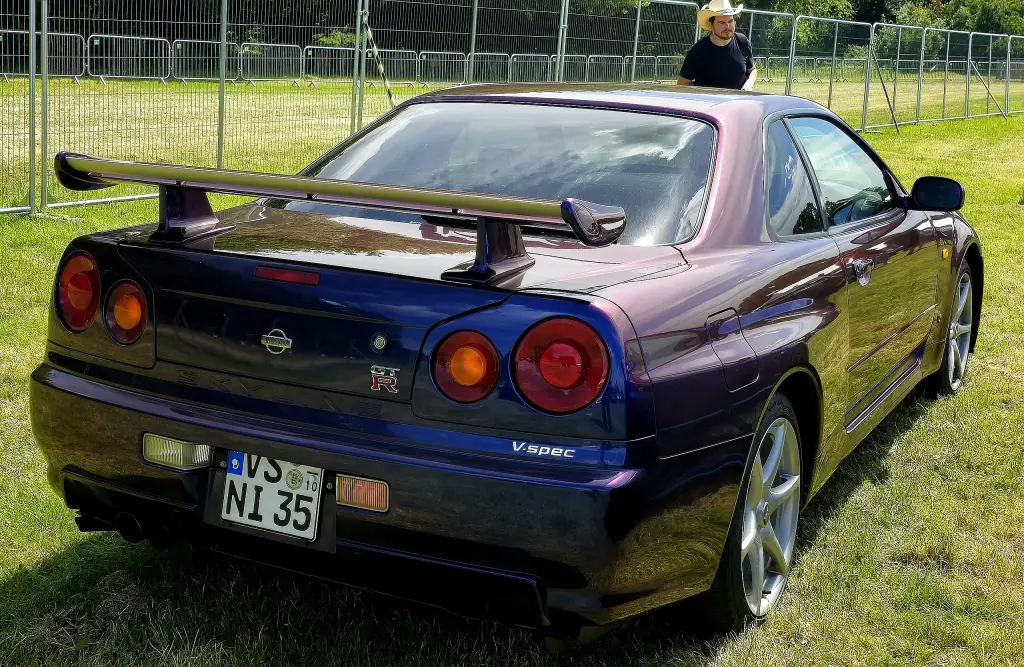
The 1999 car
The R34 was shorter from front to rear than its predecessor and had less front overhang, a response to customers who thought the R33 too bulky. The valve covers were painted glossy red instead of black. A new 5.8-inch LCD multifunction display in the centre of the dashboard showed seven live readings such as turbocharger pressure (1.2 bar maximum), oil and water temperature; the V·spec added intake and exhaust gas temperatures. The V·spec (Victory Specification) also had the ATTESA E-TS Pro system with an active limited-slip differential at the rear, firmer suspension, lower ground clearance and a rear carbon-fibre diffuser, while standard GT-Rs had the non-Pro system and a mechanical differential. As with the R32 and R33, Nissan introduced a V·spec N1 as a homologation special, sold without air conditioning, audio equipment, rear wiper or boot lining; only 38 were built, 12 of which Nismo used for Super Taikyu racing.
Later versions
In October 2000 the V·spec II replaced the V·spec, with even stiffer suspension, larger rear brake rotors and a carbon-fibre bonnet with a NACA duct; 1,855 were built for Japan and 18 V·spec II N1 cars. The M·spec of May 2001 was based on the V·spec II but had special “Ripple control” dampers, a leather interior with heated front seats and a standard aluminium bonnet; the M stood for Mizuno, Nissan’s chief engineer. The last cars, the V·spec II Nür and M·spec Nür of February 2002, were named after the Nürburgring, where the Skyline was developed. They had an improved RB26DETT based on the N1 racing engine with larger turbochargers, steel instead of ceramic turbine blades, gold valve covers and a 300 km/h speedometer. Following Japanese industry norms the car was advertised at 280 PS, but left the factory with over 334 PS. A total of 1,003 were built.
Abroad
The Skyline GT-R was never made outside Japan, and its export markets were Hong Kong, Singapore, Australia and New Zealand, plus the UK from 1997. The Middlehurst Nissan dealer imported 80 V·spec cars to the UK with modifications that included three extra oil coolers, a revised ECU map, a full leather interior, stiffer suspension and a 250 km/h limiter; 10 went to Hong Kong and Singapore and 5 to New Zealand. In tests by motoring magazines the R34 covered a quarter mile in 12.2 seconds and accelerated from 0–100 km/h in 4.4 seconds. In 1999, during Nissan’s testing at the Nürburgring Nordschleife, it set an unofficial lap time of 7:52, which beat the record of the R33, until then the fastest production car there.
Design and features
- Drive: ATTESA E-TS all-wheel drive, with an active rear differential on the V·spec.
- Display: a 5.8-inch dash screen showing boost, oil and water temperatures.
- Rating: advertised at 280 PS, in reality well above that.
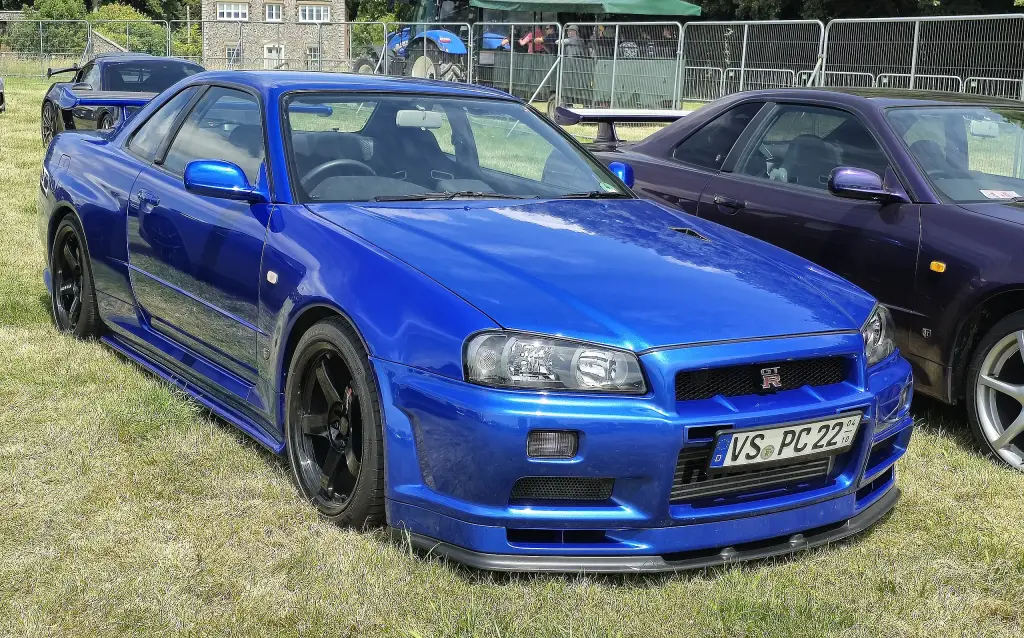
Nissan Skyline GT-R R34 versions
- GT-R and V·spec (1999): the first R34s.
- V·spec N1: 38 homologation cars without air conditioning.
- V·spec II (2000): stiffer suspension and a carbon-fibre bonnet.
- M·spec (2001): a softer, leather-trimmed version with Ripple control dampers.
- V·spec II Nür and M·spec Nür (2002): the final 1,003 cars.
The R34 followed the Nissan Skyline GT-R R32; its successor is in the Nissan GT-R article, and the family in the Nissan Skyline. See also our Nissan collection and the guide to homologation specials.
Sources
- Nissan Skyline GT-R, English Wikipedia: the Godzilla nickname and the fifth-generation (R34) versions