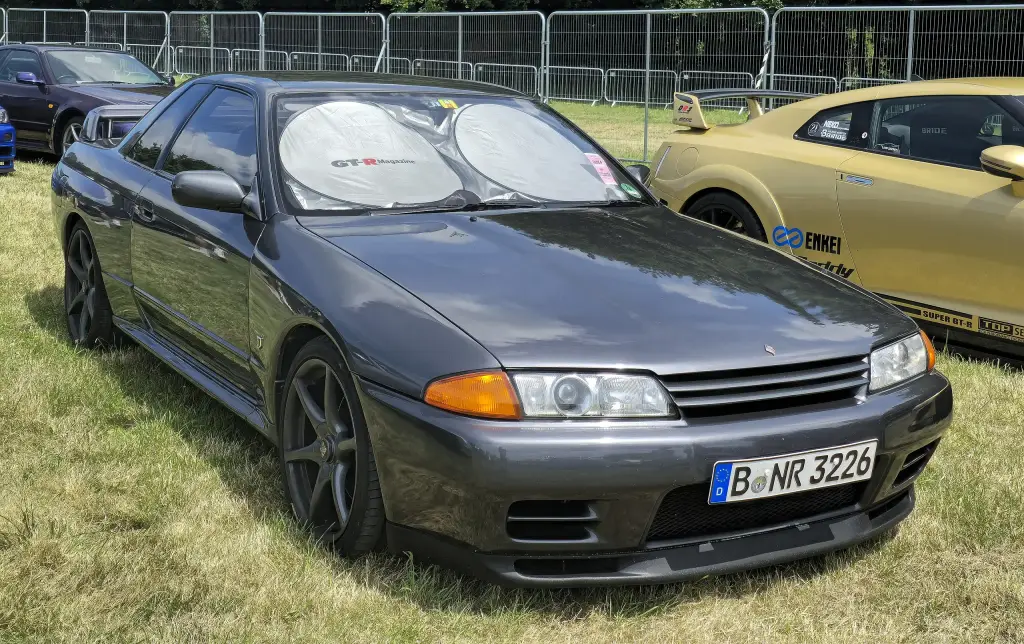
The eighth-generation Nissan Skyline (R32) debuted in 1989, and its top version, the GT-R (BNR32), was developed with Group A racing in mind. With a twin-turbocharged 2.6-litre straight-six and four-wheel drive, it dominated Japanese and Australian touring-car racing and became known as Godzilla.
Nissan Skyline GT-R (R32) at a glance
| Generation | eighth-generation Skyline (R32), debuted 1989; GT-R first produced in 1988 including prototypes |
|---|---|
| Engine | RB26DETT 2.6 L DOHC twin-turbo straight-six |
| Output | 280 PS (206 kW) and 368 N·m, officially; about 320 PS in reality |
| Drive | four-wheel drive with ATTESA and HICAS four-wheel steering |
| 0–100 km/h | 4.7 seconds |
| Target | the Porsche 959; Naganori Ito was chief engineer |
| R32 total built | 313,491, of which 43,937 GT-Rs |
| Japanese Touring Car Championship | 29 wins from 29 starts; titles every year 1989 to 1993 |
| Bathurst 1000 | won in 1991 and 1992 |
| Nismo GT-R | 500 road cars and 60 racing cars |
This page is based on the R32 section of the English Wikipedia article on the Nissan Skyline, a single source.
History of the Nissan Skyline GT-R (R32)
The R32 Skyline debuted in 1989 as a two-door coupe or four-door hardtop sedan. It offered several RB-series straight-six engines and, on most versions, HICAS four-wheel steering. It was a “compact” under Japanese tax rules, which is why smaller engines were offered. The R32 was also the first Skyline with part-time all-wheel drive.
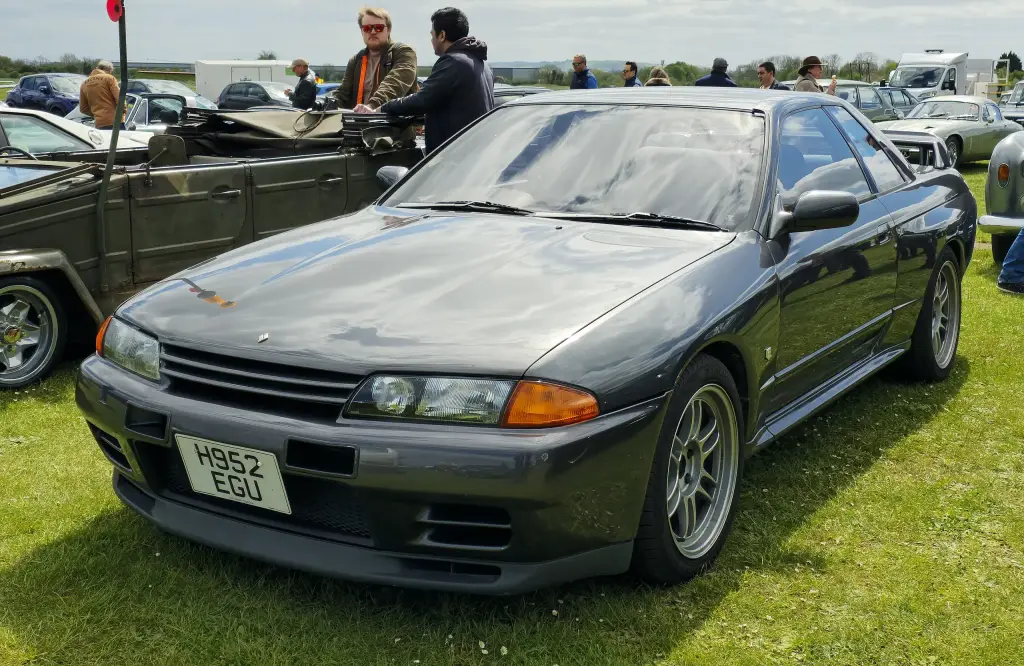
The GT-R (BNR32) was first produced in 1988 with its prototypes; the first six Nismos were built in 1989, and the other 554 Nismo GT-Rs followed in 1990, all in Gunmetal Grey. The chief engineer, Naganori Ito, intended it for Group A racing, so its design specification was drawn up together with a copy of the Group A rules, and the Porsche 959 was Nissan’s target. The Nürburgring Nordschleife production car record at the time of development was 8:45, set by a Porsche 944. Nissan test driver Hiroyoshi Katoh reset it with an 8:20.
The 280 PS agreement
The RB26DETT engine actually produced about 320 PS but was rated at 280 PS because of the Japanese car makers’ gentlemen’s agreement not to exceed that figure. It was designed for about 500 hp in racing trim and then held back by the exhaust, boost limit and engine computer. The GT-R had a much larger intercooler, larger brakes and aluminium front guards and bonnet, flared arches and more supportive seats. Inside, the clock was replaced with a torque meter that showed how much torque went to the front wheels, from 0 to 50 per cent.
Racing
The R32 GT-R dominated the Japanese Touring Car Championship, winning 29 races from 29 starts and the series title every year from 1989 to 1993, and took 50 races from 50 starts in the N1 Super Taikyu series from 1991 to 1997. In Australia, where it arrived in 1990, it ended the reign of the previously all-conquering Ford Sierra Cosworth and won the Bathurst 1000 in 1991 and 1992. The Australian press nicknamed it Godzilla, a “monster from Japan”; Australia was the first export market and the name spread. Its dominance was a significant factor in the end of Group A touring-car racing, and the Japanese championship splintered soon after.
V-Spec
When the car was designed the homologation rules required 16-inch wheels, which limited the brakes, and Nissan’s four-piston calipers were not competitive. After the rules changed to allow 17-inch wheels, the GT-R V-Spec (for Victory) appeared in February 1993 on 17-inch BBS mesh wheels with larger Brembo calipers. A year later the V-Spec II followed with wider tyres. In August 2014 the first R32 GT-Rs became eligible for US import under the 25-year rule.
Design and features
- Drivetrain: twin-turbo straight-six, electronically controlled four-wheel drive and four-wheel steering.
- Body: flared arches, aluminium front guards and bonnet, a larger intercooler.
- Homologation effect: 16-inch wheels capped the brakes until the rules changed.
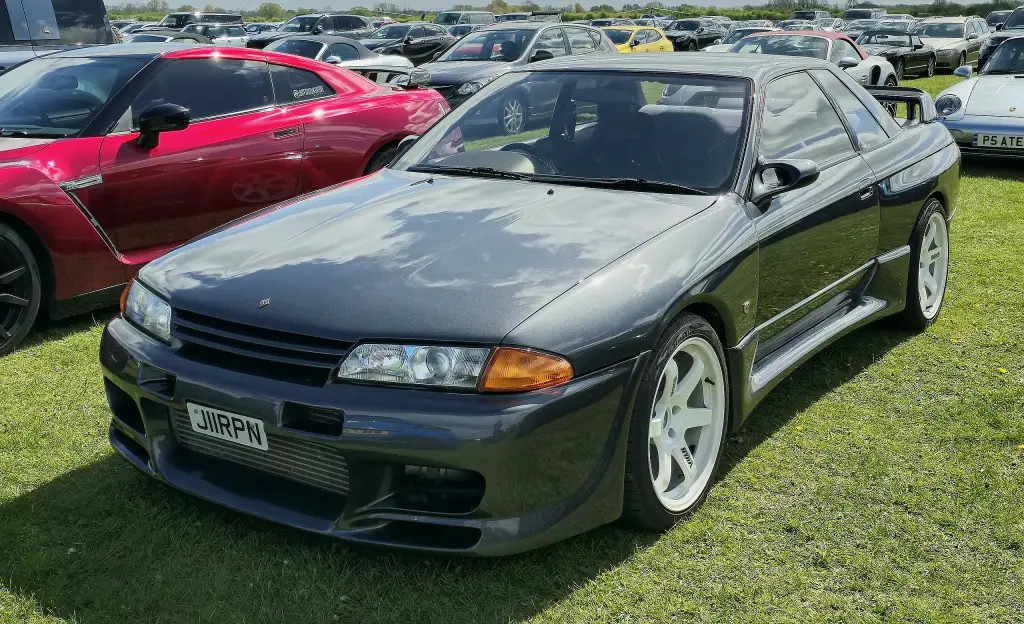
Nissan Skyline GT-R (R32) versions
- GT-R (BNR32): the standard 280 PS car.
- Nismo GT-R: 500 road cars and 60 racing cars.
- V-Spec and V-Spec II (1993, 1994): 17-inch wheels and Brembo calipers.
The R32 belonged to the Nissan Skyline line and later gave way to the Nissan GT-R. More cars are in our Nissan collection.
Sources
- Nissan Skyline, English Wikipedia: eighth generation (R32) and the GT-R (BNR32)