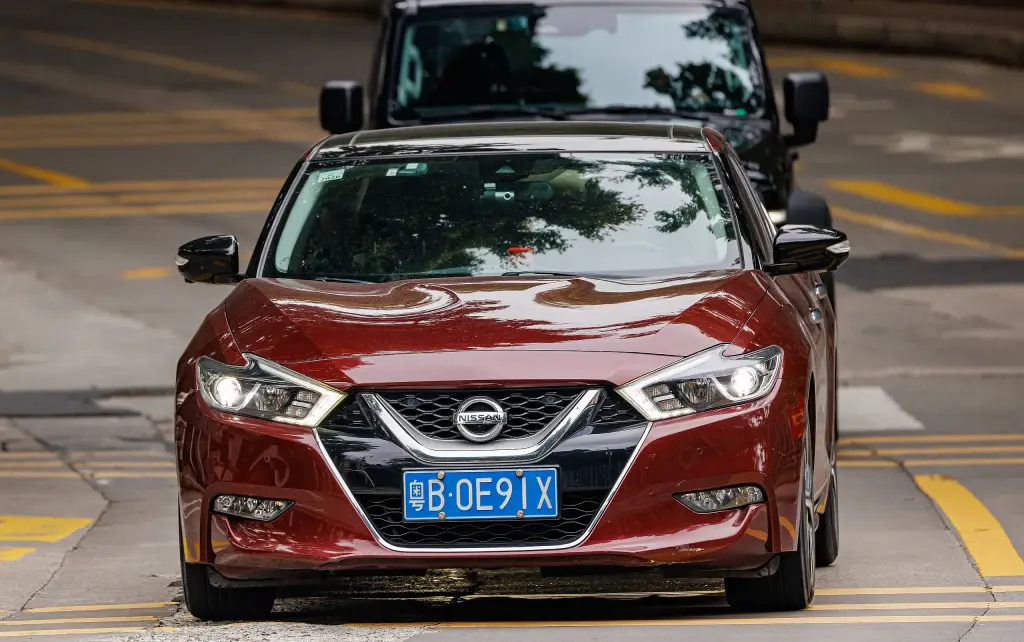
The Nissan Maxima is a five-seat, front-engine saloon that Nissan has sold as its flagship mainly in North America, the Middle East, South Korea and China across eight generations. It debuted for the 1982 model year as the Datsun Maxima, replacing the Datsun 810.
Nissan Maxima at a glance
| Production | since 1981 |
|---|---|
| First sold as | Datsun 810 and Datsun Maxima |
| Bodies | four-door sedan and five-door wagon |
| First engine | 2.4-litre six, 120 hp |
| Diesel option | 2.8-litre LD28 six, mid-1981 to 1983 |
| Second generation | front-wheel drive from 1985 |
| Second-generation engine | 3.0-litre VG30E V6, 157 hp |
| Built in | Oppama, Japan; Smyrna, Tennessee from 2004 |
| Position | above the Altima and Stanza |
based on one source: the English Wikipedia article on the Nissan Maxima; the collected material describes the first two generations in detail.
History of the Nissan Maxima
The first Maxima
The first car to wear the Maxima badge was the second-generation Datsun 810, sold only in North America from 1980 as a 1981 model. It was essentially the Japanese Datsun Bluebird 910 with the wheelbase stretched 100 mm to fit an inline six. Two trims were offered, the 810 Deluxe and the upper 810 Maxima, as a four-door sedan or a five-door wagon. For 1982 all 810s were rebranded Datsun Maxima, and for 1984 some North American Datsuns carried both Datsun and Nissan badges.
Early equipment
The Deluxe came with a five-speed manual and the Maxima only with a three-speed automatic. The 2.4-litre six was the same engine as the Datsun 240Z, raised to 120 hp, and a 2.8-litre LD28 diesel six was available from mid-1981 to 1983. Sedans had independent rear suspension while the wagon used a leaf-sprung live axle with drum brakes. The Maxima carried a phonograph-based voice warning system that spoke alerts such as “door is open”; the 1981 cars were the first talking cars marketed in the United States, though they offered only one warning, asking the driver to turn off the lights.
Front-wheel drive
On 17 October 1984 the first front-wheel-drive Maxima arrived for 1985, based on the Bluebird U11 with a 157 hp 3.0-litre VG30E V6, the first V6 mass-produced in Japan and the first Nissan V6 with front-wheel drive. It was the last generation offered as a station wagon. A 1987 update brought automatic shoulder belts and a long list of luxury equipment, and for 1988 the DUET-SS Super Sonic Suspension used sonar to read the road ahead and adjust the shock absorbers. Later generations kept the Maxima as Nissan’s flagship saloon, built at Oppama until North American assembly began at Smyrna for 2004; production for the United States and Canada ended in July 2023.
Design and features
- Voice warning: a phonograph-based talking alert system.
- First Japanese V6: the VG30E was Japan’s first mass-produced V6.
- Sonar suspension: DUET-SS read the road with sonar in 1988.
- Eight generations: the longest-running Nissan saloon name in America.
Nissan Maxima versions
- Datsun 810 Maxima (1981): the first car with the badge.
- Datsun Maxima (1982–1984): the rebranded first generation.
- Maxima second generation (1985–1988): front-wheel drive and the VG30E.
- Maxima SE: the sporty trim with three-way adjustable shocks.
- Later Maxima generations (to 2023): Nissan’s North American flagship.
The Maxima began as a six-cylinder Bluebird and sits above the Altima, with its later generations related to the Cefiro. More cars are in the Nissan collection.
Video: 2014 Nissan Maxima 3.5SV Review, Walkaround, Exhaust & Test Drive
Video by YouTube on YouTube.
Sources
- Nissan Maxima, English Wikipedia: first and second generations, engines, equipment, production