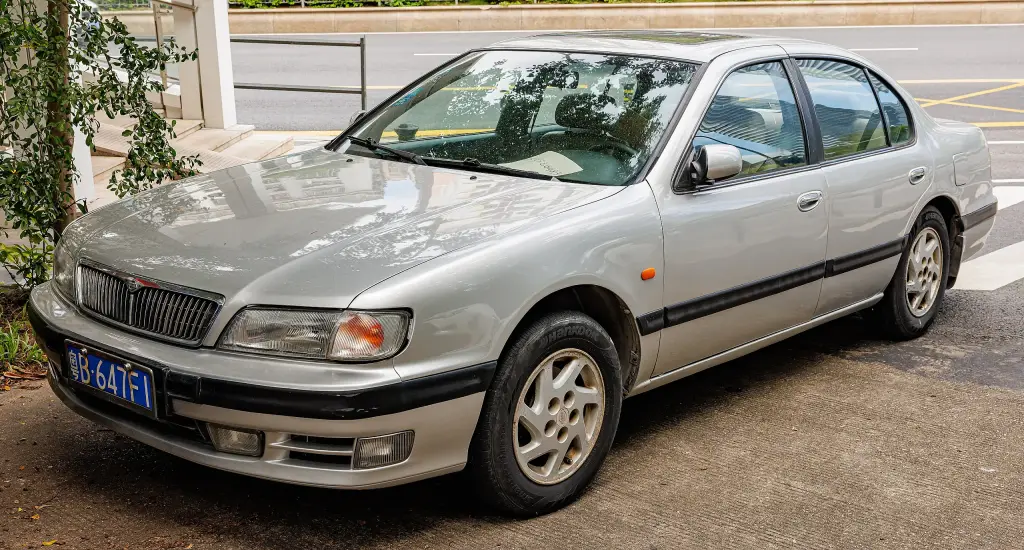
The Nissan Cefiro was a mid-size passenger car built over three generations. Almost all were four-door saloons, with a five-door wagon offered briefly from 1997 to 2000. Most Cefiros used Nissan’s VQ V6 engines, and the name was applied in export markets to the Maxima, the Samsung SM5 and the Infiniti I30 and I35.
Nissan Cefiro at a glance
| Production | 1988–2004 |
|---|---|
| Generations | A31 (1988–1994), A32 (1995–1998), A33 (1995–2004) |
| Drive | rear-wheel drive in the A31; front-wheel drive afterwards |
| A31 engines | RB20 single and twin-cam sixes, RB20DET turbo |
| A31 platform | shared with the Skyline R32 and Laurel C33 |
| Other badges | Nissan Maxima, Samsung SM5, Infiniti I30 and I35 |
| Name origin | Zephyr, the Greek god of the west wind |
based on one source: the English Wikipedia article on the Nissan Cefiro.
History of the Nissan Cefiro
A31 (1988–1994)
The first Cefiro was released in Japan in September 1988, sharing its transmission, chassis, engine and suspension with the Skyline R32 and Laurel C33, except the diesel engine, which only the Laurel had. The ATTESA E-TS all-wheel-drive system arrived after the mid-model refresh, borrowed from the Skyline. It competed with the Toyota Mark II, Cresta and Chaser trio and was sold as a third alternative to the Laurel and Skyline, each at a different Nissan dealership. The name was chosen because the A30 code had already been used by the 1967–1971 Gloria, and the car replaced the Stanza.

A31 equipment
The car was slightly more expensive than the equivalent Skyline or Laurel but brought projector-beam headlights, an automatically tinting rear-view mirror, electrically adjustable seats, automatic headlights and radio controls on the steering wheel. HICAS-II four-wheel steering, the Super Sonic Suspension and ATTESA E-TS could be ordered separately but not combined. Super Sonic Suspension used a sonar module under the front bumper to scan the road and adjust the dampers, with Auto, Soft, Medium and Hard settings selected from the console; the setting also changed steering feel and automatic gearshift points. At launch there were 810 possible combinations of engine, suspension, transmission and trim.
A32 and A33
The second and third generations moved to front-wheel drive with V6 engines only. The A32 of 1995 also became the Maxima in North America and Australia, the Infiniti I30, the Maxima QX in Europe and Russia and, built under licence, cars for Indonesia, Malaysia and Taiwan. The name was later used again on the first-generation Teana for Asian and Latin American markets, and was retired in 2012.
Design and features
- Skyline chassis: the A31 shared its platform with the R32 Skyline and C33 Laurel.
- Sonar suspension: Super Sonic Suspension scanned the road surface.
- Million combinations: 810 engine, suspension and trim options at launch.
- Many badges: sold as the Maxima, Samsung SM5 and Infiniti I30 and I35.
Nissan Cefiro versions
- Cefiro A31 (1988–1994): rear-wheel drive with RB20 sixes.
- Cefiro A32 (1995–1998): front-wheel drive, V6, basis of the Maxima and I30.
- Cefiro A33 (1995–2004): the final generation.
- Cefiro wagon (1997–2000): a briefly offered five-door.
The Cefiro shared its first platform with the Skyline and Laurel, and its later generations became the Maxima. More cars are in the Nissan collection.
Sources
- Nissan Cefiro, English Wikipedia: generations, A31 chassis and equipment, export names