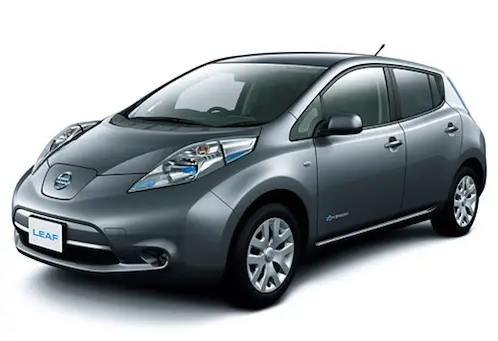
The Nissan Leaf is a battery electric car built since 2010, sold as a five-door hatchback until 2025, when it became a crossover. The name is a backronym for leading environmentally-friendly affordable family car. It was unveiled on 1 August 2009 and became the world’s first mass-market zero-emission car.
Nissan Leaf at a glance
| Production | since 2010 |
|---|---|
| Name | backronym for leading environmentally-friendly affordable family car |
| First generation | ZE0, 2010–2017 |
| Second generation | ZE1, from 2017 |
| First-generation battery | 192 flat laminated lithium-ion cells, developed with NEC |
| First-generation motor | 80 kW, range about 160 km |
| Second-generation battery | 40 kWh, later 62 kWh in the Leaf e+ |
| Second-generation motor | 110 kW, 160 kW in the e+ |
| Built at | Oppama, Smyrna, Sunderland |
| Awards | European Car of the Year, World Car of the Year, Car of the Year Japan 2011–2012 |
based on one source: the English Wikipedia article on the Nissan Leaf.
History of the Nissan Leaf
Launch
Nissan unveiled the Leaf on 1 August 2009 as the world’s first series- production battery electric vehicle, and production began on 22 October 2010 at Oppama in Yokosuka. Before that, Nissan built three prototype electric cars: the EV-01 and EV-02 based on the Z11 Cube and the EV-11 based on the C11 Tiida. Cars for Europe and the United States were imported from Oppama until early 2013; battery manufacturing at Smyrna began on 12 December 2012 and Leaf production there on 9 January 2013, with British production following on 28 March 2013.
First generation (ZE0)
The first Leaf used 192 flat, laminated lithium-ion cells developed with NEC, with the pack under the floor and between the wheels. The motor produced 80 kW and gave a range of about 160 km, with charging of 16 hours on 120 volts or 8 hours on 230 volts, and a fast charger restoring 80 percent in about 30 minutes. Critics accepted its spacious boot and standard heated seats but complained about the inexpensive interior materials and debated its battery range.
Second generation (ZE1)
The second-generation Leaf arrived in October 2017 for the 2018 model year, with deliveries in North America and Europe from February 2018. It was mechanically similar but had more range and power, with a 40 kWh battery giving an EPA range of 243 km and a 110 kW motor. It gained Android Auto and Apple CarPlay, optional ProPilot Assist lane centring and one-pedal braking. From 2019 the Leaf e+ added a 62 kWh battery, a 160 kW motor and an EPA range of 364 km. A 2020 concept, the RE-LEAF, was a ruggedised emergency-services version intended as a mobile power source. The car received facelifts in 2022.
Design and features
- Mass-market EV: the first electric car built and sold in large numbers.
- Under-floor battery: 192 laminated cells packaged between the wheels.
- One-pedal driving: regenerative braking can stop the car without the brake pedal.
- e+ version: 62 kWh battery and 160 kW motor from 2019.
Nissan Leaf versions
- Leaf ZE0 (2010–2017): the first generation with the 24 kWh pack.
- Leaf ZE1 (2017–): 40 kWh battery and 110 kW motor.
- Leaf e+ (2019–): 62 kWh and 160 kW.
- RE-LEAF (2020): a concept for disaster response.
The Leaf followed Nissan’s early electric experiments such as the Hypermini, and it shares its platform thinking with the Note. More cars are in the Nissan collection.
Video: 2013 Nissan Leaf Tekna – Fahrbericht der Probefahrt
Video by YouTube on YouTube.
Sources
- Nissan Leaf, English Wikipedia: launch, batteries, motors, ranges, production plants, generations