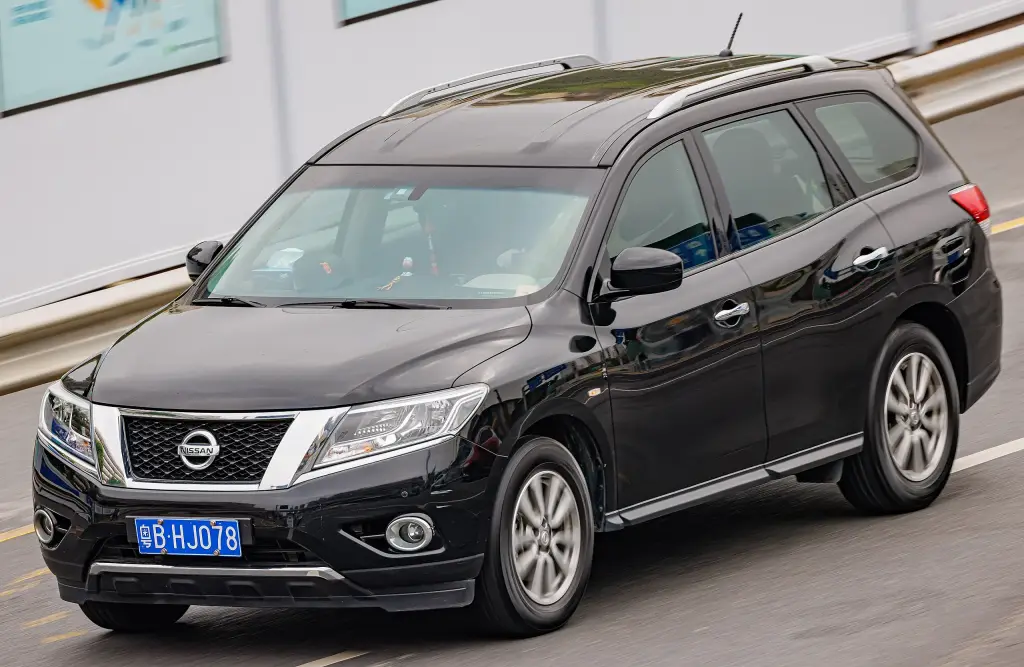
The Nissan Pathfinder is a range of SUVs built since 1985. Until the third generation it was based on Nissan’s compact pickup platform shared with the Navara and Frontier, and outside North America it was marketed as the Nissan Terrano. From 2004 the vehicles were sold globally as the Pathfinder, and in 2012 the R52 became a three-row crossover on the unibody D platform.
Nissan Pathfinder at a glance
| Production | since 1985 |
|---|---|
| First generation | YD21 / WD21, from July 1986 |
| Platform | Hardbody pickup, ladder frame |
| Bodies | two-door from 1986, four-door from October 1989 |
| Engines | 2.4-litre Z24i, 3.0-litre VG30i then VG30E, 2.7-litre TD27 diesel |
| Power | 140 PS VG30i in Japan; 153 hp VG30E from 1990 |
| Rear suspension | five-link coil, borrowed from the Safari |
| Japanese name | Nissan Terrano |
| Crossover from | R52, 2012 |
| Mid-size role passed to | Terra / X-Terra, 2018 |
based on one source: the English Wikipedia article on the Nissan Pathfinder.
History of the Nissan Pathfinder
YD21 (1985)
The first Pathfinder was unveiled in May 1985 and introduced in July 1986 as a two-door body-on-frame SUV for the 1987 model year in the United States, sharing most components with the Nissan Hardbody truck. It was built on a ladder frame as Nissan’s answer to the Chevrolet Blazer, Ford Bronco II, Jeep Cherokee, Toyota 4Runner and Isuzu MU. Its optional four-wheel-drive system could be engaged electronically while moving, unusual at the time; all YD21s came with two-wheel drive or manually engaged four-wheel drive. Base cars had a 2.4-litre four, and a 2.7-litre TD27 diesel was available in some countries, gaining a turbocharger in November 1988.
Terrano in Japan
In Japan the car was sold at Nissan Shop locations as the Terrano, a smaller companion to the Safari. Although based on the Hardbody, it borrowed the Safari’s five-link coil rear suspension to improve off-road ability. Besides the station wagon in two and later four doors, Japan also received a commercial Estate Van. The two-door could be had with the VG30i V6 of 140 PS in Japanese trim. The Terrano was positioned as a luxury off-roader, an “off-road Fairlady ZX”, with climate-controlled air conditioning, electric windows, seats and locks and, in 1993, Recaro seats; Autech added the Wide R3M Urban and AJ Limited packages. A Terrano entered the ninth Paris–Dakar in 1985 and raced for years afterwards.
Four doors and beyond
The four-door Pathfinder arrived in October 1989 without stretching the wheelbase or length. The rear door handles were hidden in the C-pillar trim so the car would look like a two-door truck with a camper shell, a device Nissan later used on the Armada, Juke, Terrano II and Xterra. For 1990 the V6 gained multi-point injection as the VG30E with 153 hp and the Z24i was replaced by the KA24E. The first generation continued until 1995. In 2012 the R52 became a three-row crossover on the unibody D platform, and in 2018 the body-on-frame role passed to the Terra and X-Terra.
Design and features
- Hidden rear handles: door handles set into the C-pillar trim.
- Safari suspension: a five-link coil rear axle for off-road ability.
- Terrano name: the same car outside North America.
- Crossover switch: a unibody platform from 2012.
Nissan Pathfinder versions
- Pathfinder YD21 two-door (1986–1989): the original.
- Pathfinder YD21 four-door (1989–1995): with hidden rear handles.
- Nissan Terrano: the Japanese and export name.
- Terrano Estate Van: the Japanese commercial version.
- Pathfinder R52 (2012–): the three-row crossover.
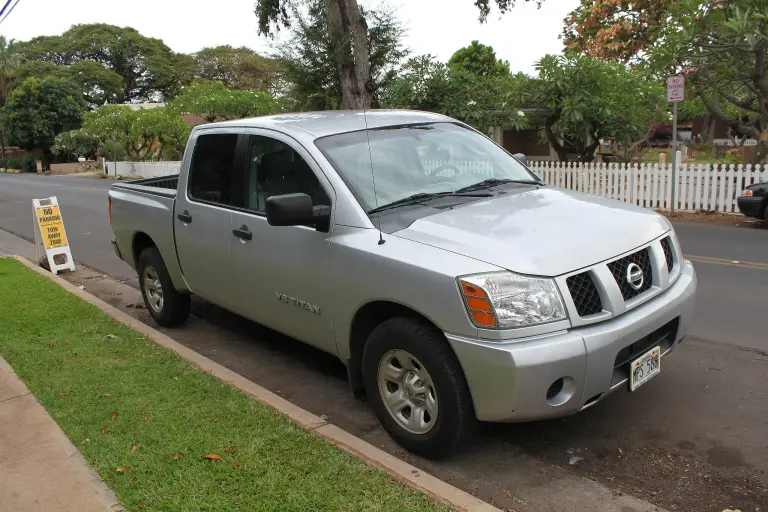
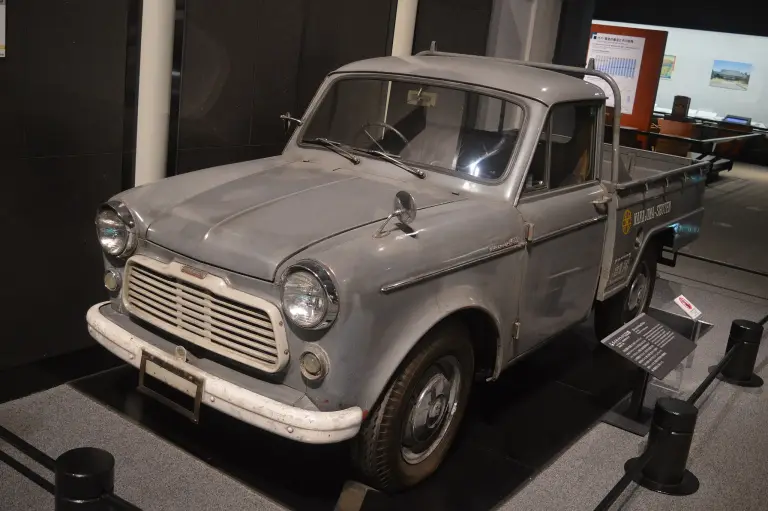
The Pathfinder was built on the Hardbody pickup and sold as the Terrano, while its Safari relative is the Patrol. More cars are in the Nissan collection.
Video: Nissan Pathfinder 2.5 dCi: Der robuste Offroad-Japaner im Motorvision-Test
Video by YouTube on YouTube.
Sources
- Nissan Pathfinder, English Wikipedia: generations, YD21 engineering, Terrano, four-door design, crossover