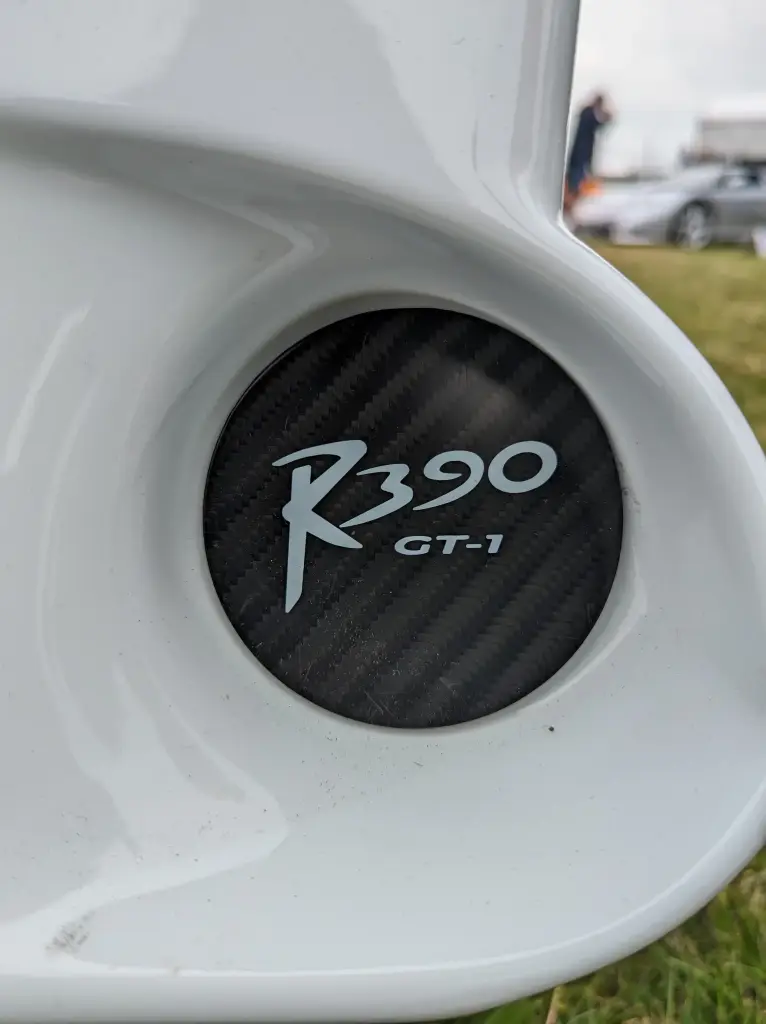
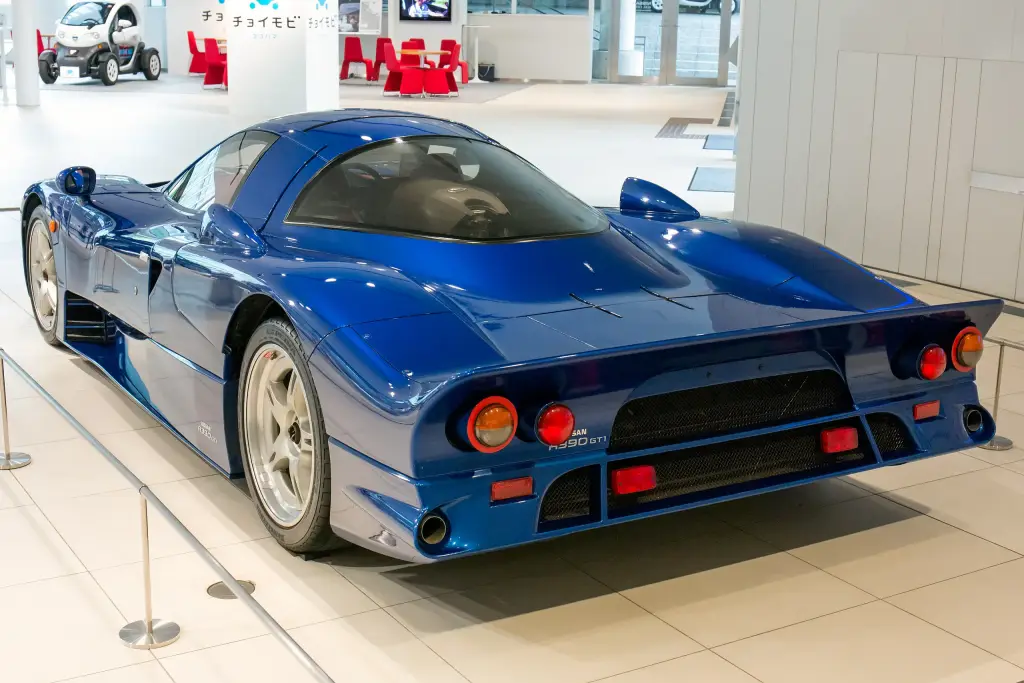
The Nissan R390 GT1 was a racing car built in Atsugi, Japan, primarily to enter the 24 Hours of Le Mans in 1997 and 1998. It was built to grand touring rules that required a homologated road version, so the R390 was designed as a road car first and the racing version developed afterwards. Only one road car was ever built.
Nissan R390 GT1 at a glance
| Built for | 24 Hours of Le Mans, 1997 and 1998 |
|---|---|
| Built in | Atsugi, Japan |
| Developed with | Tom Walkinshaw Racing and Nismo |
| Engine | VRH35L 3.5-litre twin-turbo V8 |
| Power | about 650 PS at 7,000 rpm; 558 PS in the road car |
| Styling | Ian Callum of TWR |
| Engineering | Tony Southgate of TWR and Yutaka Hagiwara of Nismo |
| Road cars | one, stored at Nissan’s Zama facility |
| Claimed road car top speed | 354 km/h |
| Best Le Mans result | third overall in 1998 |
based on one source: the English Wikipedia article on the Nissan R390 GT1.
History of the Nissan R390 GT1
Why it was built
After returning to sports car racing in 1995, Nismo had some success with the Skyline GT-R LM in GT1, but the car was quickly outpaced by manufacturers using loopholes to build racing cars that barely resembled road models, such as the Mercedes-Benz CLK GTR and Porsche 911 GT1. A purpose-built car was needed, so Nismo turned to Tom Walkinshaw Racing to develop the R390 GT1, named in the tradition begun in the 1960s by the R380.
Engine and chassis
The old iron-block RB26DETT was rejected as too heavy and too high-centred, and Nismo revived the VRH35Z from the R89C Group C car: a 3.5-litre aluminium V8 with a lower centre of gravity that could be used as a stressed member. It was modified as the VRH35L and produced about 650 PS at 7,000 rpm, detuned to 558 PS in the road car. Ian Callum of TWR led the styling, while Tony Southgate, designer of the Le Mans-winning Jaguar XJR-9, and Yutaka Hagiwara of Nismo led the mechanical and aerodynamic design. The car resembles the Jaguar XJR-15 and used its cockpit tooling, the tub, greenhouse and roofline, with new front and rear ends and suspension to GT1 rules.
At Le Mans
All three cars failed scrutineering at the 1997 event and had to be modified, which led to gearbox overheating and retirements. For 1998 the R390 gained a longer rear body to create luggage space for the ACO, a new rear wing and a rear diffuser. In 1997 Martin Brundle set the fastest time in pre-qualifying at 3:43.15, the best car qualified fourth and finished twelfth overall after two gearbox changes, while two cars retired. In 1998 Nissan entered four upgraded cars and all four finished in the top ten, at third, fifth, sixth and tenth.
Design and features
- VRH35L V8: a 3.5-litre twin-turbo from the R89C Group C car.
- Jaguar-derived cockpit: the tub and greenhouse share XJR-15 tooling.
- One road car: built for homologation and kept at Zama.
- 1998 result: third, fifth, sixth and tenth at Le Mans.
Nissan R390 GT1 versions
- R390 GT1 road car (1997): the single homologation car.
- R390 GT1 race car (1997): three cars in black and red livery.
- R390 GT1 race car (1998): four upgraded cars with a longer tail.
The R390 replaced the Skyline GT-R LM in Nissan’s GT1 programme, and its engine came from the same racing line as the GT-R. More cars are in the Nissan collection.
Video: Nissan R390 GTR Supercar – Le Mans
Video by YouTube on YouTube.
Sources
- Nissan R390 GT1, English Wikipedia: development, engine, designers, road car, Le Mans results