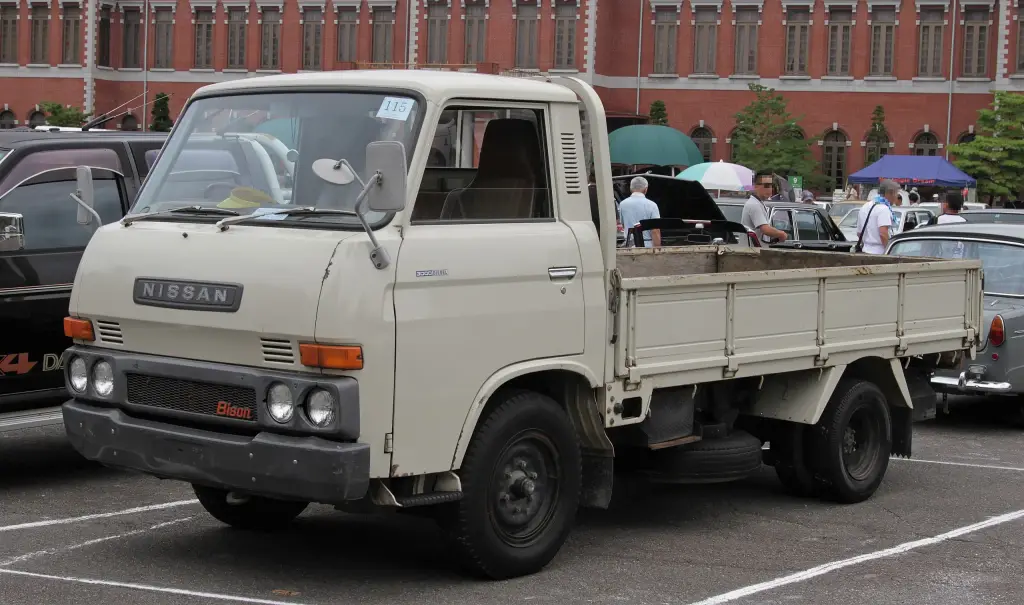
UD Trucks Corporation is a Japanese company that builds and sells diesel trucks, buses, bus chassis and special-purpose vehicles, based in Ageo, Saitama. Until 2010 the company was known as Nissan Diesel, and since 2021 it has been a wholly owned subsidiary of Isuzu. The UD name came from the Uniflow Diesel Engine and is now presented as meaning “Ultimate Dependability”.
Nissan Diesel / UD Trucks at a glance
| Headquarters | Ageo, Saitama, Japan |
|---|---|
| Former name | Nissan Diesel, until 2010 |
| Current owner | Isuzu, since 2021 |
| UD name origin | Uniflow Diesel Engine, 1955 |
| Founded | December 1935 as Nihon Diesel Industries |
| Founder | Kenzo Adachi |
| First engines | KD-series two-cycle diesels |
| 1940 | TT6 series trucks, 4.5 tons payload |
| 1942 | renamed Kanega-Fuchi Diesel |
| 1946 | renamed Minsei Industries |
based on one source: the English Wikipedia article on UD Trucks, formerly Nissan Diesel; the collected material covers the early history.
History of the Nissan Diesel / UD Trucks
Origins in diesel engines
In December 1935 Nihon Diesel Industries was set up in Kawaguchi, on the outskirts of Tokyo, under the leadership of Kenzo Adachi, who had bought diesel engine schematics from a Krupp-Junkers patent. The company began building KD-series two-cycle diesel engines after a partnership and technology exchange with Friedrich Krupp AG. In November 1939, to test the durability of the LD1 truck, the company drove one 3,000 km across Japan, through Hakone, Osaka, Kyoto, Gero, Ikaho, Niigata and Aizu on very primitive mountain roads, and it returned 13 days later without a single failure. That run made the trucks’ reliability known.
Trucks and buses
In 1940 production of the TT6 series trucks with a 4.5-ton payload began, and in 1942 the company became Kanega-Fuchi Diesel. It went on to develop the 7.5-ton TN93 series, the largest payload in the Japanese market, and the country’s first monocoque buses with rear-mounted engines, the BR3 series. In 1946 the name changed to Minsei Industries, and in 1949 work began on the 7.5-ton TN93 trucks.
The UD name
In 1950 Minsei Diesel Industries was spun off from Minsei Industries and set out to become a complete transport equipment maker. In 1955 the UD name was born when the company introduced a range of uniflow-scavenging two-cycle diesel engines: UD stood for Uniflow Diesel, after the engine it had invented for its trucks. Production began of trucks and buses with the 110 PS UD3, 150 PS UD4 and 230 PS UD6 engines. In 1957 development started on Japan’s first RFA series air-suspension buses and on the 10-ton 6TW10 trucks, called “Jumbo” in overseas markets. The company continued as Nissan Diesel until 2010, when it took the UD Trucks name, and became wholly owned by Isuzu in 2021.
Design and features
- Uniflow Diesel: the 1955 engine that gave the UD name.
- Built for reliability: a 3,000 km test in 1939 with no breakdowns.
- Trucks and buses: TT6 and TN93 trucks and the BR3 monocoque bus.
- Isuzu ownership: a wholly owned subsidiary since 2021.
Nissan Diesel / UD Trucks versions
- Nihon Diesel Industries (1935–1942): the founding company.
- Kanega-Fuchi Diesel (1942–1946): the wartime name.
- Minsei Diesel Industries (1950–): the company that launched UD engines.
- Nissan Diesel (to 2010): the name the trucks were sold under.
- UD Trucks (since 2010): the current name and owner.
UD trucks and the Nissan Atlas shared a market, and the Atlas itself was built by UD Trucks for Japan, while the Cabstar came from the same light-truck family. More cars are in the Nissan collection.
Sources
- UD Trucks, English Wikipedia: company history, UD engine, trucks, buses, ownership