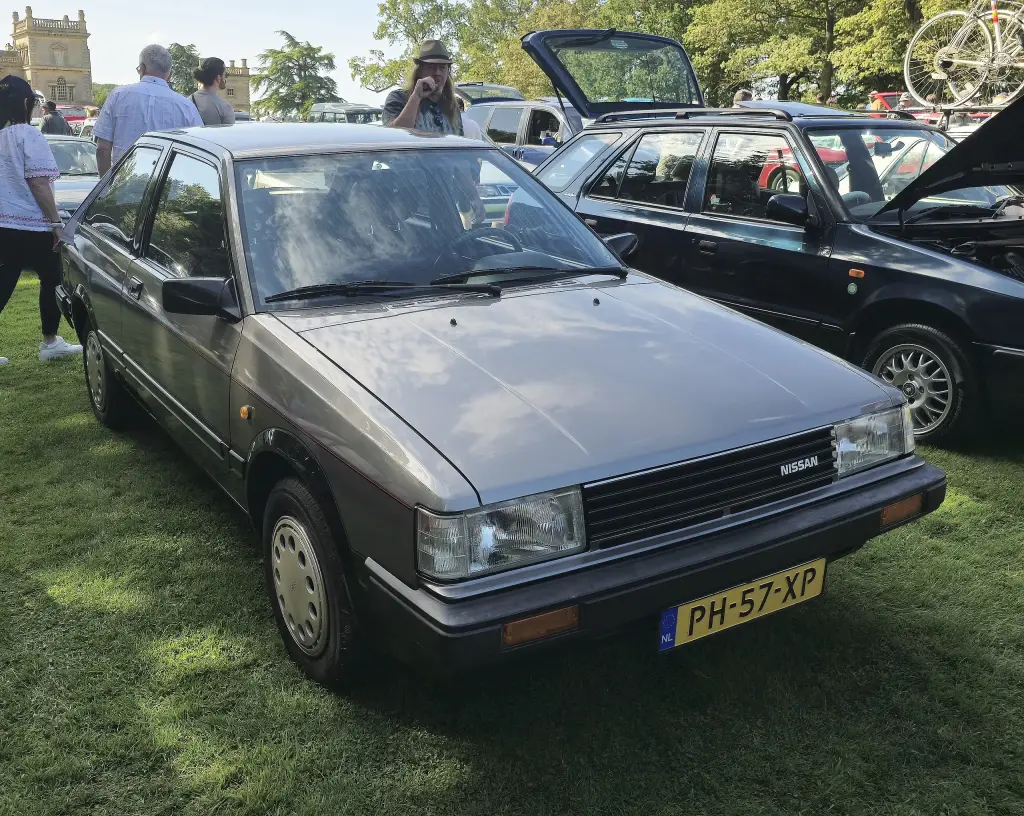
The Datsun Cherry, later the Nissan Cherry, was a series of subcompact cars and Nissan’s first front-wheel-drive supermini line. It was introduced in 1970, the year Nissan’s merger with Prince was complete, and its direct successor worldwide was the Nissan Pulsar. In Japan the car was sold through the Nissan Cherry store network.
Nissan Cherry at a glance
| Also called | Datsun Cherry; Datsun 100A and 120A in Europe |
|---|---|
| Production | from October 1970 |
| Layout | front engine, front-wheel drive |
| Generations | E10, then F10 |
| Engines | 988 cc A10, 1,171 cc A12 |
| Sports version | Cherry X-1 with twin-carburettor A12T |
| Suspension | four-wheel independent |
| Successor | Nissan Pulsar |
based on one source: the English Wikipedia article on the Nissan Cherry.
History of the Nissan Cherry
Prince’s plan, Nissan’s car
Before merging with Nissan, the Prince Motor Company had planned a front-engine, front-wheel-drive car for mass production. After the 1966 merger the idea became the Cherry, released in 1970 as Nissan’s first front-wheel-drive car. Its powertrain descended from Prince’s concept, which was inspired by the transmission-in-sump layout of the Mini but kept the gearbox in a separate housing so that it did not share oil with the engine. The transfer gears gave the E10 its characteristic transmission whine.
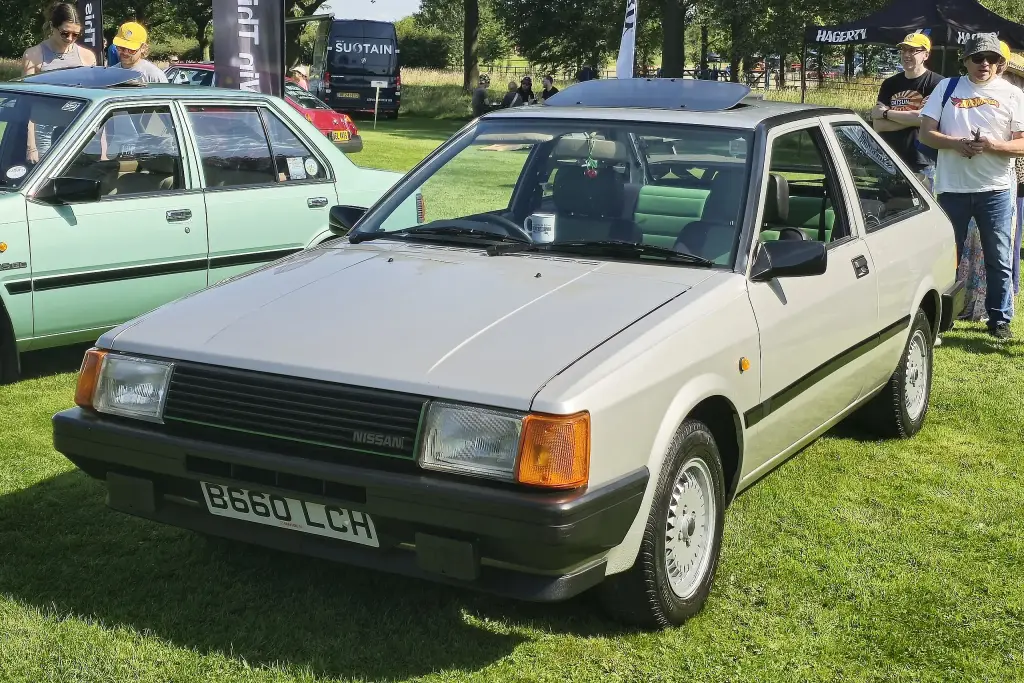
E10 (1970)
The E10 had four-wheel independent suspension and used two versions of Nissan’s A-series overhead-valve four: the 988 cc A10 and the 1,171 cc A12. The sporting Japanese-market Cherry X-1 had a twin-carburettor A12T with dual-sidedraught Hitachi carburettors. In Europe the A10-engined car was the Datsun 100A and the A12 the Datsun 120A, the latter only as a coupé or as a semi-automatic from 1978. The Cherry was sold at the newly established Nissan Cherry Shop in Japan, while the Sunny went to Nissan Satio Shop and the Bluebird to Nissan Bluebird Shop.
Sales success
The Cherry arrived in Britain just before Datsun’s sales surge, which went from just over 6,000 cars in 1971 to more than 30,000 the following year. Although a successor was launched in 1974, the original was so popular in the UK that it stayed on sale there until 1976. As the Cherry F-II flagged, the smaller E10 continued in many markets until 1977. In a 1973 Motor magazine poll, 76 percent of E10 owners said they would buy the same model again, the highest score the survey had recorded and ahead of the 66 percent given by Volkswagen Beetle owners.
Design and features
- First front-wheel drive: Nissan’s first such car, from 1970.
- Separate gearbox: a Prince layout with its own oil supply.
- Four-wheel independent suspension: unusual for a small car of the period.
- Cherry X-1: the twin-carburettor sporting version.
Nissan Cherry versions
- Cherry E10 (1970–1977): saloon, coupé from 1971 and van from 1972.
- Cherry X-1: twin-carburettor A12T for Japan.
- Datsun 100A: European name for the A10-engined car.
- Datsun 120A: A12 engine, coupé or semi-automatic.
- Cherry F10: the second generation from 1974.
The Cherry was replaced by the Pulsar, and its role as Nissan’s small car later passed to the Micra. More cars are in the Nissan collection.
Video: 1985 Nissan Cherry Turbo Up Close
Video by YouTube on YouTube.
Sources
- Nissan Cherry, English Wikipedia: origin, E10 engineering, export names, UK sales