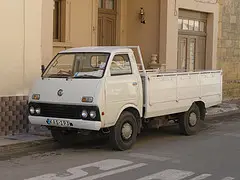
The Prince Homer was a small commercial vehicle made by the Prince Motor Company, sold as a van called the Homy, as a double cab or as a regular cab truck. It was sold at Nissan Prince Store dealerships after Prince merged with Nissan in 1966, and the name was dropped in 1982 when the line was absorbed into the Nissan Atlas.
Prince Homer at a glance
| First model | T64, sold as the Prince Homer or PMC T64 |
|---|---|
| Nissan version | T640, from 1966 |
| Van version | called the Homy |
| T641 | from 1968, cat-whiskers grille, Datsun Homer in Europe and Australia |
| Heavier version | T642, 1.25 tons, no van body |
| T20 | from 1972, J15 and J16 engines |
| F20 / PF20 | from 1976, 1,982 cc H20 engine |
| F21 | from 1979, meeting 1979 emissions rules |
| Ended | February 1982 |
| Successor line | Nissan Atlas F22 |
based on one source: the English Wikipedia article on the Prince Homer; no free photographs of the Homer were found.
History of the Prince Homer
T64 and T640
The first model was the T64, sold as the Prince Homer or PMC T64. The T640 was introduced in 1966 and sold as a Nissan with no changes apart from badging, because Prince had merged with Nissan; it shared its body with the Nissan Cabstar sold at Nissan Bluebird Store, and production ended in 1968. The Homer T640 was first fitted with the 1,484 cc OHV G1 engine from the Prince Skyline 1500, and in 1967, after the merger, it received a single-carburettor version of the 1,595 cc R16 four from the Datsun Fairlady.
T641 and T20
The T641 arrived in 1968 with the slotted grille replaced by a “cat-whiskers” design. It was rebadged as the Nissan Homer for Japan and sold in Europe and Australia as the Datsun Homer; a van version carried the code V641, and a 1.25-ton model called the T642 was built without a van body. The Homer was also sold in Taiwan by Yue Loong, first as the Yue Loong YLN-251. The T20 replaced the T641 in 1972 with the same grille but taller front indicators, and was powered by the 1,483 cc J15 or 1,567 cc J16 engine. T20 production ended in 1976.
F20 and the end
The final Homer, the F20, was built from 1976 to 1982 with all-new bodywork and the 1,982 cc H20 engine. In September 1979 the F21 was introduced, able to pass the 1979 emissions standards and lightly facelifted, and it was built from 1980 to 1982. The F20 was also sold in Japan as the Nissan Cabstar, and as the Datsun Cabstar abroad. Production ended in February 1982, when the Homer line was absorbed into Nissan’s new F22 Atlas. The name lived on in Taiwan, where Yue Loong used it on the F22 Atlas and on the Caravan E23 minibus, sold as the Homer 747.
Design and features
- Three bodies: van, double cab and regular cab truck.
- Homy van: the passenger van version carried its own name.
- Prince then Nissan: sold by both companies without mechanical changes.
- Cabstar link: the same vehicle was sold as the Nissan Cabstar.
Prince Homer versions
- Prince Homer T64: the original.
- Nissan Homer T640 (1966–1968): the rebadged version.
- Homer T641 and T642 (1968–1972): the cat-whiskers grille and the 1.25-tonner.
- Homer T20 (1972–1976): the J15 and J16 engines.
- Homer F20 and F21 (1976–1982): the final generation.
The Homer was sold alongside the Cabstar and was replaced by the Atlas, while its van version, the Homy, became part of the Caravan story. More cars are in the Nissan collection.
Video: Homer’s Auto Glass Nissan Titan
Video by YouTube on YouTube.
Sources
- Prince Homer, English Wikipedia: models, engines, van version, Cabstar link, end of the name