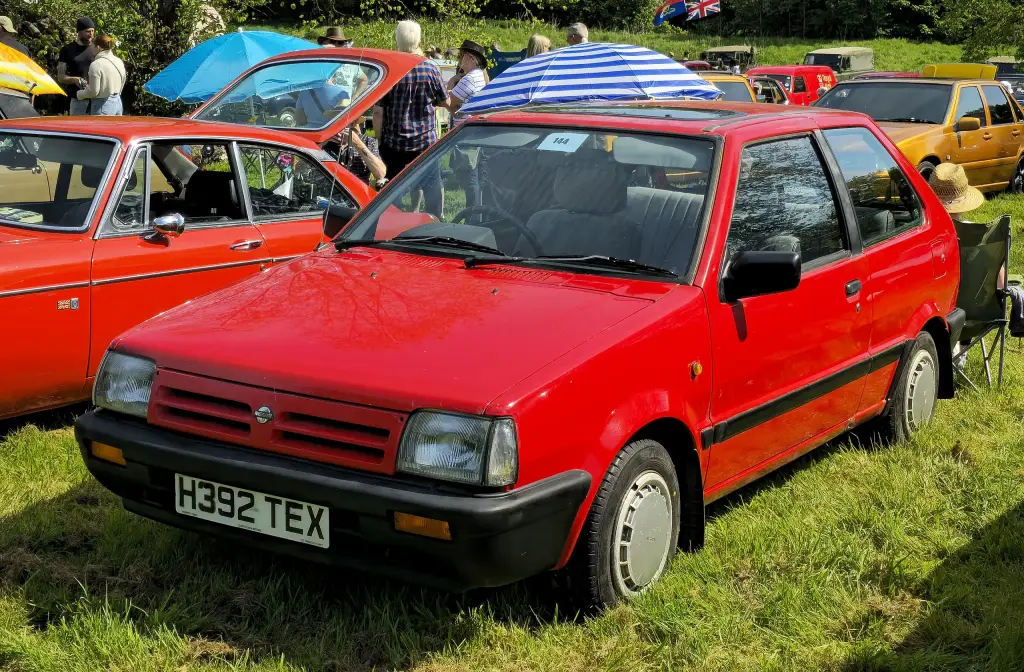
The Nissan Micra, also known as the Nissan March in Japan and in many markets across Asia and Latin America, is a supermini built since 1982. It partly replaced the Nissan Cherry and was sold in Japan through the Nissan Cherry Store network. Until Nissan began selling kei cars, the March was its smallest car at home.
Nissan Micra at a glance
| Production | since October 1982 |
|---|---|
| Also called | Nissan March, and Datsun-Nissan Micra in some markets |
| First generation | K10 |
| Replaced | Nissan Cherry (partly) |
| First engine | all-aluminium MA10S 1.0-litre four |
| Power | 50 PS and 55 PS in Europe |
| Weight | 630 kg in early European trim |
| Gearboxes | four or five-speed manual; three-speed Nissanmatic automatic |
| European launch | June 1983 |
| Japanese dealers | Nissan Cherry Store, later Nissan Red Stage |
based on one source: the English Wikipedia article on the Nissan Micra; the collected material concentrates on the first generation.
History of the Nissan Micra
K10 (1982)
The original March was introduced in Japan in October 1982 to challenge the Honda City, Daihatsu Charade, Suzuki Cultus and Toyota Starlet, and to replace the Cherry, which had grown with each generation. In Japan it was sold only at Nissan Cherry Store dealers and benefited from work by the former Prince engineers Nissan had acquired in 1966. The body was originally designed for Fiat as a replacement for the 127, but Fiat chose the Giugiaro-styled Uno instead.
Engineering
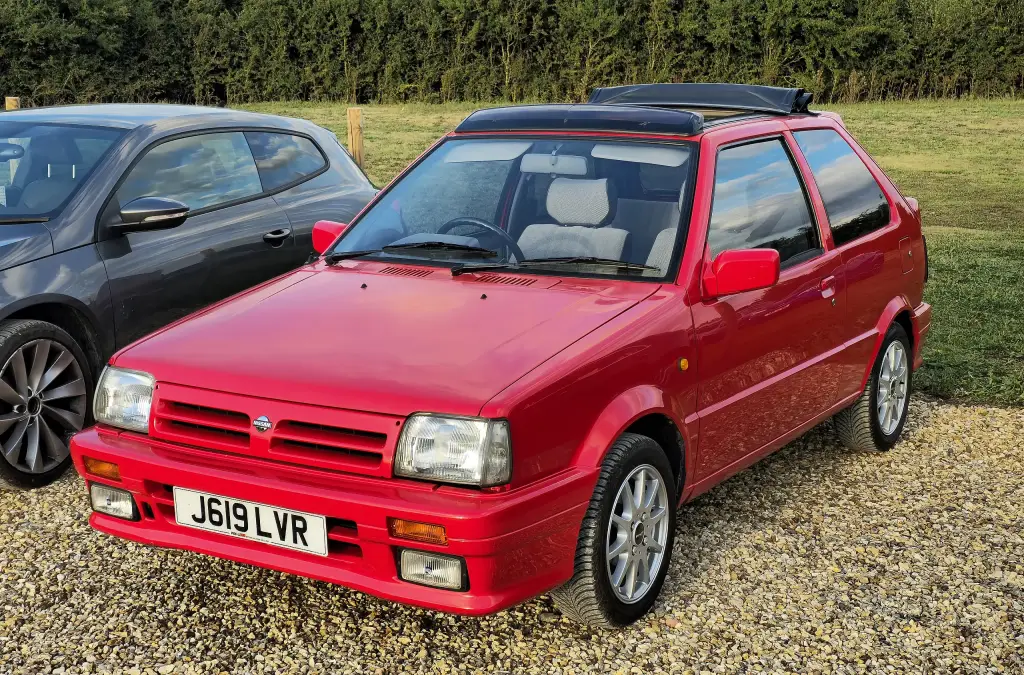
The car was sold as the Micra in Europe with very low fuel consumption, helped by an engine used only in the March and Micra, unusually high gearing and a weight of 630 kg in early European trim. That weight target meant minimal insulation, so early Micras were loud. Japanese buyers gained from an engine below 1,000 cc at road-tax time. The all-aluminium MA10S SOHC engine gave 37 kW or 40 kW in the high-compression version with the five-speed option, and a four- or five-speed automatic called Nissanmatic was offered, both unusual in a supermini.
Europe and the Pike cars
The Micra reached Europe in June 1983 and Canada in 1984 for 1985, replacing the Pulsar hatchbacks there. Because it arrived while Nissan was phasing out the Datsun name, a small Datsun badge appeared on the tailgate for the first two years, and in some European markets the car was the Datsun-Nissan Micra. It sold well in Britain, peaking at over 50,000 in 1989. The K10 chassis also produced the Be-1, Pao and Figaro specials of the 1980s. In 1995 the Micra topped the small-car class in an ADAC reliability survey of four- to six-year-old cars.
Design and features
- Low weight: 630 kg in early European trim.
- MA10S engine: an all-aluminium 1.0-litre four used only in this car.
- Pike car base: the K10 underpinned the Be-1, Pao and Figaro.
- Reliability: best in its class in the 1995 ADAC survey.
Nissan Micra versions
- Micra K10 (1982–1992): the original supermini.
- Micra Turbo (Japan, 1985): the MA10ET turbo, never sold in Europe.
- Datsun-Nissan Micra: early cars with the Datsun badge.
- Nissan March: the Japanese name, used in many Asian markets.
The Micra replaced the Cherry and its platform produced the Pao and Figaro. More cars are in the Nissan collection.
Video: 2013 Nissan Micra 1.2 DIG-S Tekna – Fahrbericht der Probefahrt
Video by YouTube on YouTube.
Sources
- Nissan Micra, English Wikipedia: K10 launch, engineering, European sales, Pike cars, reliability