The Nissan Pulsar was a line of cars produced from 1978 until 2000, when it was replaced in Japan by the Bluebird Sylphy. The name was used again from 2013 on cars based on the Sylphy and Tiida, and in 2014 on a European-only replacement for the Tiida. The original Pulsar was a hatchback sold only at Nissan Cherry Store in Japan, replacing the Cherry.
Nissan Pulsar at a glance
| Production | 1978–2000; again from 2013 |
|---|---|
| First model | N10, from May 1978 |
| Japanese dealers | Nissan Cherry Store |
| Position | below the Nissan Violet and Sunny |
| Bodies | three- and five-door hatchback, sedan, coupé, van and wagon |
| Export names | Datsun Cherry, Datsun 100A to 150A, Datsun 310, Datsun Pulsar |
| Four-wheel drive | optional on some models from 1986 |
| Derivatives | Nissan Langley and N10 EXA coupé |
| Name origin | a pulsating star, a rotating neutron star |
based on one source: the English Wikipedia article on the Nissan Pulsar; the collected material concentrates on the first generation.
History of the Nissan Pulsar
N10 (1978)
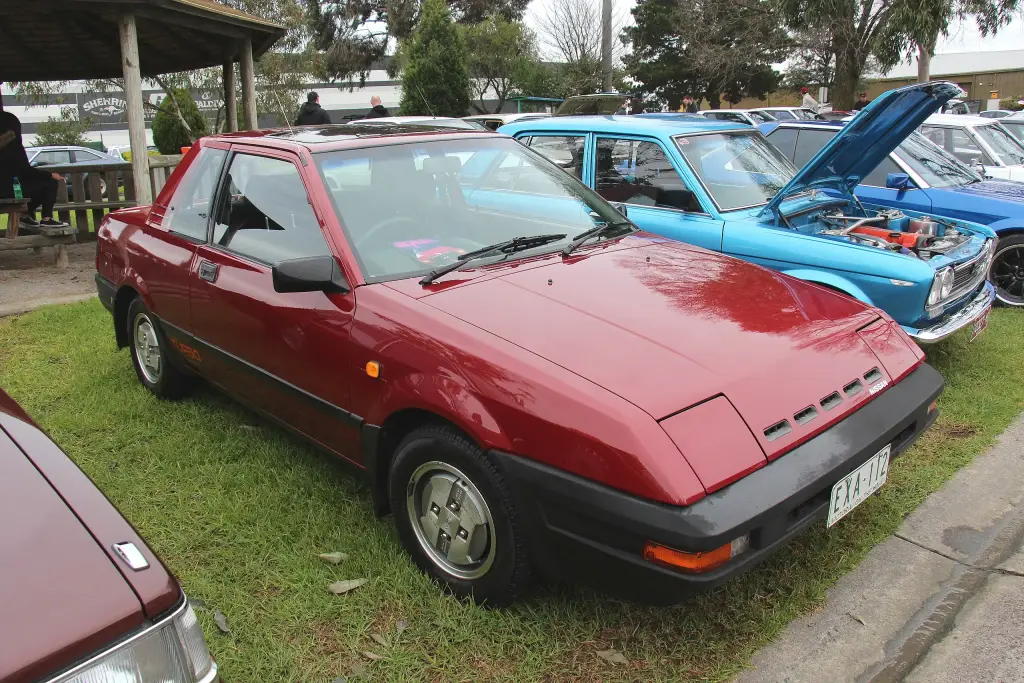
The N10 Pulsar arrived in May 1978 and replaced the Cherry F-II, benefiting from the engineering work of Prince, which had developed the original Cherry before merging with Nissan in 1966. It kept the Cherry’s rack-and-pinion steering and independent suspension, with coilover struts in front and coil-sprung trailing arms at the rear. It was a subcompact to complement the Sunny sedan, sold through a different dealer network: Nissan Satio Shop for the Sunny and Nissan Cherry Shop for the Pulsar. An unusual long nose came from Nissan’s plan to build a longitudinal rear-wheel-drive version for developing markets, though only front-wheel-drive cars were actually made. At launch there was only a four-door fastback sedan with a 1.2 or 1.4-litre engine; three-door and coupé hatchbacks followed in September 1978 as did a fuel-injected 1.4.
Names around the world
It retained the Cherry name in Europe and many export markets, sold as the Cherry Europe in Belgium and as the Datsun Cherry or Datsun 100A to 150A across Europe and Asia, the Datsun 310 in the United States and Canada and the Datsun Pulsar in Australia, New Zealand, South Africa and Malaysia. In Greece it was the first passenger car assembled at Nissan’s new plant, where local partner TEOKAR built it with 1.0 and 1.2-litre engines from 1980. Late South African Pulsars used the square Skyline-style headlights and tail lights from the Langley.
Langley and later generations
Another derivative, the Nissan Langley, arrived in Japan in 1980 as a “mini Skyline” exclusive to Nissan Prince Shop, with independent suspension at all four wheels, MacPherson struts at the front and trailing-arm coils at the rear. The N10 Pulsar came as three- and five-door hatchbacks, a short-lived four-door fastback, a five-door van or wagon and a three-door coupé with a wrap-around rear window. Between 2000 and 2005 the name was used in Australia and New Zealand on rebadged Sylphys before the Tiida replaced it, and in 2013 it returned on cars based on the Sylphy B17 and Tiida C12.
Design and features
- Long nose: designed for a rear-drive version that was never built.
- Many names: Cherry, Datsun 100A to 150A, Datsun 310 and others.
- Langley derivative: the Japanese mini Skyline version from 1980.
- Dealer split: sold at Nissan Cherry Shop next to the Sunny at Satio.
Nissan Pulsar versions
- Pulsar N10 (1978–): the original hatchback and sedan range.
- Pulsar EXA coupé: the three-door fastback with a wrap-around window.
- Nissan Langley (1980–): the Prince Store derivative.
- Datsun Pulsar: the export name in Australia and southern Africa.
- Pulsar from 2013: Sylphy and Tiida-based cars for Australia and Europe.
The Pulsar replaced the Cherry and was sold in Europe under that name, its sibling being the Sunny and its later versions related to the Sylphy. More cars are in the Nissan collection.
Video: Nissan Pulsar review – Auto Express
Video by YouTube on YouTube.
Sources
- Nissan Pulsar, English Wikipedia: N10 design, names and markets, Langley, later use of the name