The Nissan Violet is a compact car first released in Japan in 1973 and produced until 1992. It was initially sold only at Nissan Cherry Store dealers as a larger companion to the Nissan Cherry. In 1977 the second generation was split into two further lines, the Nissan Auster and the Nissan Stanza, and all three shared the A10 series identifier.
Nissan Violet at a glance
| Production | 1973–1992 |
|---|---|
| First series | 710 |
| Bodies | two-door saloon, two-door coupé, four-door fastback, four-door saloon, estate and van |
| Export names | Datsun 140J and 160J; Datsun 710 in the US |
| Most powerful Japanese version | 1600 SSS-E, 110 PS |
| Export 160J SSS | 95 PS with twin carburettors |
| Second generation | from 1977, split into Auster and Stanza |
| Third generation | T11, front-wheel drive from 1981 |
| Ended | 1992 |
based on one source: the English Wikipedia article on the Nissan Violet; no free photographs of the Violet were found.
History of the Nissan Violet
710 series (1973–1977)
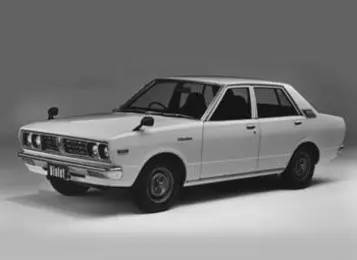
Introduced in January 1973, the Violet was a smaller version of the Datsun Bluebird 610, sold outside Japan as the Datsun 140J or 160J and in the United States simply as the Datsun 710. It was built as a two-door saloon, a two-door coupé, a four-door fastback and later a regular four-door saloon, an estate and a van. The Violet let Nissan increase the size of the existing Bluebird a little. The sporty SSS had independent rear suspension while other versions used a leaf-sprung rear axle. North American 710s had large separate bumpers instead of the curved, fitted pieces used elsewhere, to meet 1973 US bumper rules, and early export cars carried small chrome plates hiding the holes left by Japanese-market fender mirrors. The most powerful Japanese version was the fuel-injected 1600 SSS-E of 110 PS; the export twin-carburettor 160J SSS claimed 95 PS. A 1,800 cc engine arrived in October 1975 for LPG taxi use only.
The 711 facelift
The original four-door body was swoopy, with a fastback line, and was one of the first Nissans to use “coke bottle styling”. The appearance was controversial and drew complaints not only about the looks but also about limited rear vision and a dark rear cabin, especially for children. Taxi companies refused to buy any more Violets, so from February 1976 Nissan replaced the whole rear end, including the roof panel and doors, with more traditional notchback bodywork, gaining space and comfort and reducing blind spots. That version took the 711 chassis code, while coupés and vans and wagons kept the old body. The two-door saloon was dropped.
Auster, Stanza and the end
The 1977 second generation was split into the Violet, the Nissan Auster and the Nissan Stanza, all A10 series and built at Hiratsuka and Yokosuka. The Stanza went to Nissan Satio Store as a larger companion to the Sunny, and the Auster to Nissan Prince Store next to the Langley. A new front-wheel-drive third generation arrived in 1981 with the T11 code, sharing its platform with the Prairie, Multi and Stanza Wagon. Export markets first knew the car as the Datsun 140J or 160J, then as the Stanza as the Datsun name was phased out in the early 1980s, briefly as the “Datsun-Nissan Stanza” in Europe until 1984. The line ended in 1992, the Stanza being replaced by the Altima in North America, the Bluebird in Japan and the Primera in Europe.
Design and features
- Coke bottle styling: an early Nissan use of the 1970s look.
- Notchback facelift: the whole rear end was replaced in 1976.
- SSS versions: independent rear suspension and more power.
- Three names: Violet, Auster and Stanza shared one base.
Nissan Violet versions
- Violet 710 (1973–1977): the original fastback saloon range.
- Violet 711 (1976–): the notchback facelift.
- Datsun 140J and 160J: the export names.
- Nissan Auster and Stanza (1977–): the A10 split.
- Violet T11 (1981–): the front-wheel-drive generation.
The Violet’s second generation became the Auster and Stanza line that later fed the Altima and Primera, and its platform was shared with the Prairie. More cars are in the Nissan collection.
Video: Rare Gem: A 1973 Nissan Violet Hardtop 1600 SSS KP710
Video by YouTube on YouTube.
Sources
- Nissan Violet, English Wikipedia: 710 series, engines, styling complaints, 711 facelift, Auster and Stanza