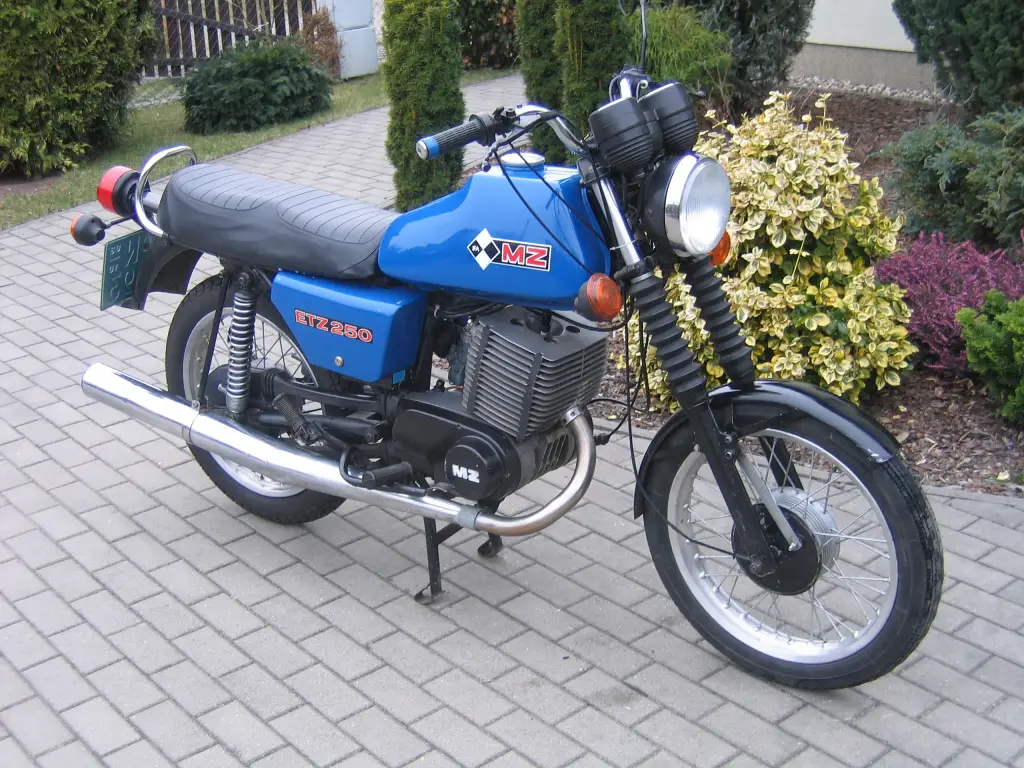
The MZ ETZ 250 was the big member of the ETZ family, built at Zschopau from 1981 to 1991 together with the ETZ 251 and ETZ 301. It carried the stiff box-profile frame first used on the TS 250, 12-volt electrics and, from 1984, a front disc brake as standard.
MZ ETZ 250 at a glance
| Maker | VEB Motorradwerk Zschopau, from 1990 Motorradwerk Zschopau GmbH |
|---|---|
| Production | 1981–1991 |
| Name | ETZ = Einheits-Typ Zschopau |
| Engine | EM 250 two-stroke single, developed from the MM 250/4 |
| Gearbox | five speeds |
| Frame | box-profile bridge frame in welded sheet steel |
| Wheels | 18 inches front and rear |
| Fuel tank | 17 litres |
| Electrics | 12 V, 180 W three-phase alternator |
| Front brake | disc as standard from 1984; Brembo until 1983 |
| Design | Dietmar Palloks |
| Colours at launch | billiard green, olympia blue, flame red |
Based on one source: the German Wikipedia article on the ETZ 250, 251 and 301.
History of the MZ ETZ 250
The ETZ 250, ETZ 251 and ETZ 301 were made between 1981 and 1991, the works being renamed Motorradwerk Zschopau GmbH on 1 September 1990. The range was joined in 1985 by the ETZ 125 and ETZ 150, and the successor company MuZ carried the big model on from 1992 with little change, selling it as the Saxon Tour and Saxon Fun.
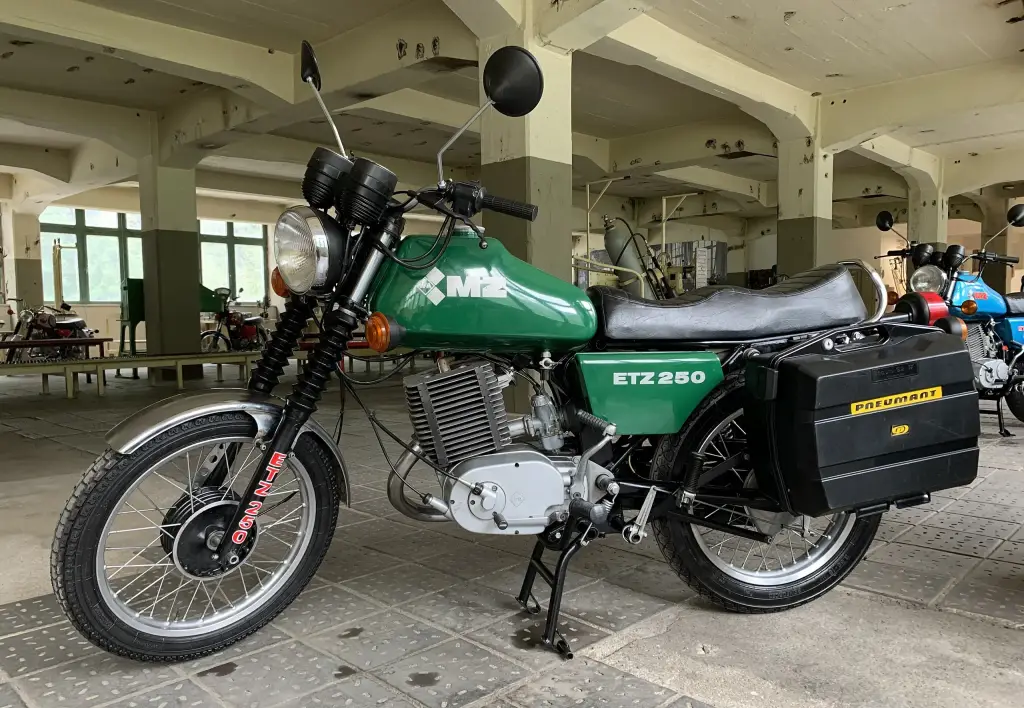
The frame followed the bridge-frame principle already used on the TS 250. Deep-drawn sheet steel parts were welded into a box section in a largely mechanised and automated process, which made the chassis stiffer than the previous model’s; the rear section was made of tube. Both wheels were 18 inches, and for comfort the ETZ left the factory only with high handlebars.
The engine was a development of the MM 250/4 of the TS 250, renamed EM 250, with a five-speed gearbox. The crankshaft was carried over almost unchanged, with only a larger connecting-rod bearing, and so were the silentblock mounting, clutch, gearbox and rev-counter drive. The engine cases were redesigned, a BVF 30 N 2–5 carburettor fed the engine, and for the first time a series MZ engine used four-channel scavenging, which raised power slightly and cut fuel consumption. Nine cooling fins instead of seven and a larger fin area gave 40 per cent more cooling surface, and “damping combs” on both sides reduced the noise radiated by the cylinder.
The styling was done with the industrial designer Dietmar Palloks. At the start of production the two side panels and the 17-litre tank came in billiard green, olympia blue or flame red, with graphics applied by screen printing. MZ offered a standard and a de Luxe version, the latter with a rev counter, a second mirror on the right, rubber gaiters for the fork and painted engine covers. A front disc brake had been reserved for export markets, using Brembo components until 1983 and an in-house design afterwards, but from 1984 it became standard equipment in the GDR as well, and drum-braked machines could be converted. Separate lubrication, with a 1.3-litre oil tank under the left side panel, was built for export only.
Design and features
- Box-profile bridge frame: welded sheet steel in a largely automated process, stiffer than the frame of the TS 250.
- EM 250 engine: developed from the MM 250/4, five speeds, four-channel scavenging and improved cooling.
- 12-volt electrics: a three-phase alternator of 180 W, the first in series MZ production, with reserve for accessories.
- Better brakes: a front disc brake as standard from 1984, with a conversion available for earlier drum-braked bikes.
MZ ETZ 250 versions
- ETZ 250: the base model of 1981.
- ETZ 251 and ETZ 301: the further designations of the same big ETZ family.
- Standard and de Luxe: the de Luxe with rev counter, second mirror, fork gaiters and painted covers.
- Export versions: with separate lubrication and, at first, the front disc brake.
- Saxon Tour and Saxon Fun: the MuZ continuation from 1992, differing only in add-on parts.
This is the big member of the MZ ETZ range; the smaller ETZ 125 and 150 came in 1985. The earlier MZ TS range supplied its engine and frame principle. More are in the MZ collection.
Video: MZ 250
Video on YouTube.
Sources
- MZ ETZ 250/251/301, German Wikipedia: frame, engine, equipment, production