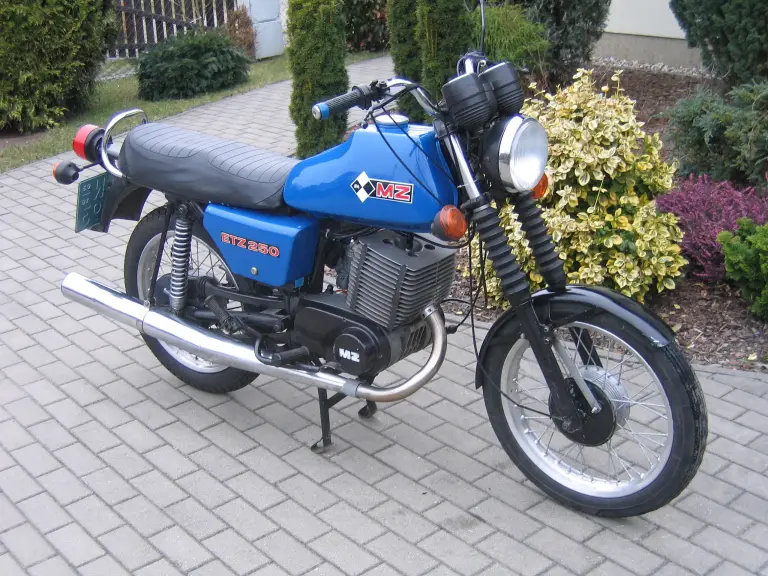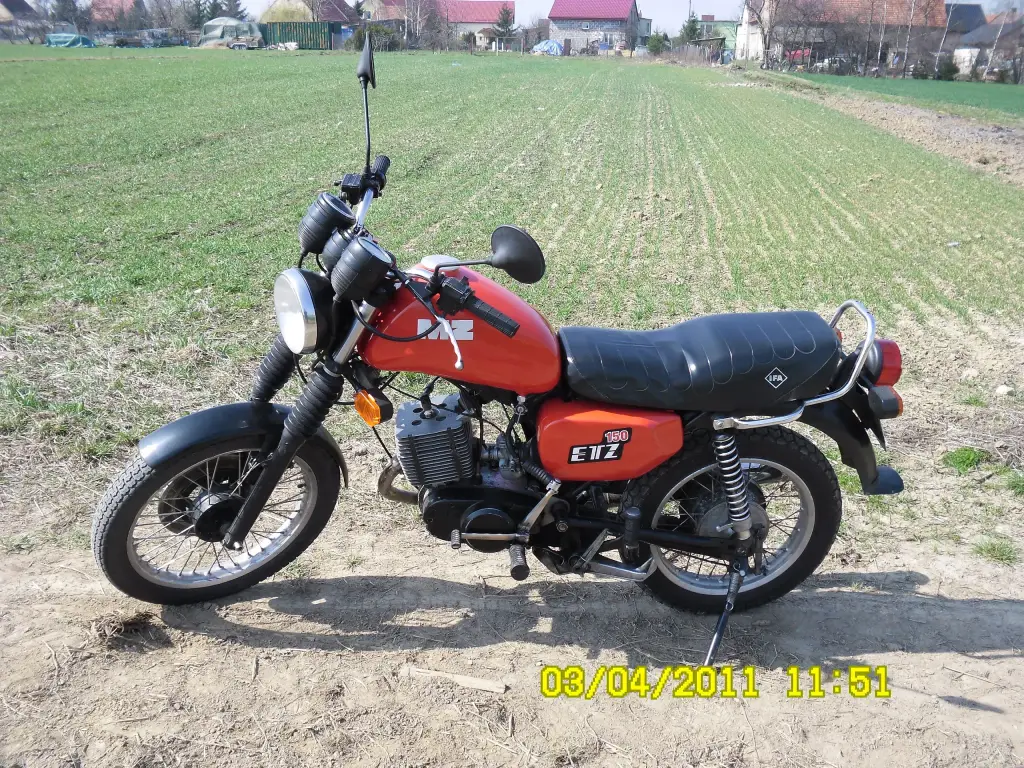
The MZ ETZ 125 and ETZ 150 were made at Zschopau from 1985 to 1991. They supplemented the ETZ 250 of 1981 and replaced the TS 125 and TS 150, using an optimised version of the bigger model’s box-profile frame.
MZ ETZ 125/150 at a glance
| Maker | VEB Motorradwerk Zschopau, from 1990 Motorradwerk Zschopau GmbH |
|---|---|
| Production | 1985–1991 |
| Premiere | Leipzig Autumn Fair, 1984 |
| Series start | 25 September 1985 |
| Engines | EM 125 and EM 150 two-stroke singles |
| Bore and stroke | 56 mm x 58 mm |
| Gearbox | five speeds |
| Frame | box-profile bridge frame, up to 100% stiffer than the TS frame |
| Wheels | 18 inches front, 16 inches rear |
| Electrics | 12 V, 180 W alternator |
| Front brake | own single-disc design as standard |
| Design | Karl Clauss Dietel and Lutz Rudolph |
Based on one source: the German Wikipedia article on the ETZ 125 and 150.
History of the MZ ETZ 125/150
The ETZ 125 and ETZ 150 were shown to the public for the first time at the Leipzig Autumn Fair in 1984, and series production began on 25 September 1985. They filled in below the ETZ 250 and took over from the TS 125 and TS 150.
The chassis used the box-profile bridge frame of the ETZ 250, developed further and made lighter by optimising wall thickness, which also let MZ use existing tooling. With an 18-inch front wheel and a 16-inch rear, the wheelbase came out 90 mm shorter than the 250’s and the machine 200 mm shorter overall. The factory quoted a torsional stiffness up to 100 per cent higher than the frame of the TS 125/150, which was built from pressed and folded half-shells. The complete front end, with fork, handlebars, controls and instrument holder, was taken over from the ETZ 250.
The engines were new designs called EM 125 and EM 150, carrying over proven elements of the TS’s MM 125/150/2. Bore and stroke stayed at 56 by 58 mm, but the 150 also came in a special version with 10.5 kW thanks to changed timing and larger transfer ports. Both got the silentblock mounting at the cylinder head, a new clutch, a five-speed gearbox with shift drum and forks, and lighter, more free-revving internals. The cylinder grew to nearly rectangular with eleven cooling fins instead of nine, and the exhaust was a new design using interference silencing, bent up by 9° behind the diffuser for ground clearance.
The tank, side panels and seat were developed with the designers Karl Clauss Dietel and Lutz Rudolph, with the brief “formal elegance with powerful expression for the classic concept of a motorcycle”. The brand letters were stamped metal characters set into recesses pressed into both sides of the tank. A front disc brake of MZ’s own design was standard, with a cheaper drum available on request, and electronic ignition became standard on all variants from 1986. A more powerful 143 cc version was at first reserved for the de Luxe model and export but was later available in the GDR too; as on the bigger ETZ, separate lubrication was built for export only.
Design and features
- Stiff box-profile frame: derived from the ETZ 250 and up to twice as stiff as the frame of the TS 125/150.
- New EM engines: five-speed gearbox, silentblock mounting, eleven cooling fins and an exhaust with interference silencing.
- 12-volt electrics: the 180 W three-phase alternator of the ETZ 250, with a 170 mm headlamp.
- Modern styling: tank, panels and seat by Karl Clauss Dietel and Lutz Rudolph, with metal brand letters set into the tank.
MZ ETZ 125/150 versions
- ETZ 125: the 123 cc model with a BVF 22 N 2 carburettor.
- ETZ 150: the 143 cc model with a 24 N 2 carburettor.
- ETZ 150 de Luxe / export: the 10.5 kW engine with changed timing and larger transfer ports.
- Disc and drum brake versions: the disc was standard, the drum a cheaper option.
- Saxon Roadstar 125 and Sportstar 125: the MuZ continuation from 1993, differing only in add-on parts.
The 125 and 150 were the small members of the MZ ETZ range, below the ETZ 250, and they replaced the MZ TS models. More are in the MZ collection.
Sources
- MZ ETZ 125/150, German Wikipedia: production, chassis, engines, equipment