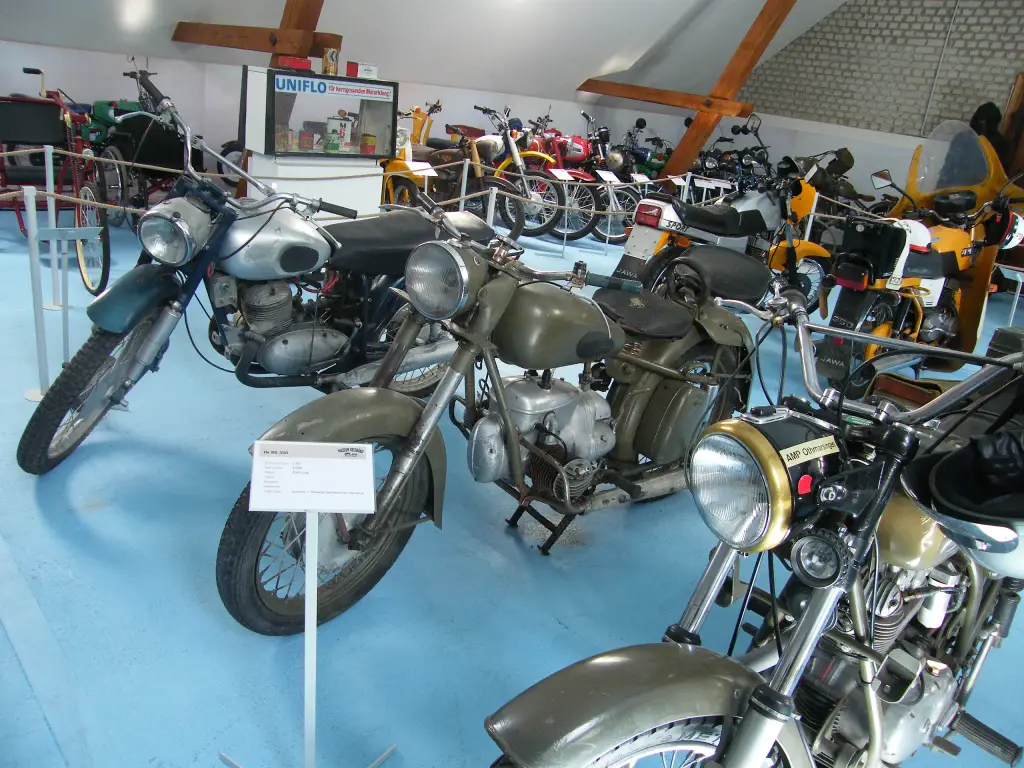
The MZ BK 350 was the first completely new design from the former DKW works after the war. Its name stands for Boxer and Kardan, and from 1952 to 1959 the Zschopau factory built 41,163 of these 343 cc two-stroke twins, 6,036 of them for export.
MZ BK 350 at a glance
| Maker | IFA-Motorradwerk Zschopau, from 1953 VEB Motorradwerk Zschopau |
|---|---|
| Production | 1952–1959, 41,163 built (6,036 exported) |
| Name | BK = Boxer, Kardan |
| Engine | air-cooled two-stroke boxer twin, 343.4 cc |
| Power | 15 hp, 17 hp from 1957 |
| Gearbox | four speeds, claw-shifted |
| Final drive | cardan shaft with universal joints |
| Frame | welded double-cradle steel frame, sidecar mounts |
| Suspension | telescopic fork, 148 mm travel; plunger rear, 50 mm |
| Brakes | two 200 mm drum brakes |
| Electrics | 6 V, 60 W generator |
| Sidecar | Stoye, Leipzig, fitted at three points |
History of the MZ BK 350
Functional prototypes of the later BK 350 were built and tested at Bark from 1946 on the basis of DKW designs, and the machine was shown as a DKW twin at the Leipzig Spring Fair in 1951. Series production was delayed until the end of 1952. At the start the motorcycle carried the name of IFA, the state vehicle-building association of the GDR, and only from 1956 was it sold as an MZ.
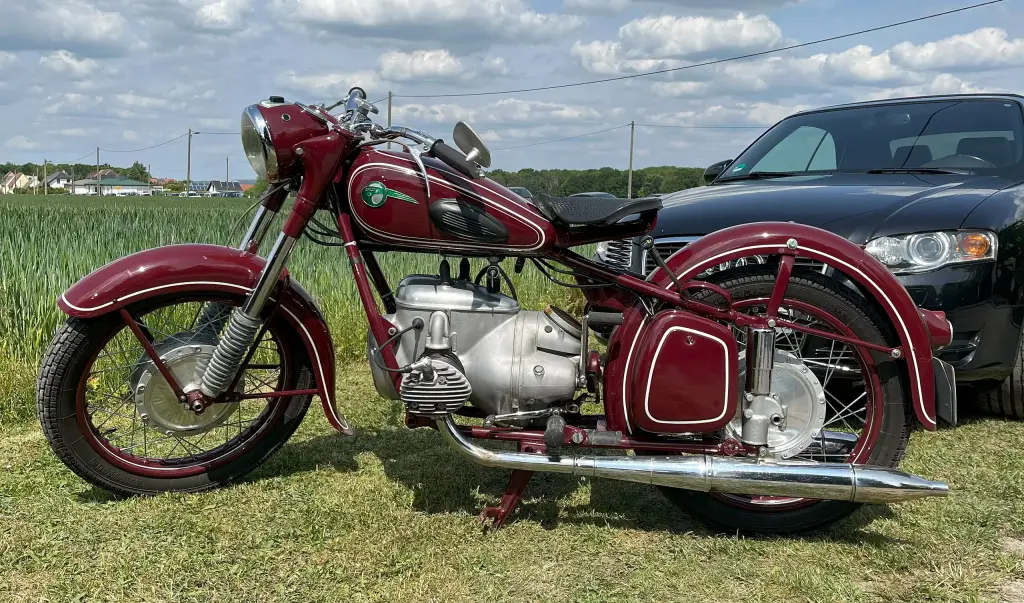
The unusual layout had practical roots. MZ explained that the displacement was split between two cylinders because three-port scavenging caused high losses above 250 cc, and that a cardan shaft was chosen because drive chains were hard to obtain at the time. The result was a boxer engine with a longitudinally mounted crankshaft; the idea came from wartime DKW work on a short-stroke boxer as an aircraft starter unit. The four-speed gearbox sits in a housing flanged to the back of the engine, and a rubber coupling in a sheet-metal case takes up changes in shaft length as the rear suspension moves.
The chassis was built for hard work. The welded double-cradle frame has mounting points for a sidecar on either side and is reinforced at the steering head with triangular gusset plates; the factory sidecar came from Stoye in Leipzig. The BK 350 also went off-road: a three-man club team rode it in the 28th International Six Days Trial at Gottwaldov in Czechoslovakia in 1953, with knobbly tyres and guards for the headlamp and cylinders.
In 1957 the output was raised from 15 to 17 hp (13 kW), because the ES 250 sold alongside it had just been lifted to 14.25 hp and the gap between the two models had become too small; better intake and exhaust silencing made the BK quieter at the same time. A full-swingarm chassis called BK 351 was finished in 1958 and a few prototypes were built, but MZ decided to concentrate on the simpler ES models. Production of the BK 350 ended in 1959. The West German magazine Das Motorrad tested an IFA BK 350 in 1955 and judged the engine good though weaker than comparable West German designs, noting vibration at idle.
Design and features
- Two-stroke boxer: 343.4 cc with a longitudinally mounted crankshaft, 15 hp and 17 hp from 1957, four-speed claw gearbox.
- Cardan drive: a shaft with a rubber coupling and universal joints instead of a chain, chosen when chains were scarce.
- Sidecar-ready frame: a welded double cradle with mounts on either side and a Stoye sidecar available ex works.
- Six-volt electrics: a 60 W generator, a 160 mm headlamp with a Bilux bulb, and the speedometer and ignition switch built into the lamp shell.
MZ BK 350 versions
- IFA BK 350 (1952–1956): the original designation, 15 hp.
- MZ BK 350 (1956–1959): the same machine under the MZ name, 17 hp from 1957.
- Sidecar outfit: with the Stoye sidecar fitted at the factory.
- BK 351 prototype (1958): a full-swingarm chassis, built only as a few functional samples.
The BK 350 was the big brother of the MZ 125 and was replaced in the range by the MZ ES series. More Zschopau machines are in the MZ collection.
Video: MZ BK 350
Video on YouTube.
Sources
- MZ BK 350, English Wikipedia: history, chassis, engine, sidecar
- MZ BK 350, German Wikipedia: development, production figures, road tests