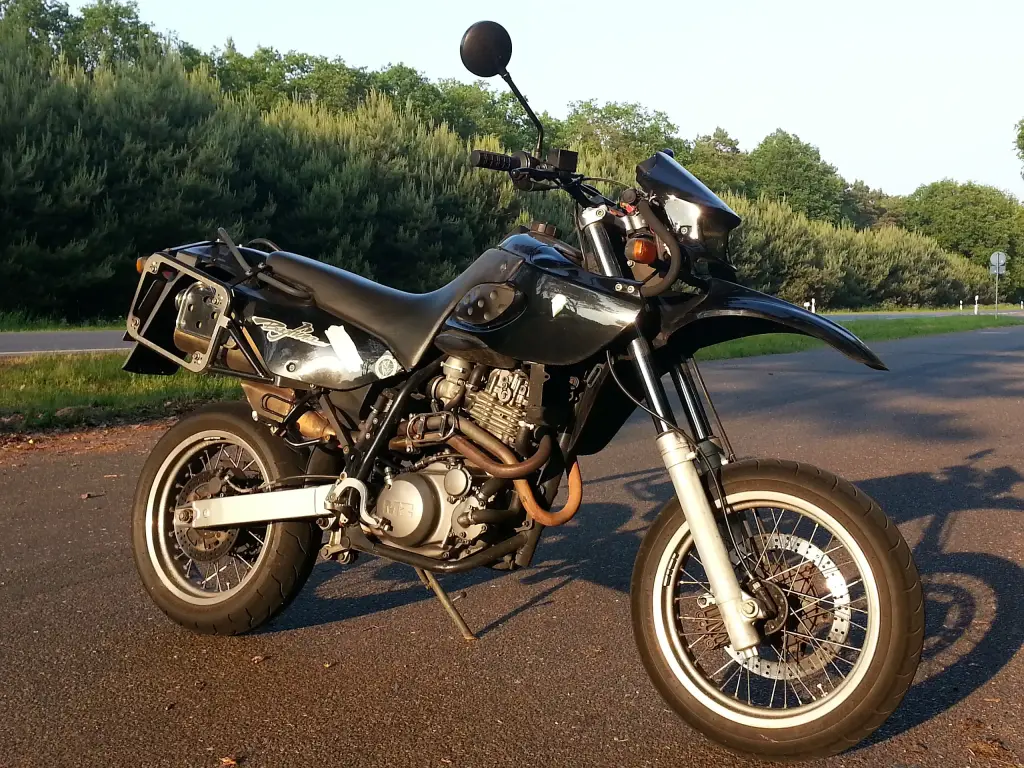
The MZ Baghira was an enduro and supermoto built by MuZ at Zschopau from 1997 to 2004. Its 660 cc four-stroke single came from the Yamaha XTZ 660 Ténéré, and with it Zschopau was, alongside KTM, the only maker offering a factory supermoto in the late 1990s.
MZ Baghira at a glance
| Maker | Motorrad- und Zweiradwerk GmbH, Zschopau (MuZ / MZ) |
|---|---|
| Production | 1997–2004 |
| Class | enduro and supermoto |
| Engine | 660 cc four-stroke single, from the Yamaha XTZ 660 Ténéré |
| Frame | own design, plastic-coated steel |
| Front suspension | Marzocchi telescopic fork, 45 mm stanchions |
| Rear suspension | WP central shock absorber |
| Brakes | Grimeca |
| Bodywork | Acerbis |
| Design | Masanori Hiraide and Oliver Neuland |
| Sister model | MZ Mastiff |
| Premiere | press launch, spring 1997 |
Based on one source: the German Wikipedia article on the Baghira and Mastiff.
History of the MZ Baghira
The takeover of MuZ by Hong Leong Industries of Malaysia gave the firm the capital to develop a new motorcycle. Building on experience with the Skorpion, Zschopau set out to make an enduro with real off-road ability and a striking look. The design came from Masanori Hiraide, a former Yamaha employee, and Oliver Neuland, and the Baghira and its sister model, the Mastiff, were shown to the press in spring 1997.
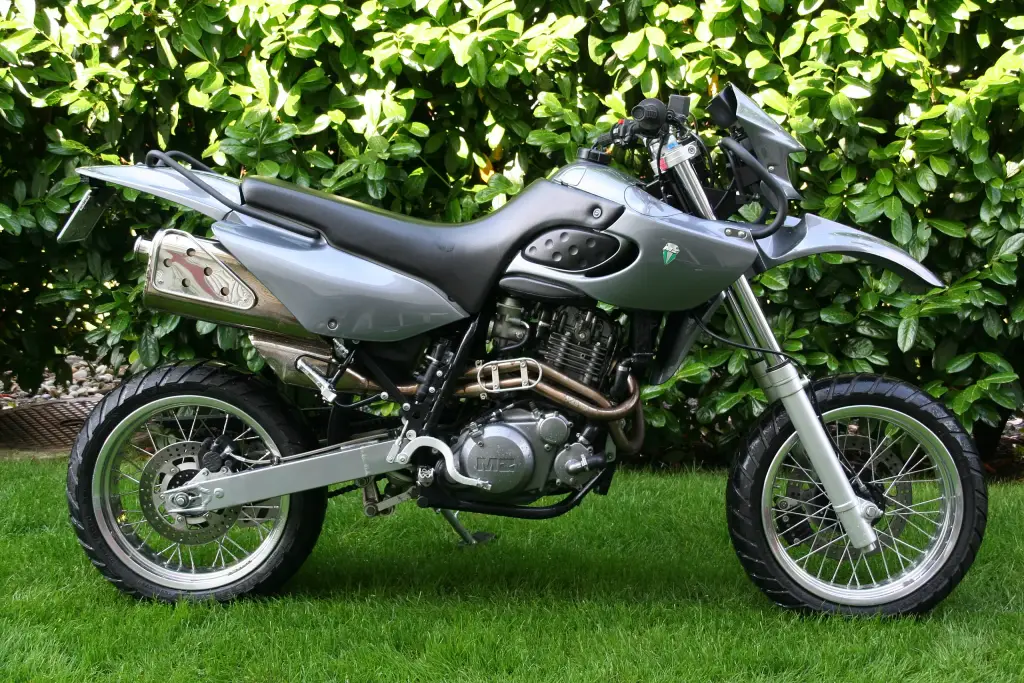
The motorcycle was built in kit fashion. The engine was bought in from Yamaha, the plastic-coated frame was MZ’s own design and many other parts came from suppliers’ catalogues: bodywork from Acerbis, the central shock from WP Suspension, a 45 mm Marzocchi fork and Grimeca brakes. The name refers to Bagheera, the panther of Rudyard Kipling’s Jungle Book.
The range covered enduro versions and several supermoto variants sold as the Baghira Streetmoto, and both were also offered as height-reduced HR models. Special editions included the all-black Streetmoto “Black Panther” and the matt green and black enduro Baghira Forest, which grew out of an MZ bid to supply the armed forces. The Mastiff, launched at the same time as a fun bike, was largely the same machine with a short front mudguard, a fork brace, a different cockpit and headlamp, a shorter swingarm, a shorter and less adjustable fork and a lower seat.
The Baghira was raced almost from the start. Test rider Mike Heydenreich rode the prototype in the Rund um Zschopau home event in 1996, and the following year development chief Jörg Hübler finished second in his class on the production model. In 1998 MuZ entered the Paris–Dakar rally at the initiative of its French importer: two of the four machines reached the finish, in 36th and 53rd places, and they were only lightly modified production bikes with sump guards and larger tanks. In 1999 Gunter Scheidhauer won the special class at the hillclimb at Rachau in Austria on a Baghira.
Design and features
- Yamaha single: the proven 660 cc four-stroke engine of the XTZ 660 Ténéré.
- Quality running gear: a 45 mm Marzocchi fork, a WP central shock and Grimeca brakes.
- Factory supermoto: the Streetmoto version was sold ready-made, a rarity in the late 1990s.
- Low-seat option: the HR variants reduced the seat height for shorter riders.
MZ Baghira versions
- Baghira Enduro: the off-road version with a full front mudguard.
- Baghira Streetmoto: the supermoto with 17-inch road wheels.
- HR models: height-reduced Enduro and Streetmoto.
- Black Panther: an all-black Streetmoto special edition.
- Forest: a matt green and black enduro aimed at military buyers.
- Mastiff: a fun bike with a short mudguard, fork brace, shorter swingarm and lower seat.
The Baghira followed the MZ Skorpion and used the same Yamaha engine family; the later MZ 1000S was the firm’s last flagship. More are in the MZ collection.
Video: MZ 660 Baghira, GoPro mix
Video on YouTube.
Sources
- MZ Baghira, German Wikipedia: model history, components, variants, competition