The MZ 125 is the final name of the IFA-DKW/IFA/MZ (RT) 125 series, built at Zschopau from 1950 to 1965. It was a copy of the DKW RT 125 of 1940–1944, whose design lost protection after the war, and with 324,561 examples it motorised a large part of East Germany.
MZ 125 at a glance
| Maker | IFA-Motorradwerk Zschopau, from 1953 VEB Motorradwerk Zschopau |
|---|---|
| Production | 1950–1965, 324,561 built in the series |
| Based on | DKW RT 125, Auto Union, 1940–1944 |
| Engine | air-cooled two-stroke single, Schnürle reverse scavenging |
| Capacity | 123 cc, bore 52 mm, stroke 58 mm |
| Power | 4.75 to 6.5 hp depending on model |
| Gearbox | three or four speeds, foot change |
| Frame | closed single-tube frame |
| Fuel | two-stroke mixture, 1:25 to 1:33 |
| Top speed | 75–85 km/h |
| Nickname | “Ifchen” |
| First shown | Leipzig Spring Fair, 1949 |
The English and German articles are translations of the same text and are used here as one source.
History of the MZ 125
The DKW main plant at Zschopau was dismantled after the war and its machinery taken to Moscow, where the M1A “Moskva” was produced as a copy of the DKW RT 125. By order of the Soviet Military Administration the Zschopau works was renamed IFA-Motorradwerk Zschopau on 1 July 1946, and its first post-war model was a developed version of the 1940 RT 125, the IFA-DKW RT 125.
That machine, later called RT 125/0, was shown at the Leipzig Spring Fair in 1949 and was already fitted with a telescopic fork, rear wheel suspension and quick-release axles. Trial samples were built in 1949 at Wilischthal, a few kilometres away, and series production at Zschopau began in 1950 — only about 1,700 machines in the first year. From 1 October 1951 a ministerial directive forbade the DKW name, and the motorcycle was sold as the IFA RT 125. It had been put into production without enough testing and suffered from a weak chain, an immature fork and a slipping clutch.
The IFA RT 125/1 of 1954 brought extensive changes that were barely visible from outside: a redesigned cylinder and head, connecting-rod bearings from the BK 350, a new carburettor, higher revs and 5.5 hp. The secondary chain was now run in patented rubber “chain tubes” and a case at the rear hub, a solution later copied by other makers; the wheelbase grew by 30 mm and the tank from 8 to 12 litres.
In 1953 the factory became VEB Motorradwerk Zschopau, and from 1956 all models were called MZ. The RT prefix disappeared from the official name and the machine became the 125/2, offered in four colours with alloy rims and a chrome tank; from 1958 full-hub brakes derived from the RT racing models improved braking. The final development was the MZ 125/3, and the series ended in 1965, when the ES range took over.
Design and features
- Simple two-stroke single: 123 cc with Schnürle reverse scavenging, an aluminium alloy block and head and a grey cast iron cylinder.
- Enclosed chain: from the RT 125/1 the secondary chain ran in rubber tubes with a rear-hub case, a patented answer to poor chains.
- 6-volt electrics: a voltage-regulated alternator and a carburettor with float and needle valve.
- Light and economical: a closed single-tube frame, 75–85 km/h and mixture lubrication at 1:25 to 1:33.
MZ 125 versions
- IFA-DKW RT 125 / RT 125/0 (1950–1954): telescopic fork, rear suspension, 8-litre tank with a tool recess.
- IFA RT 125/1 (1954): 5.5 hp, rubber chain tubes, 12-litre tank, socketed and soldered frame joints.
- MZ 125/2 (from 1956): four paint colours, alloy rims, chrome tank; full-hub brakes from 1958.
- MZ 125/3: the final development of the series before production ended in 1965.
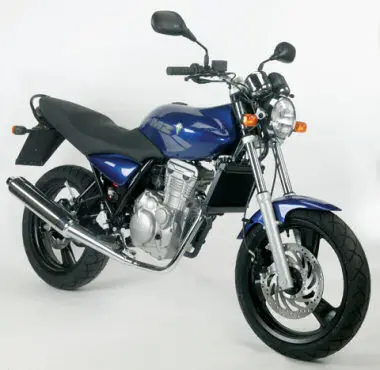
The 125 was the smallest of the early Zschopau models; the bigger MZ BK 350 with its boxer engine and cardan shaft was its stablemate, and the MZ RT 125 of 2000 revived the name. More are in the MZ collection.
Sources
- MZ 125, English Wikipedia: history, technical details, variants
- MZ 125, German Wikipedia: model history, nickname, production figures