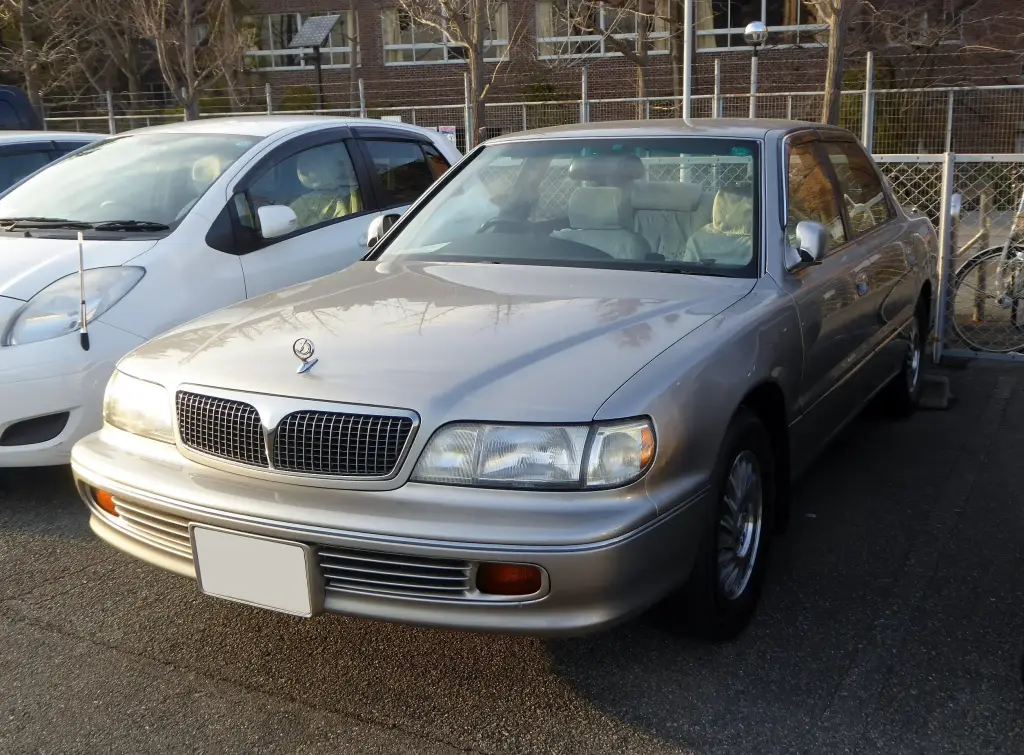
The Mitsubishi Debonair is a four-door executive sedan introduced in 1964 as Mitsubishi’s flagship in Japan. Three generations were built over 35 years, and the first two were made mainly for senior executives of the Mitsubishi group and its affiliated companies rather than for the general public.
Mitsubishi Debonair at a glance
| Maker | Mitsubishi Motors |
|---|---|
| Production | 1964–1999 |
| Generations | three |
| First shown | 10th All Japan Motor Show, October 1963 |
| Designer | Hans S. Bretzner, influenced by the 1961 Lincoln Continental |
| First engine | KE64 1,991 cc six, 105 PS |
| From 1970 | 6G34 Saturn 6, 1,994 cc, 130 PS |
| From 1976 | 4G54 Astron 2,555 cc four |
| First generation | A30 to A33, built until 1986 |
| First generation built | 21,703 |
| Replaced by | Mitsubishi Proudia in 1999 |
Based on one source: the English Wikipedia article on the Mitsubishi Debonair.
History of the Mitsubishi Debonair
A flagship for the group
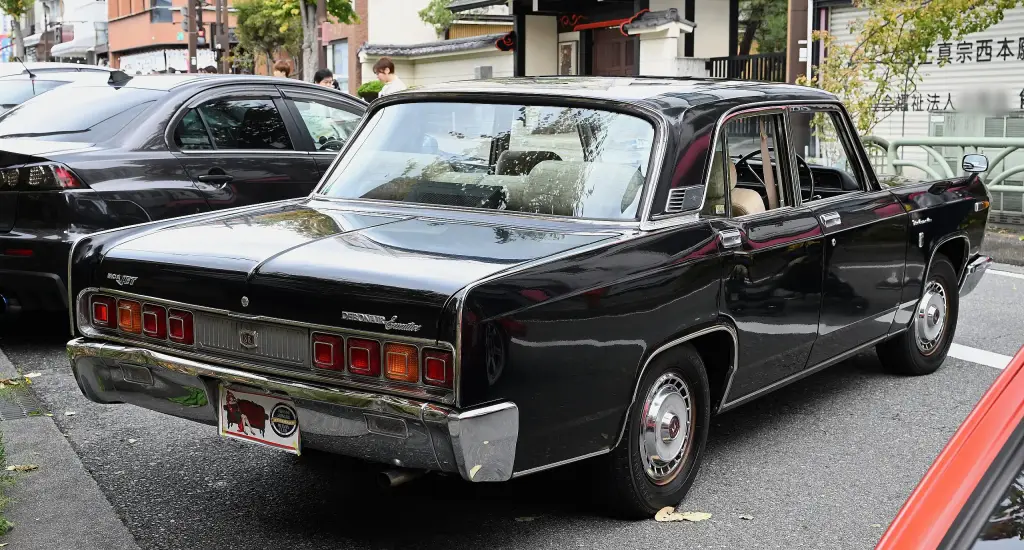
The Debonair was first shown at the 10th All Japan Motor Show in October 1963 and production began in time for the Tokyo Olympics in October 1964. Its appearance was described as dignified, and it was one of the first Japanese-built luxury sedans, with a 2.0-litre six-cylinder engine and exterior dimensions kept just under the government limits for compact cars while offering a spacious interior. At the time it was the largest sedan Mitsubishi had built, and the company, known for small economical cars, saw it as a special-purpose vehicle rather than a model for ordinary buyers.
The car competed with the Nissan Cedric, Prince Gloria, Isuzu Bellel and Toyota Crown. It was largely the work of the former General Motors designer Hans S. Bretzner, and its slab-sided panels, squared wheel arches, wrap-around front indicators and tapered rear fins showed the influence of the 1961 Lincoln Continental. From 1969 it was sold through the Galant Shop retail chain. Engine displacement was held to 2.0 litres to keep the annual road tax down, and the bill fell further if the car could be justified as a business vehicle.
Twenty-two years of one shape
The first generation stayed in production from 1964 until early 1986 with only minor redesigns, marked I to IV, sharing that habit with the Toyota Century. It had double-wishbone front suspension and leaf springs with a live axle at the rear throughout. The original A30 used the KE64 1,991 cc six with twin carburettors and twin exhausts, giving 105 PS and 155 km/h. From September 1970 the 6G34 Saturn 6 of 1,994 cc raised output to 130 PS and top speed to 180 km/h, and the car was then sold only in Executive trim. A facelift in October 1973 brought smaller front indicators moved higher on the wings, deleted front vent windows and rectangular tail lights.
The 1976 model dropped the manual gearbox in favour of a three-speed Borg-Warner automatic. When the 4G54 Astron 2,555 cc four arrived in June 1976 the trim became Executive SE and the code A32; anti-lock brakes followed in 1979. In April 1978 emissions rules brought the A33 code, and in 1985, its last full year, only 205 were sold. A total of 21,703 first-generation cars were built in just over 22 years.
Later generations
Two more generations followed, from 1986 and from 1992, and the Debonair was finally replaced in 1999 by the Proudia. Apart from a small export effort in the 1960s the car was sold mainly in Japan, although the second and third generations were also built under licence in South Korea with considerable success.
Design and features
- Executive purpose: built mainly for Mitsubishi group executives.
- One shape for 22 years: minor updates only between 1964 and 1986.
- Continental style: Hans Bretzner’s design echoed the 1961 Lincoln Continental.
- Tax-aware engines: displacement kept at 2.0 litres to limit road tax.
- Early technology: anti-lock brakes from 1979, a Borg-Warner automatic from 1976.
Mitsubishi Debonair versions
- A30 (1964–1970): 1,991 cc KE64 six with 105 PS.
- A31 (1970–1976): 6G34 Saturn 6 with 130 PS.
- A32 (1976–1978): 2,555 cc Astron four, Executive SE trim.
- A33 (1978–1986): emissions-ready version.
- Second and third generations: 1986 and 1992, also built in South Korea.
The Debonair was replaced by the Proudia, and its position in the range sat above the Galant and Diamante. More cars are in the Mitsubishi collection.
Sources
- Mitsubishi Debonair, English Wikipedia: introduction, design, engines, production totals