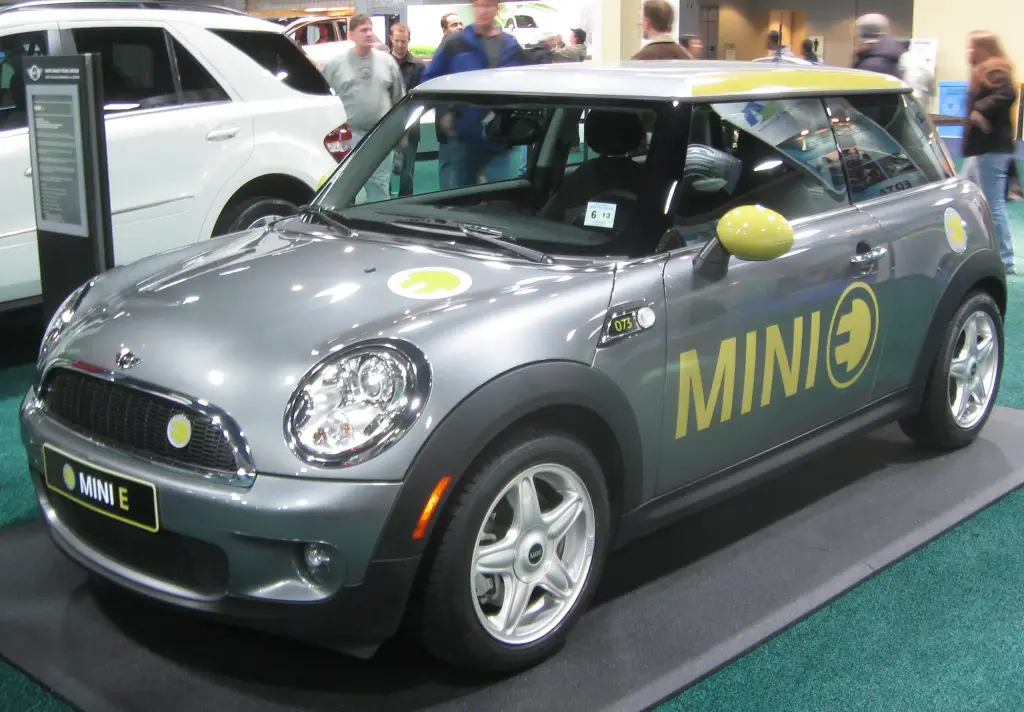
The Mini E was an electric Mini built by BMW for field trials in 2009 and 2010. It was a conversion of the Mini Cooper, with an electric motor in place of the engine and a battery pack where the rear seat used to be. The cars were leased, never sold, and most were destroyed when the trials ended.
Mini E at a glance
| Maker | BMW (Project i), converted from the Mini Cooper |
|---|---|
| First shown | Los Angeles Auto Show, 2008 |
| Trials | from June 2009 in the United States; UK from December 2009 |
| Motor | asynchronous electric, 204 PS (150 kW), 220 Nm |
| Drive | front wheels |
| Battery | lithium-ion, 35 kWh, 259 kg, in place of the rear seat |
| Top speed | limited to 153 km/h |
| Acceleration | 0–100 km/h in 8 seconds |
| Range | 251 km under optimal conditions; EPA 160 km |
| Charging | 120 V in 20 hours; 240 V in 3.5 hours |
| Built in | gliders from Oxford, electrics fitted in Munich |
| US programme | 450 cars; 9,500 people applied |
The article is based on one source, the English Wikipedia page on the Mini E.
History of the Mini E
A laboratory on wheels
BMW showed the Mini E at the Los Angeles Auto Show in 2008. It used the Mini brand to test electric drive, and it also helped the company meet California rules that require carmakers to offer zero-emission vehicles. The car belonged to BMW Project i, which was followed in January 2012 by a trial of the BMW ActiveE and ended with the BMW i3 of 2013.
The conversion was done in Germany. The Oxford factory supplied complete cars without engines, and a team in Munich fitted the electric running gear. AC Propulsion announced in November 2008 that it was supplying the motor technology, an air-cooled induction motor with a copper rotor, and the lithium-ion battery.
What it was like
The motor sat in the former engine bay and drove the front wheels with 204 PS and 220 Nm. The 35 kWh battery weighed 259 kg and took the place of the rear seat, so the Mini E was strictly a two-seater with a shallow load area behind. Top speed was limited to 153 km/h and 0 to 100 km/h took 8 seconds. Range was quoted at 251 km in optimal conditions, while the American EPA certified 160 km, with city and highway estimates of 175 and 154 km.
Charging from a 120-volt socket took 20 hours, or 3.5 hours on 240 volts at 32 or 48 amps; the rate was set from the instrument panel before charging. The throttle was drive-by-wire with a deliberate soft start to protect the motor from standing starts, and the regenerative braking was strong enough that lifting off the accelerator slowed the car as if the brake pedal had been pressed.
The trials
The first trial began in the United States in June 2009, leasing 250 cars in Los Angeles and 200 in the New York area at 850 dollars a month for a year, including insurance, maintenance and a home charging box. Some 9,500 people applied for the 450 cars. A British trial started in December 2009 with more than forty cars handed to private users for two consecutive six-month periods; together the programmes made BMW the first major manufacturer to put more than 500 electric cars into private hands.
The cars were leased, not sold, and had to go back to BMW. Some went to museums, some to laboratories in Germany and the rest were dismantled and crushed. The forty British cars stayed in use after the trial ended in March 2011 and formed part of BMW’s fleet for the London 2012 Olympic Games. The experience led to the production Mini Electric in 2019.
Design and features
- Motor in the old engine bay: 204 PS and 220 Nm to the front wheels, with a top speed limited to 153 km/h.
- Battery instead of a rear seat: 35 kWh and 259 kg where the back bench used to be, making the car a two-seater.
- Strong regenerative braking: lifting off the throttle slowed the car sharply and recovered energy.
- Two charging rates: 20 hours on a household socket, 3.5 hours on a 240-volt wall box.
- Lease only: the cars were never sold and most were destroyed after the trials.
Mini E versions
- US trial cars (2009): 450 cars leased in Los Angeles and the New York area.
- UK trial cars (2009–2011): more than forty cars, later used for the London 2012 Olympics.
- German and other trials: cars also went to Germany, France, Japan and China.
- Museum and laboratory cars: a few were kept for display or further testing instead of being crushed.
The petrol car it was built from is the Mini Hatch, and the later production electric Mini belongs to the same line. The two-seat sports Mini of the same years is the Mini Coupé. More cars are in the Mini collection.
Video: 2009 MINI E – Jay Leno’s Garage
Video by Jay Leno’s Garage on YouTube.
Sources
- Mini E, English Wikipedia: trials, specification, charging, production