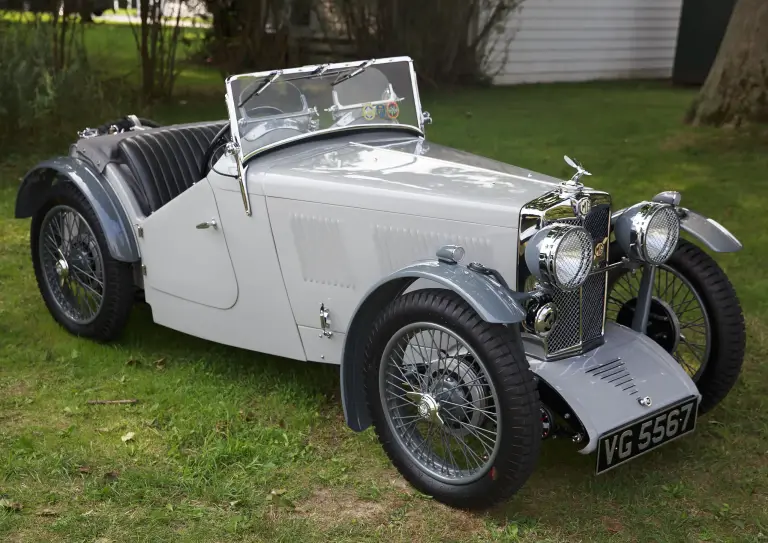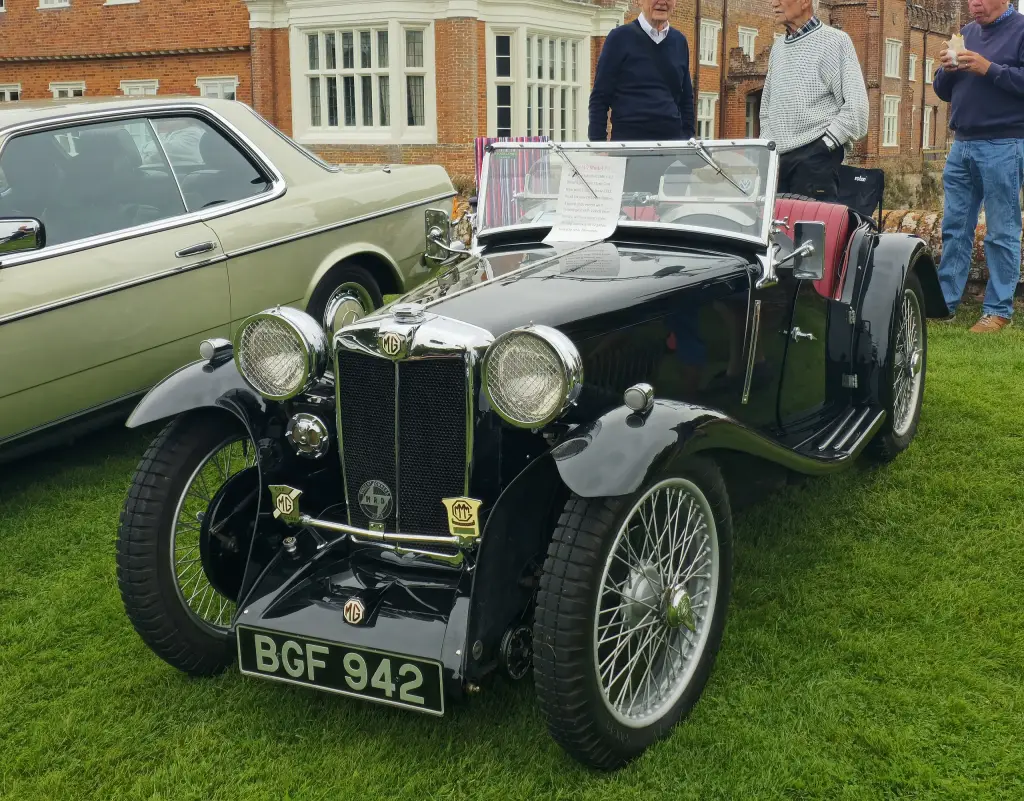
The MG P-type was a two-door sports car produced from 1934 to 1936, using an updated version of the Wolseley-designed overhead-camshaft crossflow engine that had powered the J-type Midget. It was built in two forms, the PA and the PB, and most cars were open two-seaters.
MG P-type at a glance
| Maker | MG, Abingdon |
|---|---|
| Production | 1934–1936 |
| Chassis | strengthened, slightly longer J-type frame |
| Engine | overhead-camshaft crossflow four, 847 cc (PA), 939 cc (PB) |
| Power | 36 bhp in the PA, 43 bhp in the PB |
| Gearbox | four-speed non-synchromesh |
| Wheelbase | 87 in (2,210 mm) |
| Track | 42 in (1,100 mm) |
| Steering | Marles Weller, later Bishop Cam |
| Brakes | cable-operated drums |
| Top speed | about 74 mph (119 km/h) for the PA |
| Built | 1,973 PA and 526 PB |
History of the MG P-type
PA
The P-type used the overhead-camshaft, crossflow engine designed and built by Wolseley, which had appeared in the 1928 Morris Minor and was fitted to the J-type Midget of 1932 to 1934. The chassis was a strengthened and slightly longer version of the J-type frame, with half-elliptic springs all round and rigid front and rear axles. Steering was at first by Marles Weller and later by the Bishop Cam system. The two-seat car had an 87-inch wheelbase and a 42-inch track.
The first PA kept an 847 cc engine similar to the J-type’s, now with a three-bearing crankshaft, an improved camshaft and twin OM-model SU carburettors. It produced 36 bhp at 5,500 rpm, for a top speed of about 74 mph and a 0–50 mph time of 20 seconds; a two-seater roadster cost £222 in 1935. Most cars were open two-seaters, but streamlined Airline coupé bodies were also made, and the P-type was available as a four-seater, a car that suffered from a lack of power and poor rear ground clearance. 1,973 PAs were built, 27 of which were later converted to PB specification.
PB
The PB was produced from 1935 to 1936 with a larger 939 cc engine, made by enlarging the bore from 57 to 60 mm, which raised output to 43 bhp. Externally it was very similar to the PA; the main differences were a vertically slatted radiator grille in place of the honeycomb type and a redesigned dashboard in different materials. 526 PBs were produced.
Racing
Unlike the J, K and L-types, whose numbers showed the body style, the P-type name gave no clue to the type of car, and the same was true of its six-cylinder sister, the N-type Magnette. In 1936 a supercharged MG PB driven by Andrew Hutchinson won the Limerick Grand Prix, one of the last major results for the model before it gave way to the T-type.
Design and features
- J-type chassis: strengthened and slightly lengthened for the new model.
- Overhead-camshaft engine: 847 cc in the PA, enlarged to 939 cc in the PB.
- Airline coupé: a streamlined closed body offered alongside the open cars.
- Bishop Cam steering: fitted to later cars in place of the Marles Weller system.
MG P-type versions
- PA (1934–1935): 847 cc and 36 bhp, 1,973 built, £222 as a roadster.
- PB (1935–1936): 939 cc and 43 bhp with a slatted grille, 526 built.
- Airline coupé: streamlined closed body on both models.
- Four-seater: a long-body version, short of power and with poor ground clearance.
The P-type followed the J-type and shared its era with the six-cylinder N-type Magnette; more cars are in the MG collection.
Sources
- MG P-type, English Wikipedia: PA and PB specifications, production and racing