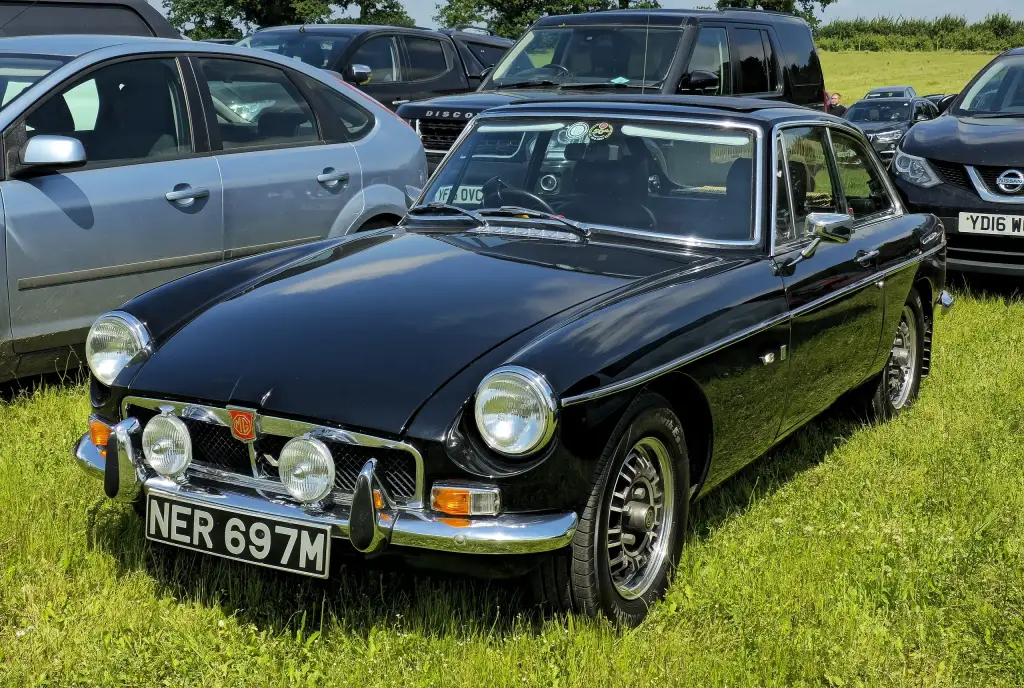
The MGB was announced on 19 September 1962 and remained in production until 1980, making it the longest-lived of the classic MG sports cars. It began as a four-cylinder soft-top roadster and grew into a range that included the GT coupé, the six-cylinder MGC and the V8.
MG MGB at a glance
| Maker | MG (BMC, later British Leyland), Abingdon |
|---|---|
| Production | 1962–1980 |
| Announced | 19 September 1962 |
| Bodies | two-door roadster; GT 2+2 coupé from 1965 |
| Construction | unitary structure, a break from the MGA’s separate chassis |
| Engine | 1,798 cc B-Series four, 95 hp at 5,400 rpm |
| Gearbox | four-speed manual, overdrive optional |
| 0–60 mph | just over 11 seconds |
| Coupé | MGB GT from 1965 |
| Six-cylinder | MGC, 1967–1969 |
| Eight-cylinder | MGB GT V8, 1973–1976 |
| Combined production | 523,836 MGB, MGC and MGB GT V8 |
History of the MG MGB
Launch
Development of the MGB began at least as early as 1958, with the prototype known by its Abingdon codename MG EX205. In structure the car was a modern design for 1962: it used a unitary body instead of the separate chassis of the MGA and the T-types, which cut manufacturing costs while adding strength. Brakes and suspension were developments of the 1955 MGA, and the B-Series engine had its origins in 1947.
Wind-up windows were standard and the driver’s compartment offered plenty of legroom, with a parcel shelf behind the seats. The three-bearing 1,798 cc engine produced 95 hp at 5,400 rpm and gave a 0–60 mph time of just over 11 seconds; a five-bearing crankshaft was adopted in October 1964. The MGB was one of the first cars designed with controlled crumple zones to protect occupants in a 30 mph impact.
GT, MGC and V8
A three-door 2+2 coupé, the MGB GT, joined the range in 1965 and remained in production until 1980, though exports of the fixed-roof car to the United States stopped in 1974. In 1967 came the six-cylinder MGC, built until 1969 with a three-litre engine and the stronger gearbox that was later shared with the V8; from 1973 to 1976 the MGB GT V8 used a 3.5-litre eight-cylinder engine. Sales of the MGB, MGC and MGB GT V8 together reached 523,836 cars.
Later cars and the RV8
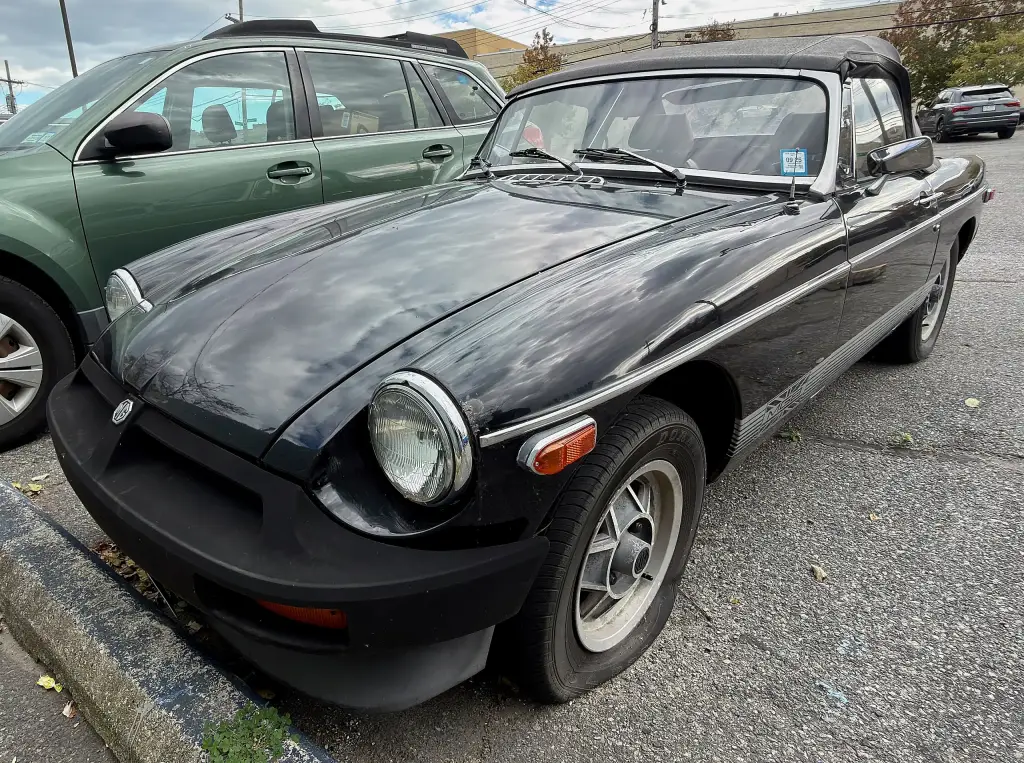
From 1975 MGBs sold in the United States were detuned to meet emission standards, their ride height was raised by an inch and distinctive rubber bumpers were fitted to satisfy bumper regulations; some California cars produced only around 70 hp by the late 1970s. British cars kept 95 bhp until 1971, falling gradually to 85 bhp by 1975. Overdrive was available on all MGBs but was fitted to fewer than 20 per cent of them.
After a twelve-year gap the MGB returned as the MG RV8, a heavily modified limited run of 2,000 cars built by Rover in the 1990s, with less than 5 per cent parts interchangeability with the original. It was replaced in 1995 by the MG F. The MGB remains a popular collector’s car thanks to inexpensive parts and simple mechanics.
Design and features
- Unitary body: cheaper to build and stronger than the MGA’s separate chassis.
- B-Series engine: 1,798 cc and 95 hp, with a five-bearing crank from 1964.
- Overdrive: an optional electrically engaged unit working in third and fourth gears.
- Crumple zones: one of the first cars designed with controlled deformation.
- GT body: a three-door 2+2 coupé added in 1965.
MG MGB versions
- MGB roadster (1962): the original four-cylinder soft-top.
- MGB GT (1965–1980): three-door 2+2 coupé.
- MGC (1967–1969): six-cylinder version with a three-litre engine.
- MGB GT V8 (1973–1976): 3.5-litre eight-cylinder coupé.
- US-specification cars (1975–1980): raised ride height and rubber bumpers.
- MG RV8 (1990s): 2,000-car revival built by Rover.
The MGB replaced the MGA and was itself revived as the RV8 before the MG F took over; more cars are in the MG collection.
Sources
- MG MGB, English Wikipedia: development, engines, GT, MGC, V8, production