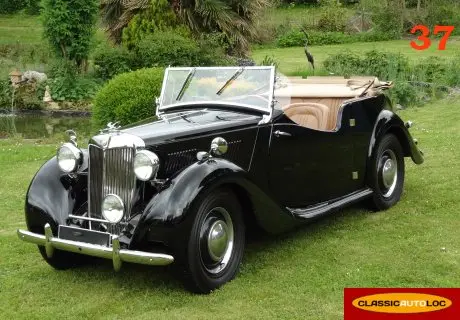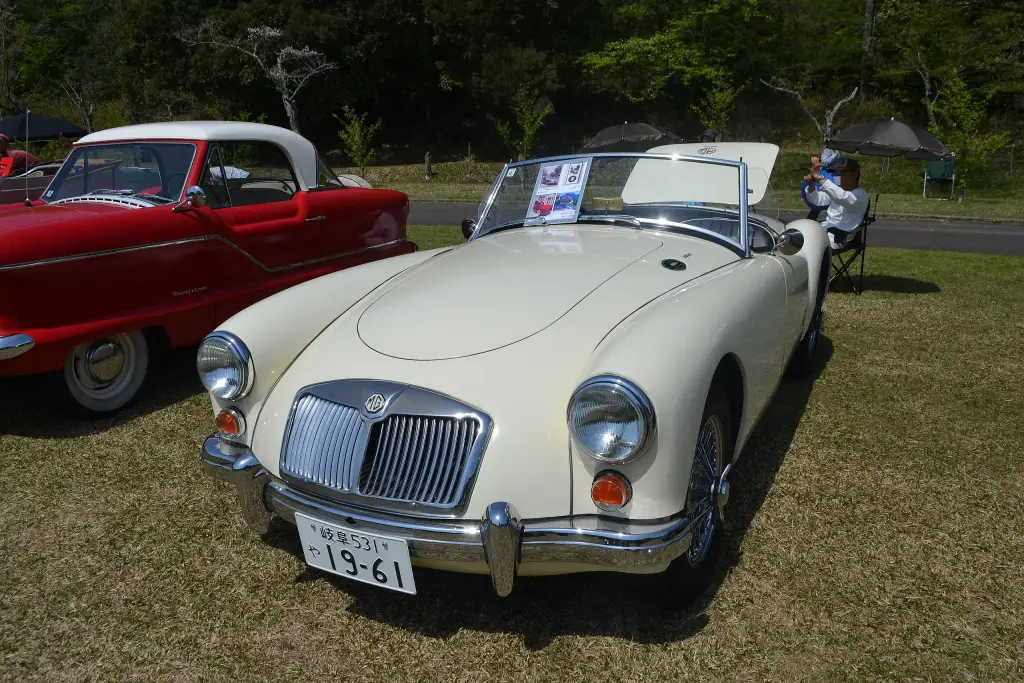
The MGA was MG’s sports car from 1955 to 1962 and represented a complete styling break from everything the company had built before. Announced on 26 September 1955 and launched at the Frankfurt Motor Show, it replaced the MG TF 1500 Midget and was built in far greater numbers than any earlier MG.
MG MGA at a glance
| Maker | MG, Abingdon |
|---|---|
| Production | 1955–1962 |
| Announced | 26 September 1955, launched at the Frankfurt Motor Show |
| Bodies | open roadster and fixed-head coupé |
| Engine | BMC B-Series four, 1,489 cc at launch |
| Power | 68 hp, soon raised to 72 hp |
| Suspension | independent front with coil springs; rigid rear axle |
| Steering | rack and pinion |
| Brakes | Lockheed hydraulic drums; discs on the Twin-Cam and 1600 |
| Top speed | 97.8 mph (157.4 km/h), The Motor, 1955 |
| 0–60 mph | 16.0 seconds, The Motor, 1955 |
| Built | 101,476 cars |
History of the MG MGA
Origins
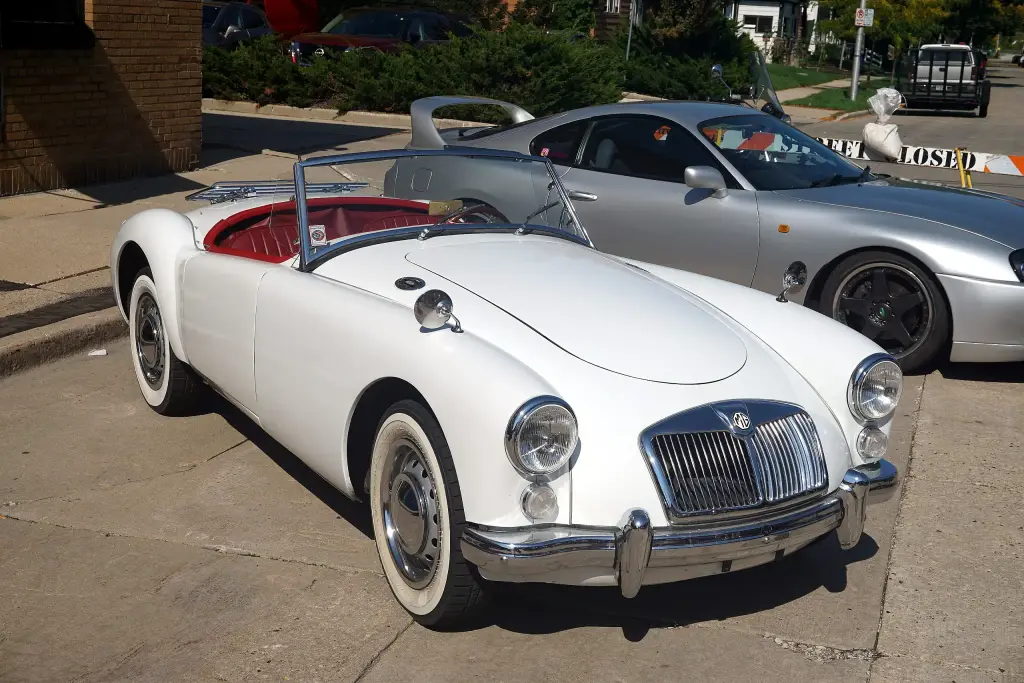
The MGA design dates back to 1951, when MG designer Syd Enever created a streamlined body for George Philips’ TD Le Mans car. The new shape traded the TF’s articulated wings and running boards for ponton styling, a single envelope enclosing the full width and length of the car. A new chassis was drawn with the side members further apart and the floor attached to the bottom rather than the top of the frame.
A prototype was shown to BMC chairman Leonard Lord, who turned it down because he had just signed a deal with Donald Healey to build Austin-Healey cars two weeks earlier. Falling sales of the traditional MG models changed his mind, and the car, initially to be called the UA-series, was brought back. Because it was so different from the older MGs it was named MGA, ‘the first of a new line’ in the words of the contemporary advertising; the name was chosen by John Thornley in 1954.
MGA 1500
Instead of the intended XPAG unit the car used the new straight-four BMC B-Series engine from the MG Magnette saloon, coupled to a four-speed gearbox. The 1,489 cc engine with twin H4 SU carburettors produced 68 hp at first and was soon raised to 72 hp. Lockheed hydraulic drum brakes were used on all four wheels, the front suspension was independent with coil springs and wishbones, and the rear used a rigid axle with semi-elliptic springs. The car came on wire-spoked or steel-disc wheels, and the convertible had no exterior door handles. A coupé version brought total production of standard MGAs to 58,750.
Twin-Cam
A high-performance Twin-Cam joined the range in 1958 with a double-overhead-camshaft aluminium cylinder head on the B-Series block, producing 108 hp, and Dunlop four-wheel disc brakes with peg-drive knock-off steel wheels. The engine proved temperamental: it suffered from detonation and burnt oil, and although most problems were cured with a low-compression 100 hp version, the reputation had been damaged. The Twin-Cam was dropped in 1960 after 2,111 cars.
1600 and Mark II
In May 1959 the standard cars received a 1,588 cc engine producing 79.5 bhp, with front disc brakes while drums remained at the rear; 31,501 were built in less than three years. For 1961 the Mark II took the engine to 1,622 cc with larger valves and revised combustion chambers for 90 bhp, together with a higher 4:1 rear axle, an inset grille and the horizontal tail lamps of the Mini. By the end of production in July 1962, 101,476 MGAs had been sold, the vast majority exported and only 5,869 kept at home, and the model was replaced by the MGB.
Design and features
- Ponton styling: a fully enclosed body with no separate wings or running boards.
- B-Series engine: the 1,489 cc unit from the Magnette saloon, later 1,588 and 1,622 cc.
- Rack and pinion steering: with independent front suspension on coil springs.
- Twin-Cam: a 108 hp double-overhead-camshaft version with four-wheel disc brakes.
MG MGA versions
- MGA 1500 (1955): 68 hp, soon 72 hp, roadster and coupé.
- Twin-Cam (1958–1960): 108 hp, Dunlop disc brakes, 2,111 built.
- 1600 (1959): 1,588 cc and 79.5 bhp with front disc brakes, 31,501 built.
- 1600 De Luxe: 70 roadsters and 12 coupés with Twin-Cam wheels and brakes.
- Mark II (1961): 1,622 cc and 90 bhp with an inset grille.
The MGA was replaced by the MGB and had followed the MG T-type; more cars are in the MG collection.
Video: 1960 MG MGA Roadster
Video by St. Louis Car Museum & Sales on YouTube.
Sources
- MG MGA, English Wikipedia: design, engines, versions, production figures