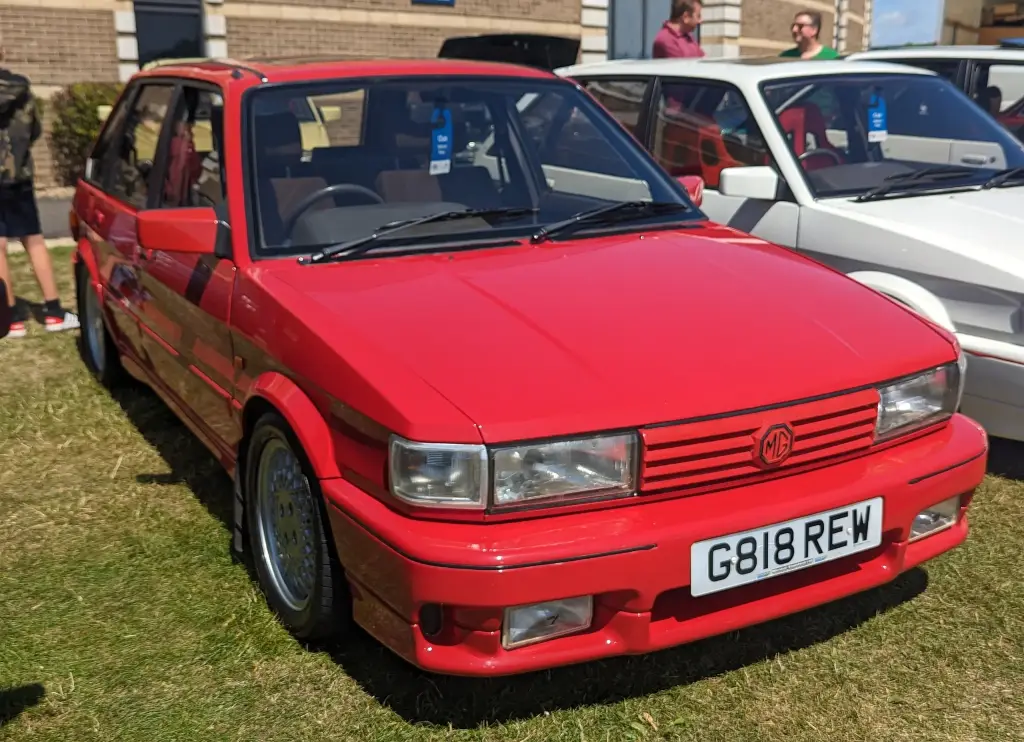
The MG Maestro was the performance derivative of the Austin Maestro, the five-door family hatchback that British Leyland launched in 1983. It was sold from 1983 until 1991 and shared its body and chassis with the Austin-badged cars, adding stronger engines, a digital instrument pack and the usual MG trimming.
MG Maestro at a glance
| Maker | MG (British Leyland, later Rover Group), Cowley |
|---|---|
| Production | 1983–1991 |
| Basis | Austin Maestro, project LC10 / LM10 |
| Body | five-door hatchback; two-door van also built |
| Launch | Maestro range launched 1 March 1983 |
| Suspension | MacPherson struts front, torsion beam rear |
| Drag coefficient | 0.36 for MG models, against 0.38 for the rest |
| Instruments | solid-state digital speedometer and vacuum fluorescent displays |
| Voice system | synthesised warning and information messages |
| Range production | 605,000 Maestros of all types |
The English Wikipedia article covers the whole Maestro range; this page uses only the parts that concern the MG-badged cars.
History of the MG Maestro
The LC10 project
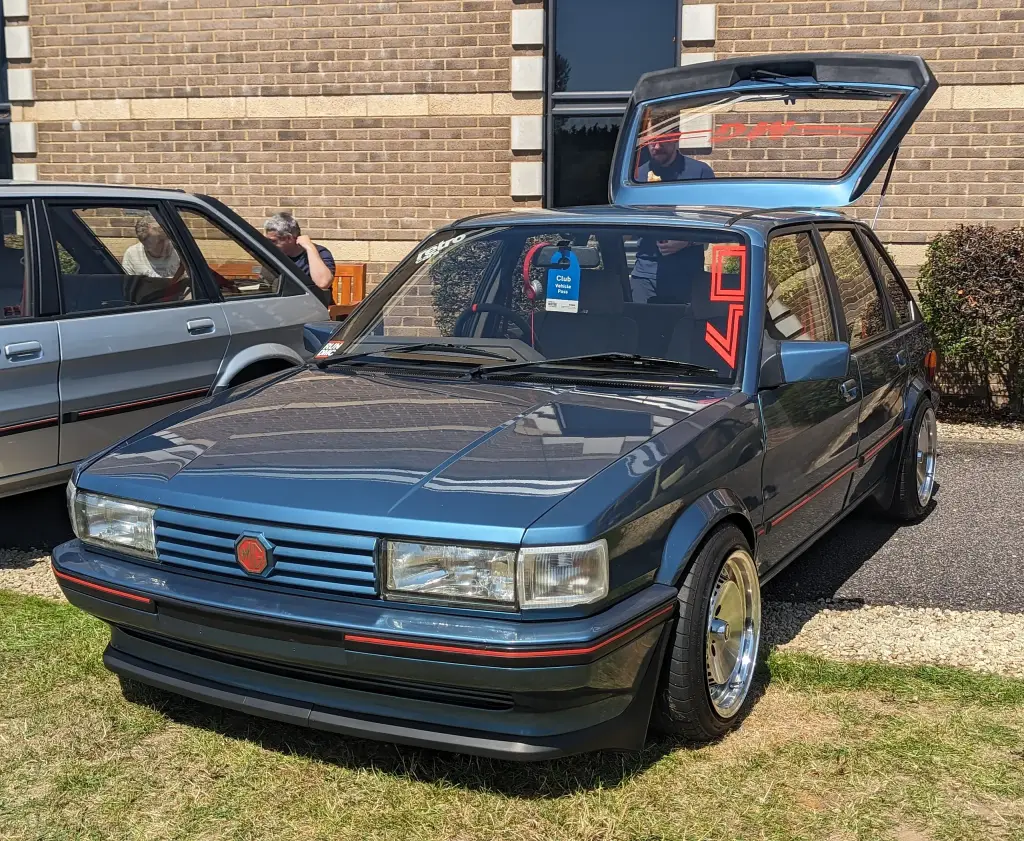
The Maestro grew out of project LC10, the car that British Leyland planned in 1977 to replace both the Austin Allegro and the Austin Maxi. It was styled by Ian Beech under David Bache and given a five-door hatchback body; a four-door notchback version diverged into a separate model, the Austin Montego. Production began at Cowley in November 1982 and the car was launched on 1 March 1983.
The Maestro abandoned the Issigonis transmission-in-sump layout for an end-on gearbox bought from Volkswagen, and the Hydragas suspension of earlier BL cars gave way to MacPherson struts at the front and a torsion beam at the rear, a cheaper arrangement that compromised load space. The car was larger and heavier than the first Volkswagen Golf.
The MG version
An MG-badged performance version was sold from 1983 until 1991. MG and Vanden Plas cars were distinguished inside by a solid-state instrument cluster with a digital speedometer and vacuum fluorescent analogue displays for the tachometer, fuel and temperature gauges, a trip computer and a voice synthesis warning and information system, recorded by the New Zealand actress Nicolette McKenzie.
The MG models also had a lower drag coefficient of 0.36 against 0.38 for the rest of the range, thanks to rear strakes on the tailgate that helped the airflow break away more cleanly. Body-coloured bumpers, a bonded laminated windscreen, homofocal headlamps, an asymmetrically split rear seat and a 12,000-mile service interval were among the features the Maestro brought to its class.
The van and the end
The van and the end
Like many BL products of the period, early cars suffered from build quality and reliability problems, which damaged the model’s reputation even as its technology looked advanced for the class.
Design and features
- Digital instruments: solid-state display with a voice warning system on MG cars.
- Lower drag: tailgate strakes cut the coefficient from 0.38 to 0.36.
- Modern chassis: MacPherson struts and a torsion beam instead of Hydragas.
- Van version: a two-door van completed the Maestro range alongside the hatchback.
MG Maestro versions
- MG Maestro (1983): the first performance version of the hatchback.
- MG Maestro EFi: fuel-injected 2.0-litre models of the later 1980s.
- MG Maestro Turbo (1989): turbocharged flagship of the MG range.
The Maestro shared its platform with the MG Montego saloon and was the successor in spirit to the MG Metro; more cars are in the MG collection.
Video: Clarkson Talking about the MG Maestro Tickford Turbo
Video by Four Nine Six on YouTube.
Sources
- Austin Maestro, English Wikipedia: LC10 project, MG version, instruments, production