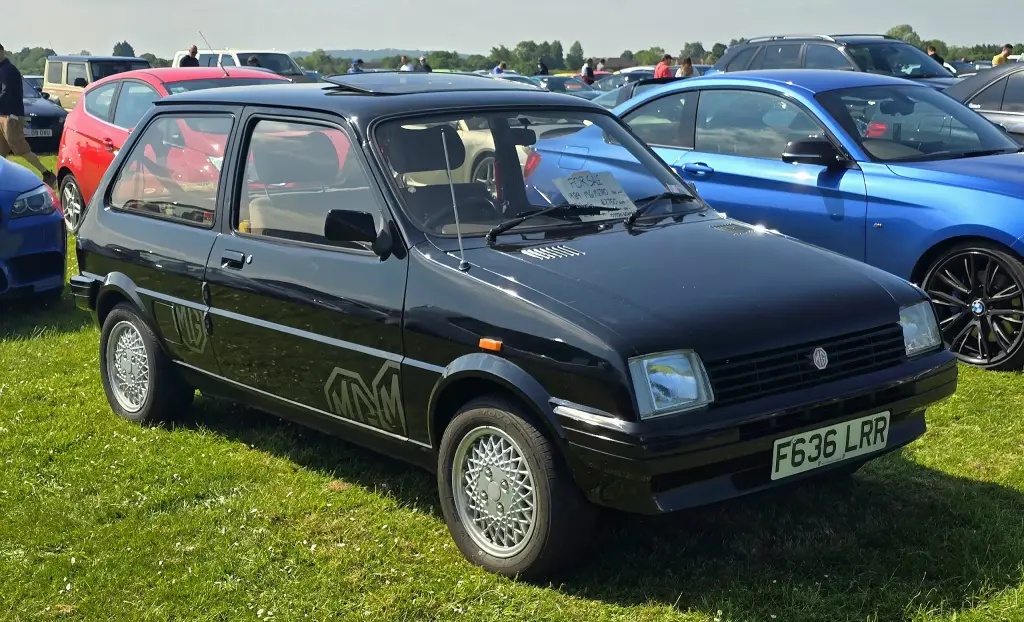
The MG Metro was the performance version of the Austin Mini Metro, the supermini that British Leyland launched in October 1980. Sportier MG versions became available in 1982, and the MG badge stayed on the range until the Metro was redesigned as a Rover at the end of the decade.
MG Metro at a glance
| Maker | MG (British Leyland, later Rover Group), Longbridge |
|---|---|
| Production | 1982–1990 |
| Basis | Austin Mini Metro, launched 8 October 1980 |
| Layout | front-wheel drive, transverse A-Plus engine |
| Wheels | 12-inch, against 10-inch on the basic Mini |
| Brakes | servo-assisted four-piston front discs, split hydraulics |
| Suspension | Hydragas, borrowed from the Austin Allegro |
| Body | three-door hatchback; a van version was also built |
| Range production | 2,078,218 Metros of all types |
| End of the name | the Metro became the Rover 100 in 1990 |
The English Wikipedia article covers the whole Metro range; this page uses only the parts that concern the MG-badged cars.
History of the MG Metro
From ADO88 to LC8
The Metro began as project ADO88, a direct replacement for the Mini with an 88-inch wheelbase. By 1977 the car was well advanced, but customer clinics disliked its styling and superminis were taking over the market segment it was aimed at. In late 1977 BL chairman Michael Edwardes ordered an eleventh-hour redesign to make the car larger and less utilitarian, and the project became LC8, BL’s first supermini.
The final design emerged under the chief stylists David Bache and Harris Mann. With limited time and money it reused much of the Mini’s engineering: the A-Series engine, front-wheel drive through a sump-mounted four-speed gearbox and subframes separate from the bodyshell. The Hydragas suspension came from the Allegro, and the drivetrain was re-engineered with new materials and tooling to become the A-Plus. Every external panel was new.
The MG Metro
The Austin Mini Metro was introduced on 8 October 1980, its name chosen by a ballot of BL employees from a shortlist of Match, Maestro and Metro. Sportier MG versions were made available from 1982, with a tuned A-Plus engine, 12-inch wheels and servo-assisted four-piston front disc brakes with fully split hydraulic systems, a considerable advance on the basic Mini’s 10-inch wheels and all-round drums.
The engineering developed for the Metro was soon passed to the Mini at little extra cost, which let BL keep the older car in production as an entry model while the Metro competed with the longer superminis of other makers. The Metro quickly became one of Britain’s best-selling cars.
The end of the MG Metro
From 1987 the car was sold simply as the Metro after the Austin brand was dropped, and in 1990 it was redesigned and took the Rover badge, sold abroad as the Rover 100, a name that replaced Metro in Britain from 1995. The van version was sold under the Morris badge and later as the Metrovan. The Metro and Rover 100 finally ceased production on 23 December 1997, outlived by three years the original Mini it had been meant to replace, and 2,078,218 Metros of all types were built.
Design and features
- Tuned A-Plus engine: the MG version was the quickest of the Metro range.
- Better brakes: servo-assisted four-piston front discs with split hydraulics.
- Hydragas suspension: interconnected fluid and gas displacers from the Allegro.
- Modern packaging: a hatchback that was larger and roomier than the Mini.
MG Metro versions
- MG Metro (1982): the first sporting version of the LC8 hatchback.
- MG Metro Turbo: turbocharged model of the later 1980s.
- MG Metro 6R4: the mid-engined Group B rally car developed from the Metro shape.
- Metrovan: the commercial version, sold under the Morris badge and later as the Metrovan.
The Metro was replaced in the MG range by the MG Maestro; more cars are in the MG collection.
Sources
- Austin Metro, English Wikipedia: development, MG versions, production