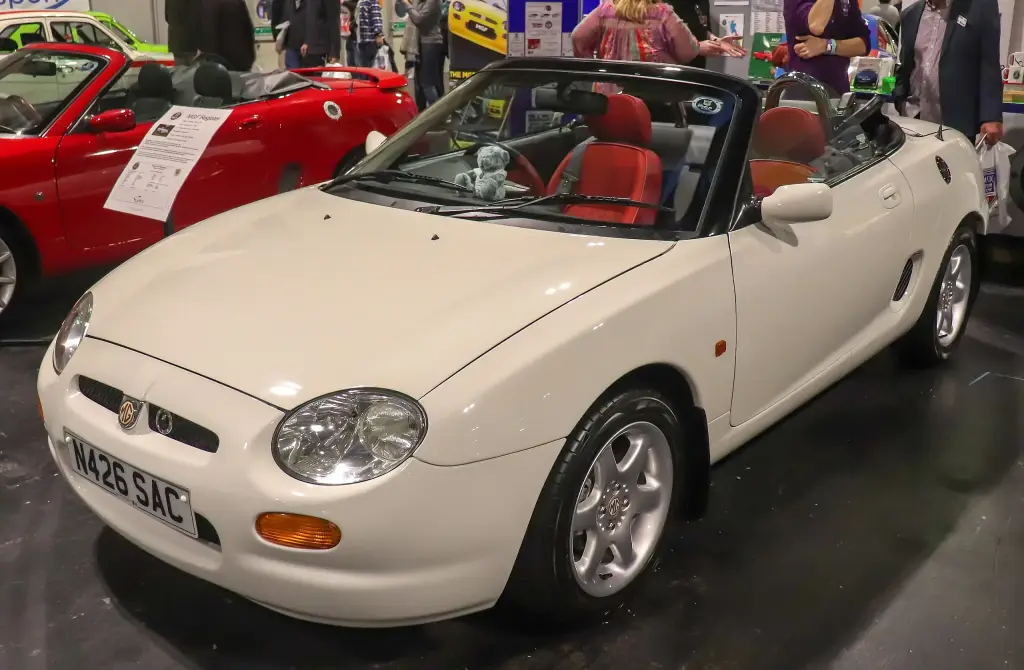
The MG F was the first model designed as an MG since the MGB, and it brought the marque back to two-seat sports cars in 1995 after fifteen years of badge-engineered hatchbacks. It was updated and renamed MG TF in 2002, survived the collapse of MG Rover in 2005 and was built once more in China before production ended in 2011.
MG F / MG TF at a glance
| Maker | Rover Group, then MG Rover, then MG Motor (Nanjing) |
|---|---|
| Production | 1995–2005 and 2007–2011 |
| Layout | mid-engine, rear-wheel drive, two-seat roadster |
| Launched | unveiled 8 March 1995, on sale September 1995 |
| Engine | 1.8-litre K-Series, 120 PS; VVC version 145 PS |
| Added in 1999 | 1.6-litre base model |
| Added in 2001 | Trophy 160 with 160 PS |
| Gearbox | five-speed manual; Steptronic CVT from 2001 |
| Suspension | Hydragas, interconnected fluid and gas displacers |
| Facelift | autumn 1999 |
| Renamed | MG TF in January 2002 |
| MG F built | 77,269 cars, plus 799 Limited versions |
History of the MG F / MG TF
A new MG sports car
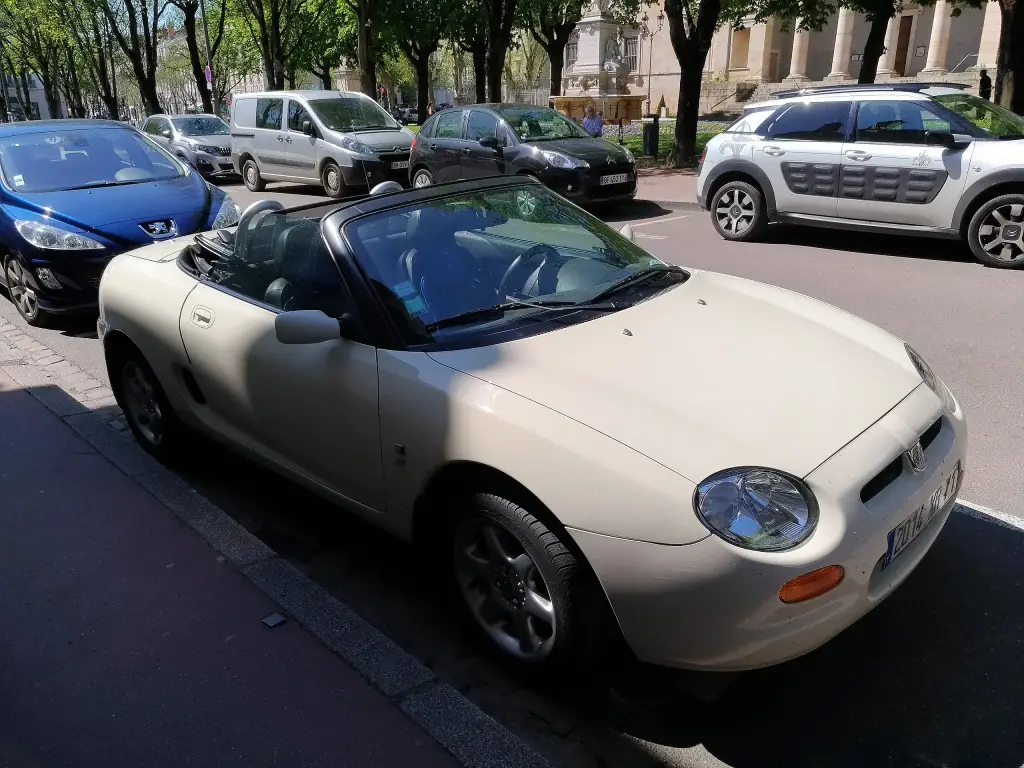
MG had stopped building sports cars in 1980, when British Leyland closed the Abingdon factory, and for the next decade the badge appeared only on modified hatchbacks and saloons. In 1992 Rover restarted production of the MGB as the limited-edition RV8, and the reaction to that car encouraged the company to continue developing a new sports model. By 1991 Rover was already working on a mid-engined two-seater of roughly the size and expected price of the Mazda MX-5 and the Lotus Elan.
The design began outside the company: Steve Harper of MGA Developments produced the initial concept in January 1991, inspired by the Jaguar XJR-15 and the Ferrari 250LM, before Rover’s own team refined it under Gerry McGovern. The production MG F was unveiled on 8 March 1995 and went on sale in September that year with a 1.8-litre K-Series engine of 120 PS. A VVC version with variable valve control and 145 PS joined the range a few months later.
The F used Hydragas suspension, with interconnected fluid and gas displacers in place of conventional springs, and it quickly became the best-selling affordable sports car in Britain.
Facelift and Trophy
The MG F was facelifted in the autumn of 1999 with a revised interior, styling changes and new alloy wheels. A 1.6-litre base model was added, and in 2001 came the Trophy 160 with 160 PS, a 0–60 mph time of 6.9 seconds and a limited production run. A Steptronic continuously variable transmission arrived the same year.
Sales held up despite the break-up of the Rover Group in 2000, when MG and Rover passed to the Phoenix consortium for £10 while Land Rover went to Ford. The F remained Britain’s best-selling convertible in the face of competition from the Mazda MX-5, BMW Z3 and Audi TT, and 77,269 were built.
MG TF and the end
In January 2002 the car was revised and given the historic TF name, reviving a badge last used on the 1950s Midget. Production stopped when MG Rover collapsed in April 2005. Nanjing Automobile bought the rights to the MG TF, restarted production at its new factory in March 2007, and finally ended it in 2011 without an immediate successor.
Design and features
- Mid-engine layout: the K-Series sits behind the seats, driving the rear wheels.
- Hydragas suspension: interconnected fluid and gas displacers instead of steel springs.
- VVC engine: variable valve control raised the 1.8 from 120 to 145 PS.
- Trophy 160: the fastest road-going F, with 160 PS and a 6.9-second 0–60 mph time.
MG F / MG TF versions
- MG F 1.8 (1995): the original 120 PS roadster.
- MG F VVC: 145 PS version with variable valve control.
- MG F 1.6 (1999): entry model added with the facelift.
- MG F Trophy 160 (2001): limited high-performance model.
- MG TF (2002): revised car with the historic TF name.
- MG TF (2007–2011): Nanjing-built version of the same design.
The F followed the MG RV8 and replaced the MGB in the range; more cars are in the MG collection.
Sources
- MG F / MG TF, English Wikipedia: development, engines, facelift, production figures