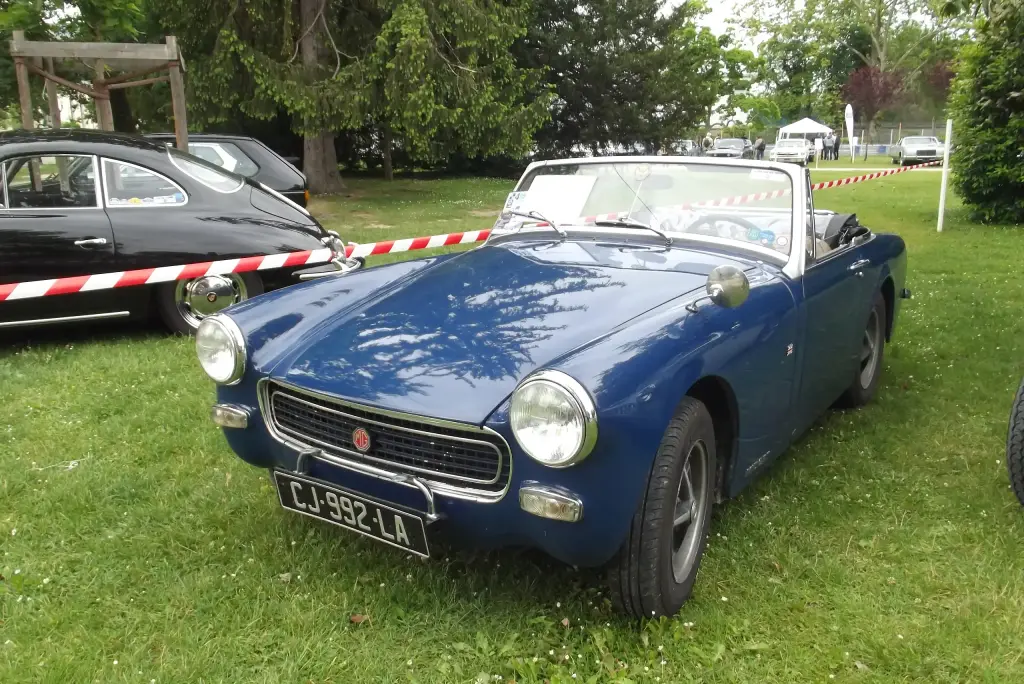
The MG Midget was a small two-seater lightweight sports car produced from 1961 to 1979, reviving a name used earlier on the M-type, D-type, J-type and T-type. The first version, announced at the end of June 1961, was a badge-engineered version of the MkII Austin-Healey Sprite.
MG Midget at a glance
| Maker | MG, Abingdon |
|---|---|
| Production | 1961–1979 |
| Basis | Austin-Healey Sprite MkII |
| Engine | 948 cc A-Series at launch, twin SU carburettors |
| Power | 46 hp at 5,500 rpm |
| MkI production | 16,080 with 948 cc and 9,601 with 1,098 cc |
| MkII (1964) | 59 hp, wind-up windows, semi-elliptic rear springs |
| MkIII (1966) | 1,275 cc, 65 hp |
| Top speed | 87.9 mph (141.5 km/h) for the 948 cc car |
| 0–60 mph | 18.3 seconds, The Motor, 1962 |
| Price | £689 including taxes in 1962 |
No free photographs of the MG Midget were found, so the original picture of the record has been kept.
History of the MG Midget
MkI, 1961–1964
The original Sprite had been created to fill the gap left when the MG T-type Midget went out of production, and because the MGA was larger and more expensive many MG buyers turned to it. A badge-engineered MG version reusing the Midget name therefore made sense. The new car differed from the Sprite only in grille design, badging, better interior trim and instruments, and extra polished exterior trim to justify its higher price.
Mechanically it was identical to its Austin-Healey counterpart, keeping the quarter-elliptic leaf springs and trailing arms of the original Sprite. The 948 cc A-Series engine with twin SU carburettors produced 46 hp, and braking was by 7-inch drums all round. Doors had no external handles and the windows were sliding Perspex side-screens; a heater was an optional extra. The Motor tested one in 1962 and recorded 87.9 mph, 0–60 mph in 18.3 seconds and a price of £689.
In October 1962 the engine grew to 1,098 cc for 56 hp, and disc brakes replaced the drums at the front, greatly improving braking at speed. These early 1,098 cc engines were less reliable than the 948, suffering crankshaft bearing failures when run hard. Production was 16,080 of the small-engined version and 9,601 of the 1,098 cc car.
MkII, 1964–1966
The MkII brought wind-up windows, swivelling quarter lights, external handles and separate locks, along with a slightly curved windscreen in a sturdier frame. A strengthened engine block with larger main bearings raised output to 59 hp, and semi-elliptic rear springs replaced the old arrangement for a better ride. A total of 26,601 were made.
MkIII, 1966–1974
The engine grew to 1,275 cc using development from the Mini-Cooper S, but detuned to 65 hp with a lower 8.8:1 compression ratio so that the Midget would not outrun the more expensive MGB. The hydraulic system gained a separate clutch master cylinder and the hood became permanently attached with an easier mechanism. From 1968 US-specification cars received a padded fascia, a collapsible steering column, a third windscreen wiper and anti-burst door latches; a taller rear axle ratio arrived in December 1968, and the tail was squared off in 1970 with MGB-style tail lamps. Rounded rear wheel arches, a Triumph steering rack and a second silencer came in 1972, alternators in 1973.
Design and features
- Light weight: a small two-seater built on the Austin-Healey Sprite base.
- Progressive engines: 948, 1,098 and 1,275 cc A-Series units.
- Front disc brakes: fitted from October 1962.
- MkIII trim: a permanently attached hood and improved mechanism.
MG Midget versions
- MkI 948 (1961): 46 hp with drum brakes, 16,080 built.
- MkI 1,098 (1962): 56 hp and front disc brakes, 9,601 built.
- MkII (1964–1966): 59 hp, wind-up windows, 26,601 built.
- MkIII (1966–1974): 1,275 cc and 65 hp.
- Later US-specification cars: emissions equipment and rubber bumpers from 1974.
The Midget took its name from the MG T-type, and the MGA was its larger stablemate; more cars are in the MG collection.
Video: 1972 MG Midget
Video by Logan Serlin on YouTube.
Sources
- MG Midget, English Wikipedia: MkI to MkIII specifications, production figures, road tests