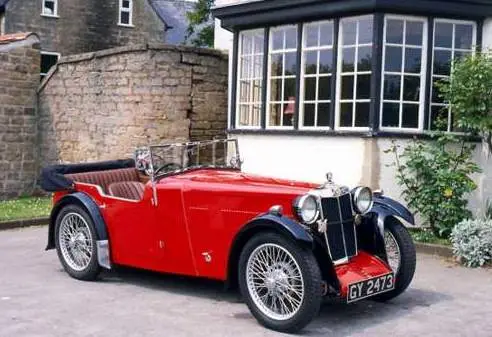
The MG F-type, better known as the Magna, was a six-cylinder sports car produced from October 1931 to 1932. It was also known as the 12/70 and was created to fill the gap between the M-type Midget and the larger 18/80.
MG F-type Magna at a glance
| Maker | MG, Abingdon |
|---|---|
| Production | October 1931–1932 |
| Also known as | 12/70 |
| Engine | 1,271 cc six-cylinder overhead camshaft, twin SU carburettors |
| Power | 37.2 bhp at 4,100 rpm, later 47 bhp |
| Gearbox | four-speed non-synchromesh, ENV |
| Chassis | D-type, lengthened by 10 inches |
| Suspension | half-elliptic springs, Hartford friction shock absorbers |
| Wheelbase | 94 in (2,388 mm) |
| Track | 42 in (1,067 mm) |
| Tyres | 4.00 x 19 on wire wheels, centre lock |
| Top speed | about 70 mph (110 km/h) |
No free photographs of the F-type Magna were found, so the original picture of the record has been kept.
History of the MG F-type Magna
A six-cylinder gap filler
MG needed a car to sit between the small M-type Midget and the expensive 18/80, and found its engine among the units that had come to William Morris with the purchase of Wolseley. The 1,271 cc six was an overhead-camshaft design already used in the 1929 M-type and before that in the 1930 Wolseley Hornet; dummy side covers disguised its origins.
Fitted with twin 1-inch SU carburettors it produced 37.2 bhp at 4,100 rpm at first, later raised to 47 bhp by revising the valve timing. Drive went to the rear wheels through a four-speed non-synchromesh ENV gearbox. The chassis was a version of the D-type frame lengthened by 10 inches, with half-elliptic springs and Hartford friction shock absorbers at both ends and rigid axles. With its sloping radiator and long bonnet the F-type could reach about 70 mph.
F, F2 and F3
The original F was limited by 8-inch brake drums, which were not really adequate for its four-seat bodies, and many cars were later fitted with the larger F2 brakes. The four-seat tourer cost £250 and the Foursome coupé £289. Chassis were also supplied to outside coachbuilders including Abbey, Jarvis, Stiles and Windover: 188 cars left Abingdon in chassis form.
The F2 arrived in late 1932 as the open two-seater of the range, with much-needed 12-inch drums all round and a body with straight-topped doors taken from the J-type Midget. The F3, also introduced in 1932, used the same brakes but carried the four-seat tourer and Foursome coupé bodies, with improved cooling through a change in the water flow. The Magna was replaced by the K-type Magnette, which was launched at the 1932 London Motor Show.
Design and features
- Six-cylinder engine: a 1,271 cc overhead-camshaft Wolseley design with twin SU carburettors.
- Long bonnet and sloping radiator: the look that identified the Magna.
- D-type chassis: lengthened by 10 inches for the six-cylinder car.
- Coachbuilt bodies: 188 chassis were sold to outside coachbuilders.
MG F-type Magna versions
- F (1931): four-seat tourer at £250 and Foursome coupé at £289, with 8-inch brake drums.
- F2 (late 1932): open two-seater on a shorter body, with 12-inch brakes.
- F3 (1932): F2 brakes with the four-seat tourer and coupé bodies.
- Coachbuilt cars: chassis supplied to Abbey, Jarvis, Stiles and Windover.
The Magna was replaced by the K-type Magnette, and its body ideas passed to the J-type. More cars are in the MG collection.
Video: 1932 MG F-Type Magna Tourer
Video by DriverSource on YouTube.
Sources
- MG F-type, English Wikipedia: engine, chassis, F2 and F3 versions