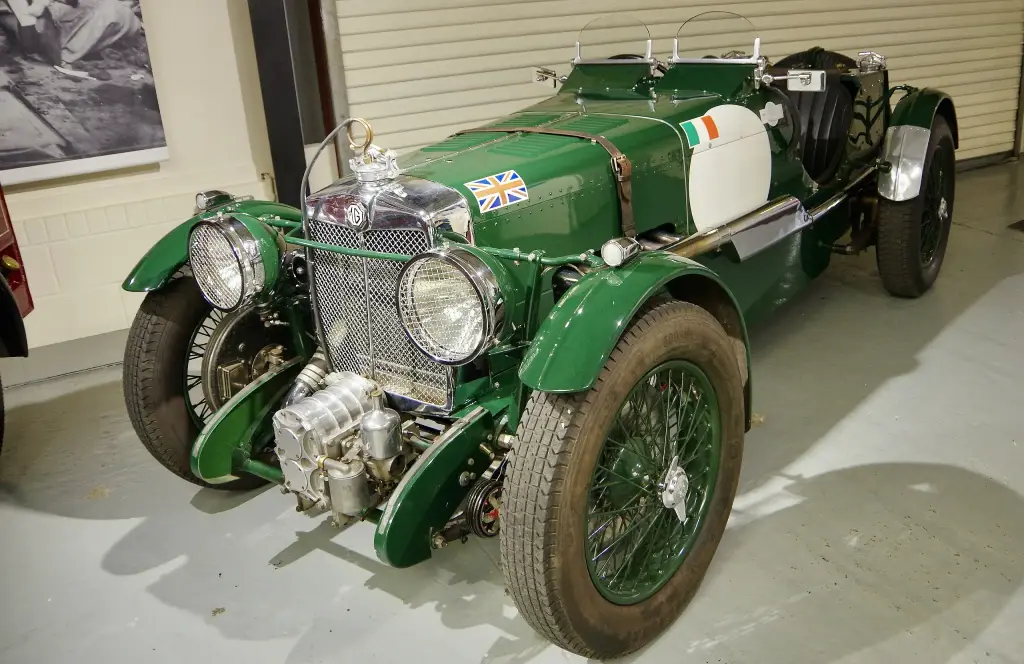
The MG K3 was the racing member of the K-type Magnette family, launched at the 1932 London Motor Show. It used the short chassis and a supercharged 1,087 cc six-cylinder engine, and it became one of the most successful British racing cars of the early 1930s.
MG K3 Magnette at a glance
| Maker | MG, Abingdon |
|---|---|
| Production | 1932–1934 |
| Chassis | short K-type chassis, 94 in (2,400 mm) wheelbase |
| Engine | 1,087 cc six-cylinder, overhead camshaft, crossflow head |
| Supercharger | Powerplus, later Marshall, mounted in front of the engine |
| Power | 120 bhp at 6,500 rpm |
| Gearbox | preselector |
| Top speed | capable of 75 mph in road trim |
| Price | £795 |
| Built | 33 cars |
| 1933 Mille Miglia | class win, Eyston and Lurani |
| 1934 Le Mans | 4th overall and Index of Performance, chassis K3027 |
History of the MG K3 Magnette
The K-type range
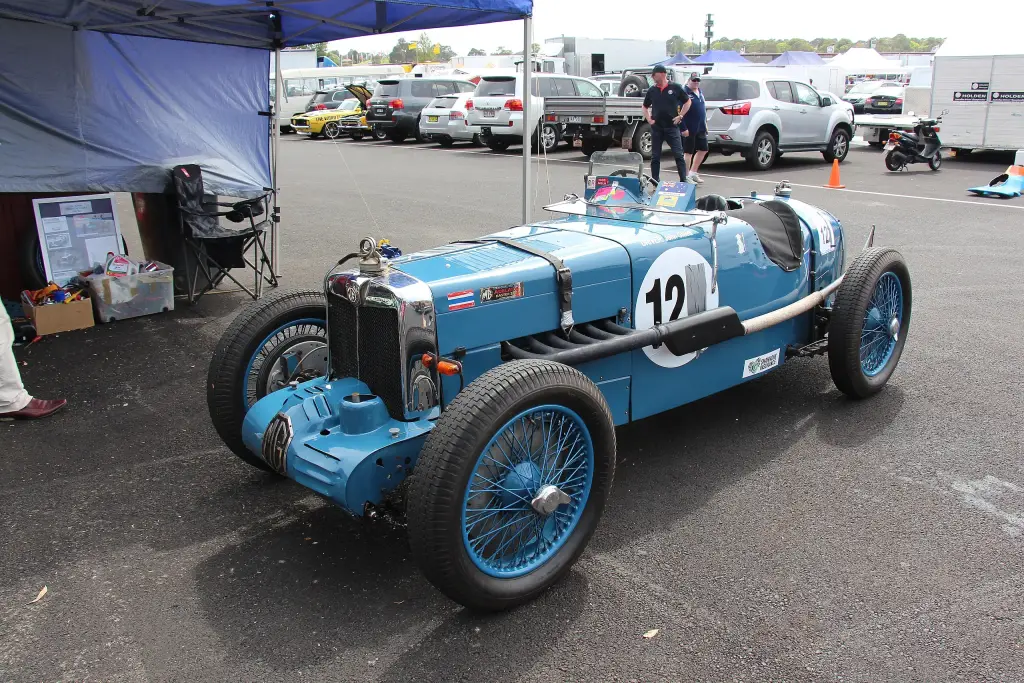
The K-type Magnette replaced the F-type Magna at the end of 1932. Its chassis was similar to the Magna’s but stronger, with the track widened by 6 inches to 48 inches, and it was offered in two lengths with wheelbases of 94 or 108 inches. The engines were based on the Wolseley overhead-camshaft design used in the F-type but heavily redesigned: the stroke was reduced from 83 to 71 mm, taking capacity from 1,272 to 1,087 cc, and a crossflow cylinder head was fitted. With triple SU carburettors the KA engine gave 39 bhp at 5,500 rpm; a revised KB with two carburettors followed in early 1933 with 41 bhp, and the KD of late 1933 returned to the 83 mm stroke for 1,271 cc and 48.5 bhp.
The racing version
The K3 was the racing variant. It used the short chassis and the KC engine, which kept the 1,087 cc capacity but added a supercharger to produce 120 bhp at 6,500 rpm. The Powerplus supercharger, later replaced by a Marshall-made unit, was prominently mounted in front of the engine below the radiator, and a preselector gearbox was used. Only 33 K3s were made, at £795 each, and as well as the works cars a number were bought privately; many replicas have since been built, often from K1 and K2 models.
Racing record
The K3 was successful straight away in 1933, winning the 1,100 cc class of the Mille Miglia with Captain George Eyston and Count Lurani, and taking an outright victory on handicap in the Ulster RAC Tourist Trophy, where Tazio Nuvolari averaged 78.65 mph. Its greatest international result came in the 1934 24 Hours of Le Mans, when chassis K3027 finished fourth overall and won the Index of Performance in the hands of Roy Eccles and C. E. C. Martin; that car is now displayed at the Simeone Foundation Automotive Museum in Philadelphia.
The K3 attracted drivers of the calibre of Sir Tim Birkin, Whitney Straight and ‘Hammy’ Hamilton. It raced well into the post-war period, and many cars did not survive intact: a car-by-car analysis shows that most have had new bodies, engine changes or were destroyed outright.
Design and features
- Supercharged six: the KC engine gave 120 bhp from 1,087 cc at 6,500 rpm.
- Short chassis: the K3 used the 94-inch wheelbase of the K2.
- Front-mounted blower: the Powerplus supercharger sat below the radiator.
- Preselector gearbox: as used in the road-going K-types.
MG K3 Magnette versions
- K3 (1933): works and privateer racing car, 33 built at £795.
- Road-going K-types: K1 with the long chassis and K2 as the open two-seater.
- Replicas: many later cars were built up from K1 and K2 chassis.
The K3 sat above the road-going MG Magnette and was developed from the F-type Magna; more cars are in the MG collection.
Video: MG K3
Video by Maurice on YouTube.
Sources
- MG K-type, English Wikipedia: K-type range, K3 specification and racing record