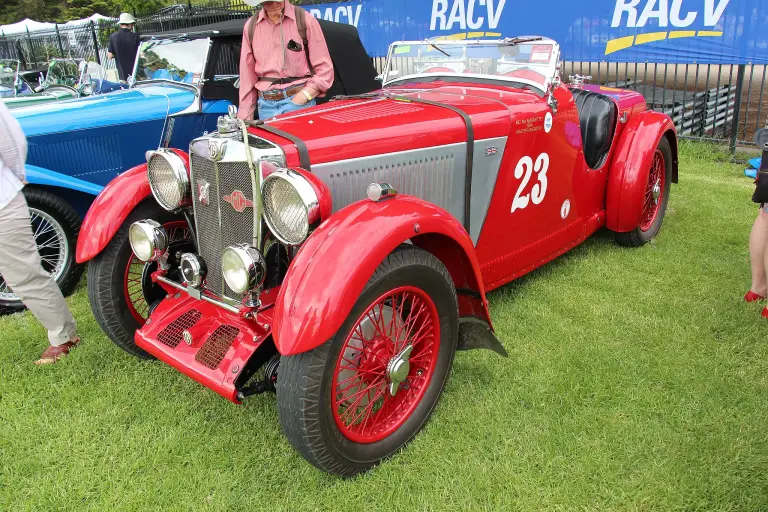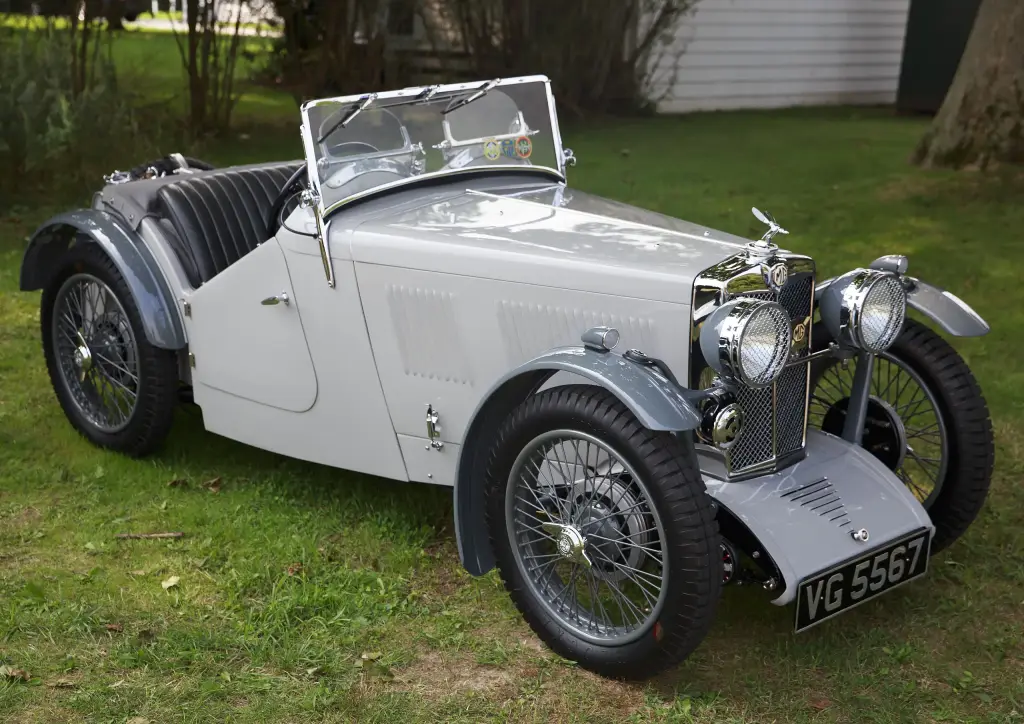
The MG J-type was a two-door sports car produced from 1932 to 1934. It used an updated version of the overhead-camshaft crossflow engine already seen in the M-type Midget, and it was built in four forms: the J1, J2, J3 and J4.
MG J-type at a glance
| Maker | MG, Abingdon |
|---|---|
| Production | 1932–1934 |
| Bodies | mostly open two-seaters; a J1 Salonette was also made |
| Engine | overhead-camshaft crossflow four, 847 cc with twin SU carburettors |
| Power | 36 bhp in the J1 |
| Gearbox | four-speed non-synchromesh |
| Chassis | D-type |
| Suspension | half-elliptic springs, Hartford friction shock absorbers |
| Wheelbase | 86 in (2,184 mm) |
| Track | 42 in (1,067 mm) |
| Brakes | Bowden cables to each drum |
| Top speed | 65 mph (105 km/h) for a standard J2 |
History of the MG J-type
J1 and J2
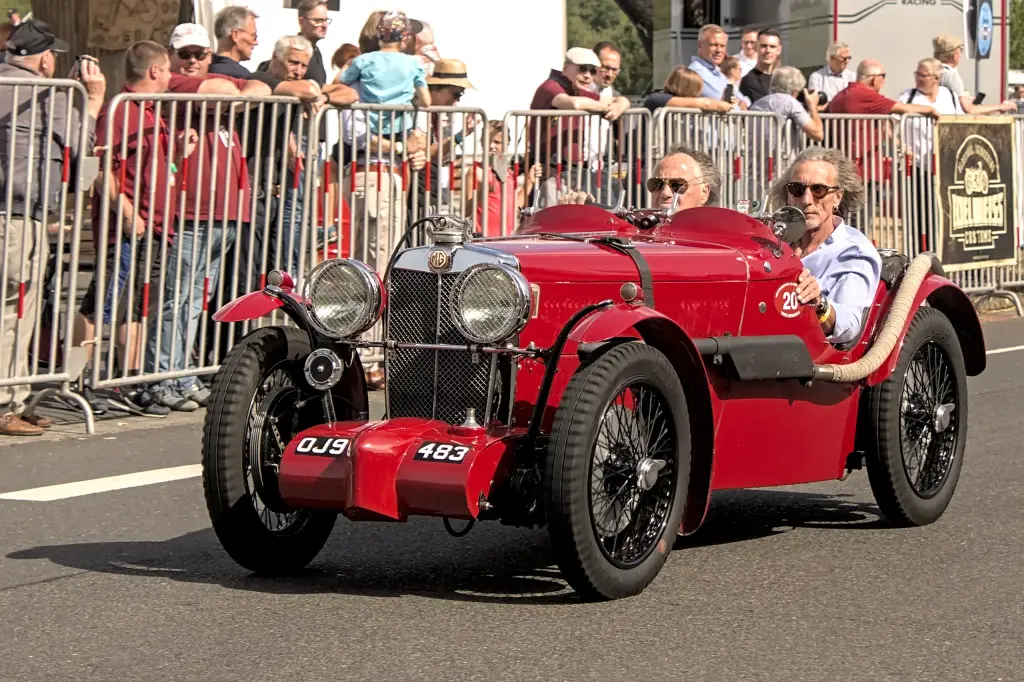
The J-type was built on the D-type chassis, with half-elliptic springs and Hartford friction shock absorbers at both ends and rigid front and rear axles. Most cars were open two-seaters, but a closed Salonette version of the J1 was also made, and some chassis went to external coachbuilders. Open cars can be told from the earlier M-type by the cut-away tops of their doors.
The J1 was the four-seat car of the range, using the 847 cc engine previously fitted to the C-type with twin SU carburettors and 36 bhp. It cost £220 in open form and £225 as a Salonette. The J2 was the road-going two-seater and by far the commonest car of the range: early examples had cycle wings, replaced in 1933 by the full-length wings that became typical of MG sports cars until the 1950s TF. A standard J2 reached 65 mph, though one prepared for The Autocar recorded 82 mph, and it cost £199.
The J2 had two well-known weaknesses. Its two-bearing crankshaft could break if the engine was over-revved, and the overhead camshaft was driven by a vertical shaft through bevel gears that also formed the armature of the dynamo, so an oil leak from the cambox seal could reach the dynamo brushgear and start a fire. Braking was by Bowden cables to each drum; the drums were small, and fitting larger ones from later models was a common period modification.
J3 and J4
The J3 was the racing version, with the engine capacity cut to 746 cc by shortening the stroke from 83 to 73 mm so that the car could compete in 750 cc class events; a Powerplus supercharger made up for the lost capacity, and the larger brakes of the L-type were fitted. The J4 was a pure racing car with lightweight bodywork and the J3 engine, using more supercharger boost to reach 72 bhp. The J-type was replaced in 1932–1933 by the P-type, which took the same chassis layout forward with a more powerful engine.
Design and features
- Overhead-camshaft engine: an updated version of the unit used in the M-type Midget.
- Four versions: from the four-seat J1 to the supercharged J4 racing car.
- Cut-away doors: the easiest way to tell a J-type from an M-type.
- Cable brakes: Bowden cables to each drum, with small drums that were often uprated.
MG J-type versions
- J1 (1932): four-seater with the 847 cc engine, £220 open or £225 Salonette.
- J2 (1932–1934): road-going two-seater at £199, the commonest J-type.
- J3: racing car with a 746 cc supercharged engine and L-type brakes.
- J4: lightweight racing version with 72 bhp from the J3 engine.
The J-type followed the F-type Magna in the MG range; more cars are in the MG collection.
Sources
- MG J-type, English Wikipedia: engine, chassis, J1 to J4 versions