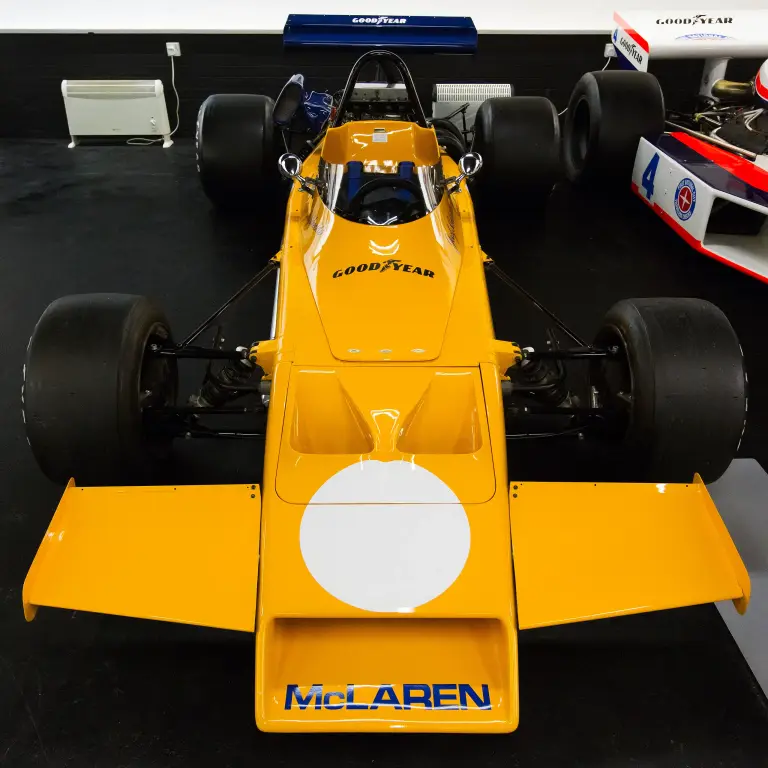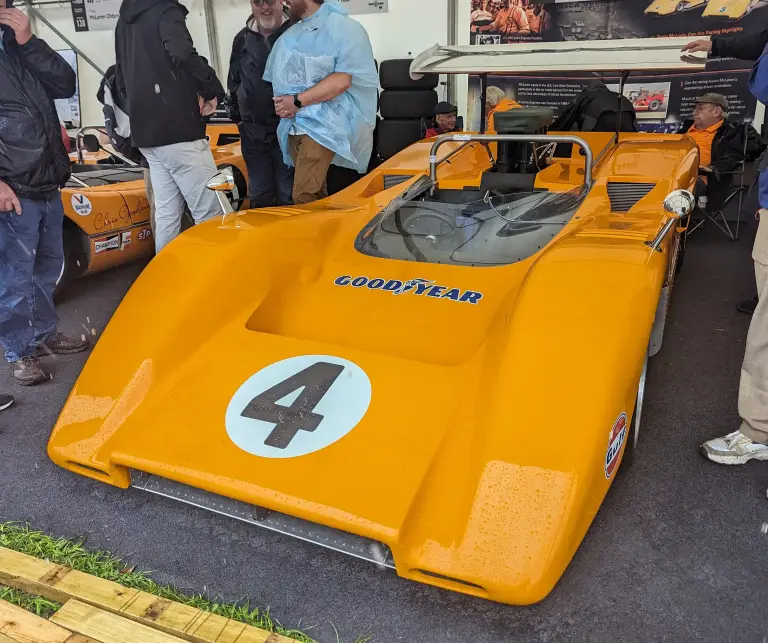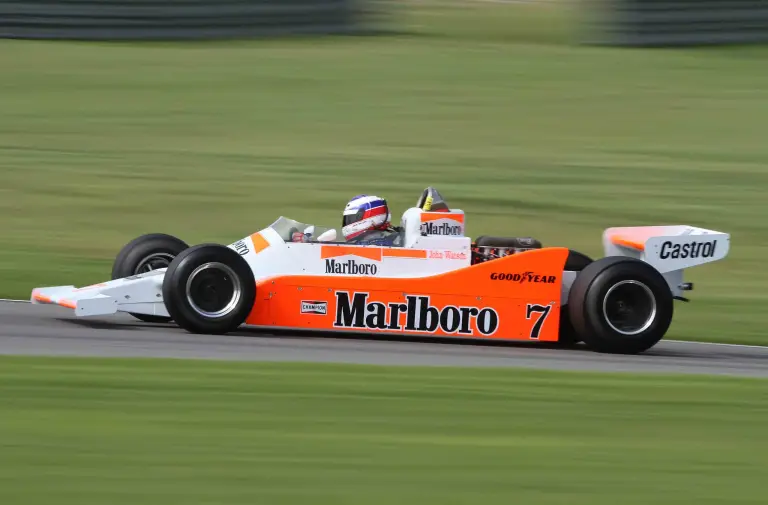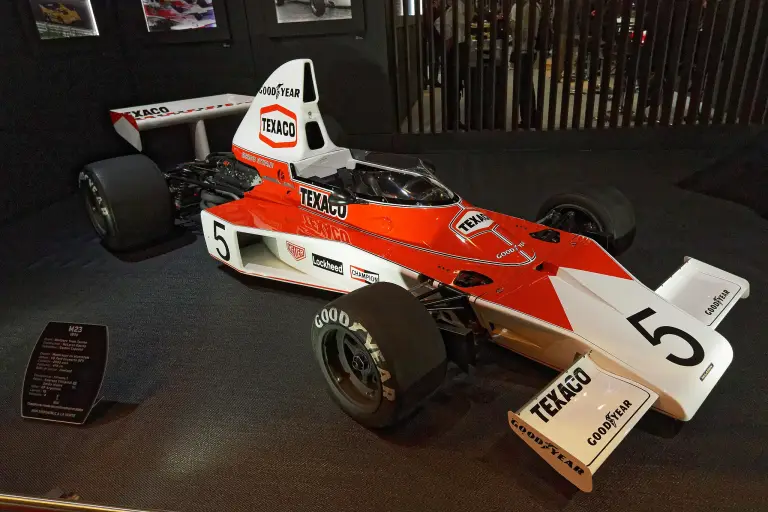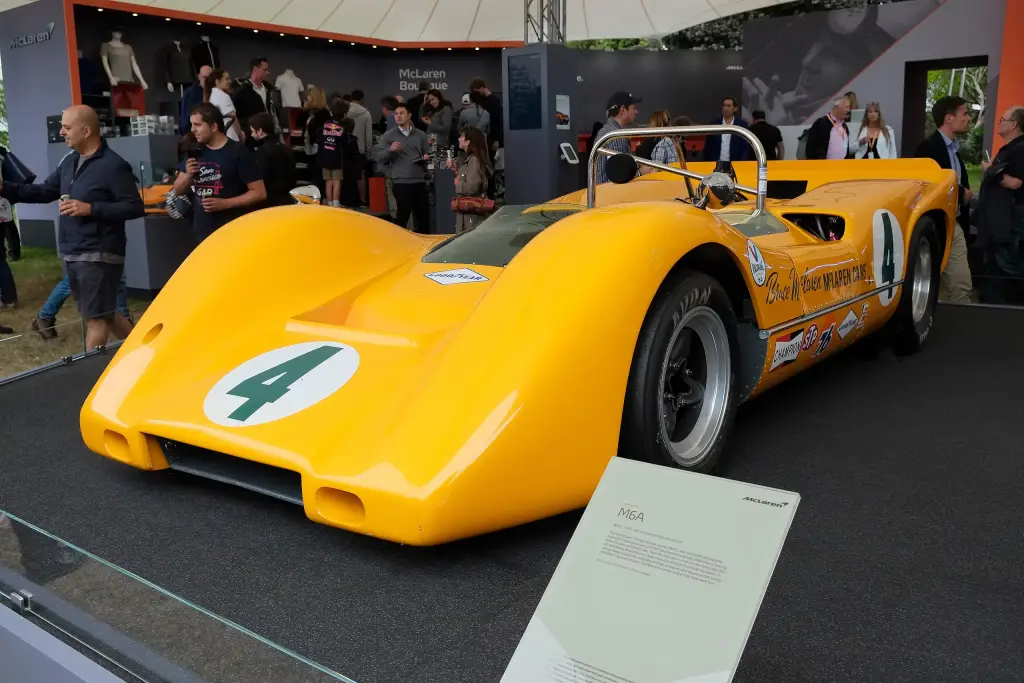
The McLaren M6A was a Group 7 prototype race car designed by Bruce McLaren and built by his team for the 1967 Can-Am season. It replaced the M1B, had McLaren’s first monocoque chassis and gave the team its first Can-Am championship, in the orange paint that became the team’s colour.
McLaren M6A at a glance
| Type | Group 7 Can-Am prototype |
|---|---|
| Season | 1967 |
| Designer | Bruce McLaren, with Robin Herd, Gordon Coppuck, Tyler Alexander and Don Beresford |
| Replaced | McLaren M1B |
| Chassis | McLaren’s first monocoque |
| Engine | Chevrolet V8 with McLaren’s own fuel injection |
| Tyres | Goodyear, replacing Firestone |
| Colour | McLaren Orange |
| Customer version | M6B, built by Trojan and sold without an engine |
| Le Mans project | M6GT fixed-head coupé |
based on one source (English Wikipedia).
History of the McLaren M6A
Bruce McLaren gathered several designers to work on the M6A during the off-season in early 1967: with him, Robin Herd, Gordon Coppuck, Tyler Alexander and Don Beresford laid out the chassis and bodywork. The car had McLaren’s first monocoque chassis and bodywork shaped to increase downforce for the Can-Am circuits. The team also began developing its own fuel injection for the Chevrolet V8s and switched from Firestone to Goodyear in exchange for a testing and development programme.
The first M6A was finished in spring 1967 and taken to nearby Goodwood, where the team covered more than 2,000 miles of testing before the season, tuning the car and gathering data for Goodyear. The cars were then shipped to North America, painted in a new orange that became known as McLaren Orange and eventually became the team’s signature colour.
The 1967 Can-Am season began in September at Road America. Bruce McLaren took pole with a new track record while Denny Hulme led once the race started; McLaren retired with an oil leak and Hulme won the car’s first race. Hulme and McLaren then finished first and second in the next two events, and after the positions were swapped in the following pair McLaren led the points going into the final round. Both cars retired at the Stardust Grand Prix with blown Chevrolet engines, but McLaren still took the 1967 Can-Am Challenge Cup with Hulme second, three points behind.
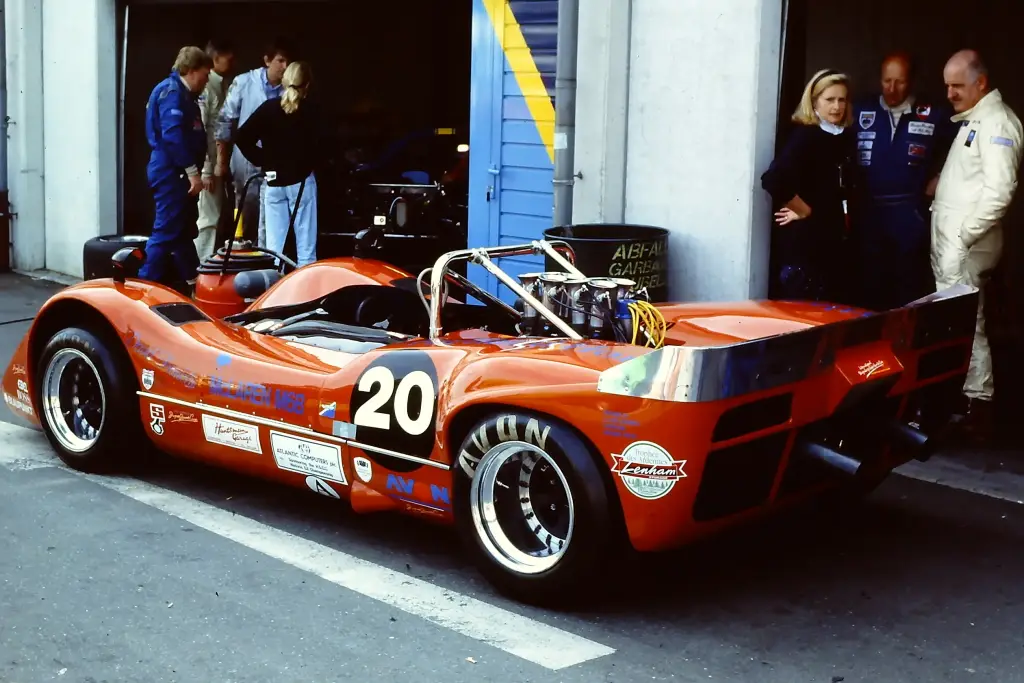
As the team moved to the M8A, M6Bs began to reach customers for 1968. Trojan built near-identical copies of the M6A, sold without an engine, and several M6As were sold too: Roger Penske bought one for Mark Donohue, who won several USRRC events and his second title, and later beat the newer M8As in a Can-Am race. After the USRRC was cancelled at the end of 1968 the cars carried on into the early 1970s, and an M6B with a 5.0-litre Repco RB760 V8 gave John Harvey the Australian Sports Car Championship in 1971 and 1972. The M6 name was also used for the closed M6GT coupé intended for Le Mans; its Group 4 homologation was never completed, only a few prototypes were finished by McLaren and Trojan, and two were converted into road cars, one of them Bruce McLaren’s own transport.
Design and features
- First McLaren monocoque: a stiffer, lighter structure than the space-frame M1 cars.
- Downforce bodywork: shaped specifically for the Can-Am circuits rather than adapted from another formula.
- Own fuel injection: McLaren developed the injection for its Chevrolet V8s in-house.
- McLaren Orange: the colour first used on these cars, which became the team’s identity.
- Customer M6B: Trojan-built copies sold without engines, which kept the design racing for years.
McLaren M6A versions
- M6A (1967): the works Can-Am car, 1967 champion.
- M6B: the customer version built by Trojan and sold without an engine.
- M6GT: a fixed-head coupé for Le Mans whose homologation was never completed; a few were built and two became road cars.
The M6A replaced the M1 cars and was followed by the M8; its monocoque also led to the M12. The road-car idea behind the M6GT was realised years later in the F1, and more cars are in the McLaren collection.
Video: 1967 McLaren M6A
Video by YouTube on YouTube.
Sources
- McLaren M6A, English Wikipedia: design, 1967 season, M6B and M6GT