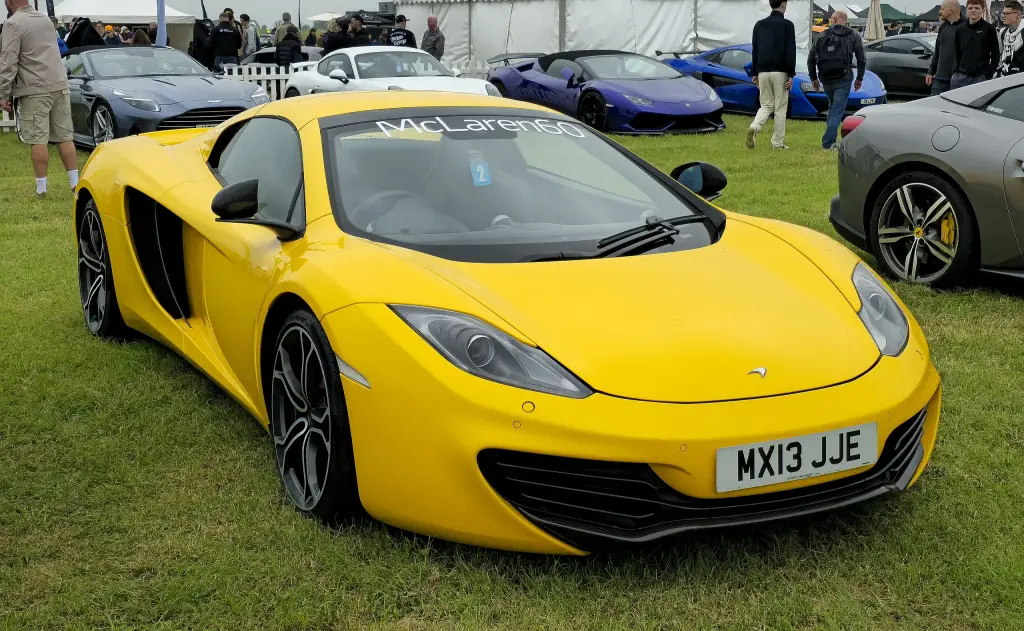
The McLaren MP4-12C, renamed the 12C in 2012, was the first series-production road car from McLaren since the F1 went out of production in 1998. It used a carbon-fibre MonoCell, a twin-turbo V8 built for McLaren by Ricardo and dihedral doors, and it was made at Woking from 2011 to 2014.
McLaren 12C at a glance
| Maker | McLaren Automotive, Woking, Surrey |
|---|---|
| Production | February 2011–April 2014 |
| Body styles | coupé and Spider (retractable hard top) |
| Engine | 3.8-litre twin-turbo V8, codename M838T, built by Ricardo |
| Power | 453 kW (about 607–616 bhp) at 7,500 rpm |
| Torque | about 600 N·m at 3,000 rpm |
| Chassis | carbon-fibre MonoCell, 80 kg |
| Suspension | double wishbones with ProActive Chassis Control hydraulics |
| Doors | dihedral |
| Built | more than 3,400 |
| Successor | 650S |
based on one source (English Wikipedia).
History of the McLaren 12C
McLaren began work on the car in 2005. Early prototypes were modified cars from other makers used as mules: the MV1 was a Ferrari 360 fitted with the 3.8-litre twin-turbo V8, the MV2 was an Ultima GTR used for brakes and suspension, and the MV3 was another Ferrari 360 for exhaust testing. Two in-house prototypes, CP1 and CP2, followed with the MonoCell tub, and more than fifty experimental cars were tested in Bahrain, Arizona, Nevada, the Arctic, Sweden, South Africa and on European circuits.

The final design was shown online in September 2009, and the car appeared in public at the Goodwood Festival of Speed in July 2010. McLaren invested £50 million in a Woking factory able to build about 4,000 cars a year, and series manufacture began on 2 February 2011. The Spider followed in July 2012, and production ended in April 2014 with more than 3,400 cars built. The 650S, which shares most of its components, took over.
The MonoCell was made by Carbo Tech in Salzburg and weighed 80 kg. McLaren invested £127.7 million in it, and the tub cut build time from the 3,000 hours needed for the F1’s carbon chassis and 500 hours for the Mercedes-Benz SLR McLaren to four hours. Carbo Tech supplied the tub for more than eight years, the largest carbon-fibre order for series-production cars at the time.
Design and features
- Carbon MonoCell: a one-piece carbon tub that was cheaper and far quicker to build than earlier carbon chassis.
- M838T engine: a 3.8-litre twin-turbo V8 made by Ricardo in West Sussex.
- ProActive Chassis Control: hydraulically interconnected suspension with double wishbones at each end.
- Dihedral doors: the car’s signature opening, combined with rear-wheel drive and a mid-mounted engine.
- Hydraulic steering: rack and pinion assistance from an electric pump rather than a belt-driven one.
McLaren 12C versions
- MP4-12C coupé (2011–2014): the original two-door fixed-roof car.
- 12C Spider (from July 2012): retractable hard-top convertible.
- 2012 rename: the MP4 prefix was dropped and the car became simply the 12C.
- 650S (2014): successor sharing most of the 12C’s components.
The 12C revived a road-car line that started with the McLaren F1; the later grand tourer is the McLaren GT. More cars are in the McLaren collection.
Video: McLaren MP4-12C Spider vs. Quad (GRIP #230)
Video by YouTube on YouTube.
Sources
- McLaren 12C, English Wikipedia: development, design, engine, production