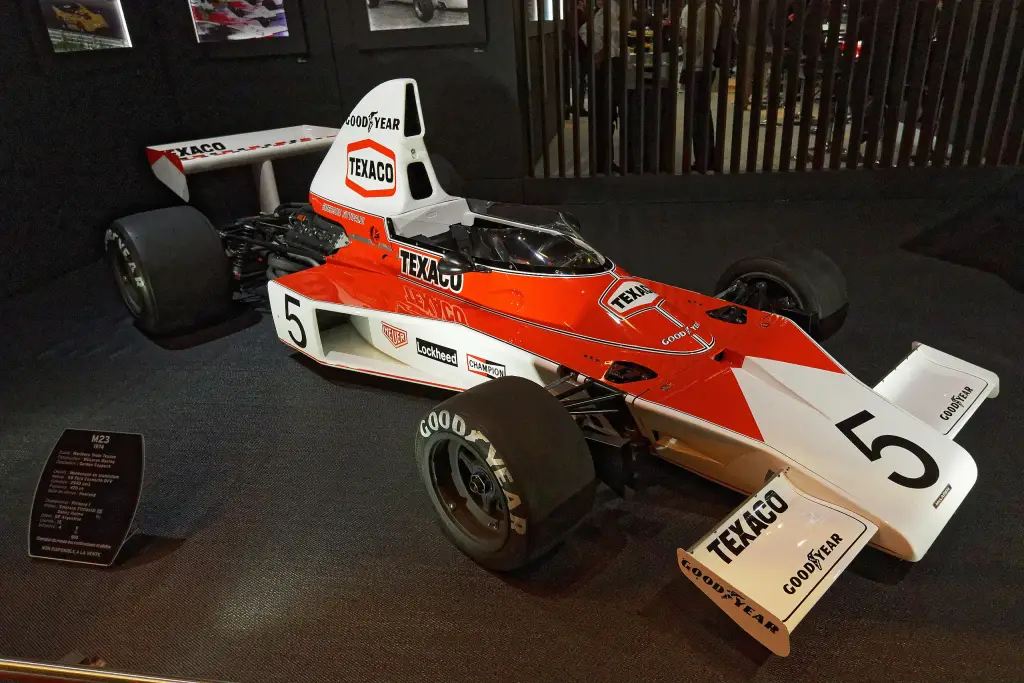
The McLaren M23 was a Formula One car designed by Gordon Coppuck with input from John Barnard and built by McLaren as a development of the M16 Indianapolis car. It raced from 1973 to 1977, won 16 Grands Prix, and brought the team its first drivers’ and constructors’ world championships.
McLaren M23 at a glance
| Type | Formula One racing car |
|---|---|
| Seasons | 1973–1977 |
| Designers | Gordon Coppuck, with John Barnard |
| Based on | McLaren M16 Indianapolis car |
| Engine | Ford Cosworth DFV V8, about 490 bhp |
| Engine preparation | Nicholson-McLaren Engines |
| Chassis numbers | 13 built, numbered 1 to 12 and 14 |
| First race | 1973, pole position for Denny Hulme |
| Titles | drivers’ 1974 (Fittipaldi) and 1976 (Hunt); constructors’ 1974 |
| Grand Prix wins | 16 |
based on one source (English Wikipedia).
History of the McLaren M23
1973: a new car
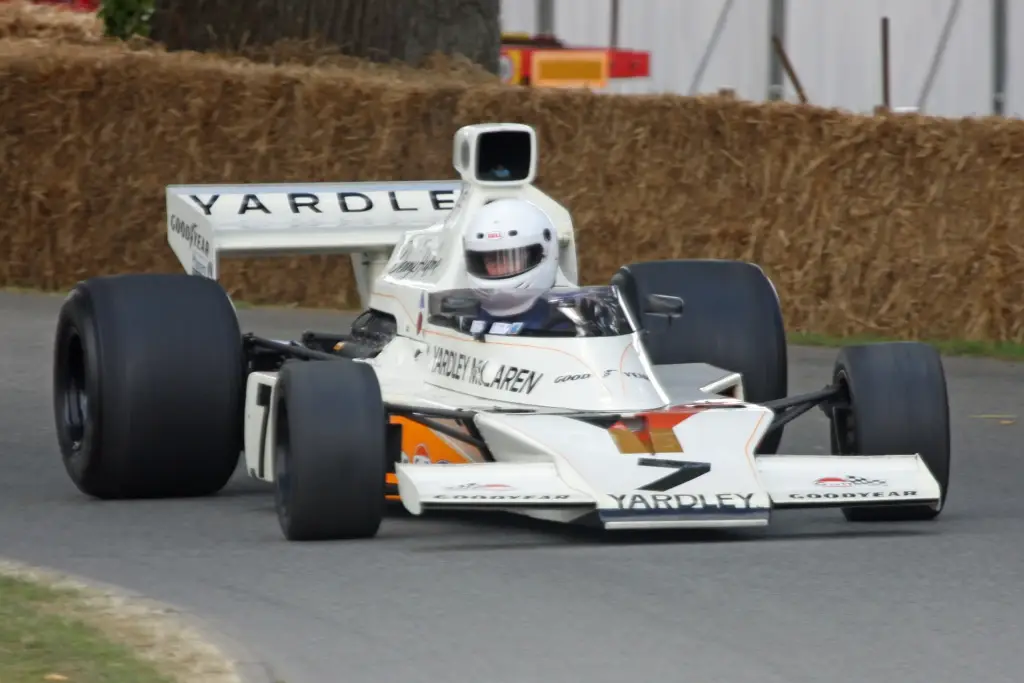
The M19 had reached the end of its development and a new design was needed to keep pace with the latest cars and with the new rules on deformable crash structures. The M23 took inspiration from the M16 Indy car and used the M19’s rear suspension. It scored pole position with Denny Hulme on its first outing, and Hulme and Peter Revson won three races between them that year, while the rookie Jody Scheckter nearly added a fourth; Scheckter also caused one of the biggest accidents Formula One had seen, spinning his M23 in front of the field at the 1973 British Grand Prix.
1974: first titles
Emerson Fittipaldi joined from Lotus in 1974 and his knowledge of the Lotus 72 helped McLaren develop the M23B. Fittipaldi gave the team its first drivers’ and constructors’ championships, beating Ferrari, Tyrrell and Lotus with four wins, three of them his own and one for Hulme. The car gained a wider track and a longer wheelbase, with redesigned bodywork and wings during the year. Marlboro became title sponsor, a partnership that lasted until 1996.
1975 and 1976
Development in 1975 brought the M23C with a six-speed gearbox, then a novelty, and Fittipaldi finished second in the championship behind Niki Lauda and McLaren third among the constructors. The team also tried aerodynamic kickups, different noses, extended bodywork over the oil coolers and side skirts that sealed the underside to the track, a forerunner of ground effects. Fittipaldi left at the end of 1975 and was replaced by James Hunt, who won a dramatic and controversial 1976 title in the M23D, taking six wins. New rules banned the tall airboxes for the Spanish Grand Prix, so the car ran with air scoops either side of the roll bar and moved its oil coolers ahead of the rear wheels.
1977 and beyond
Development stopped at the end of 1976 as the M26 was expected to take over, but when the new car proved troublesome Hunt and Jochen Mass used the M23E early in 1977 and were still competitive, taking poles and podiums. Gilles Villeneuve made his Grand Prix debut in an M23 at the 1977 British Grand Prix. One car later went to South African Dave Charlton and then to the Australian John McCormack, who fitted a 4.9-litre Repco-modified Leyland V8 for Formula 5000 and won the 1977 Australian Drivers’ Championship; he also put it on pole for the 1978 Australian Grand Prix.
Design and features
- M16 DNA: an Indianapolis car’s ideas adapted to Formula One, with the M19’s rear suspension.
- Cosworth DFV: about 490 bhp thanks to preparation by Nicholson-McLaren Engines.
- Continuous development: wider track, longer wheelbase, six-speed gearbox and new bodywork across five seasons.
- Ground-effect experiments: side skirts and bodywork changes that pointed towards the M26 and later cars.
- Long life: still scoring poles and podiums in 1977, four years after its debut.
McLaren M23 versions
- M23 (1973): the original car, on pole at its first race.
- M23B (1974): wider track and longer wheelbase for Fittipaldi’s championship season.
- M23C (1975): six-speed gearbox and aerodynamic experiments.
- M23D (1976): James Hunt’s championship car with revised air intakes.
- M23E (1977): the final development, used while the M26 was sorted.
- Formula 5000 car: McCormack’s Repco Leyland-engined conversion.
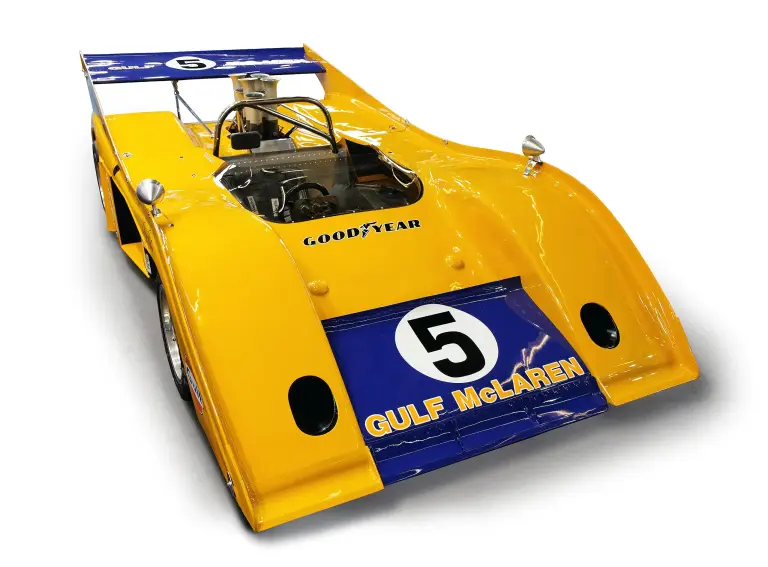
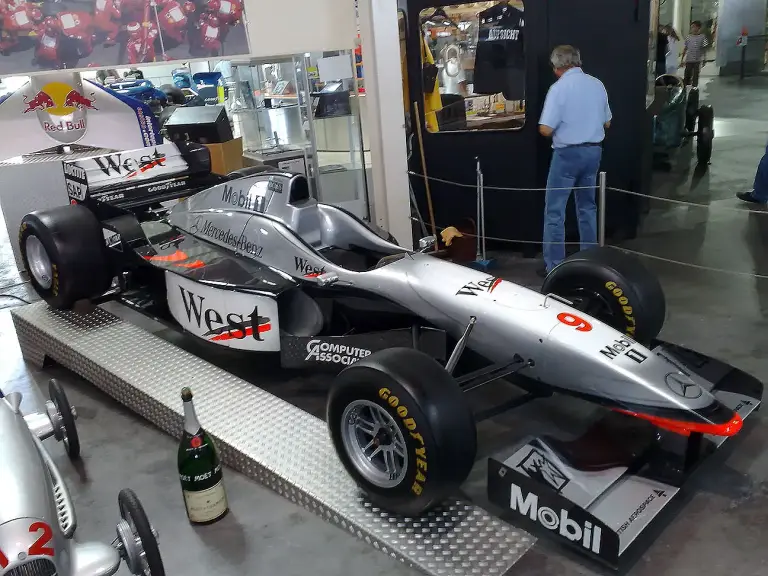
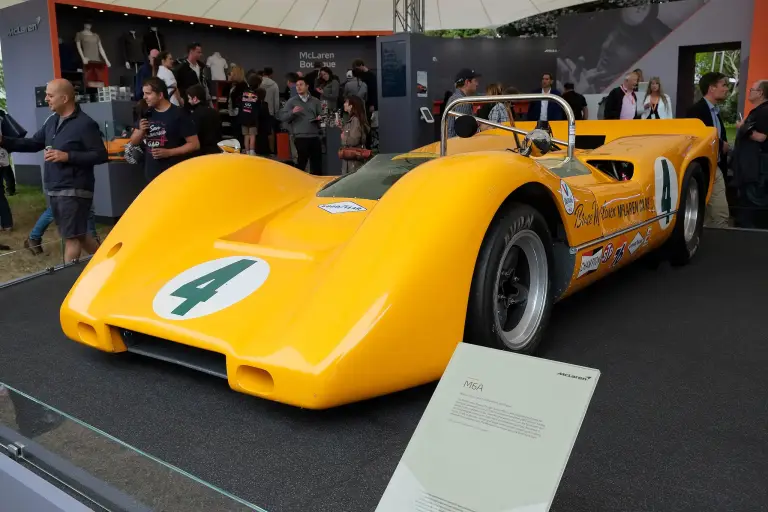
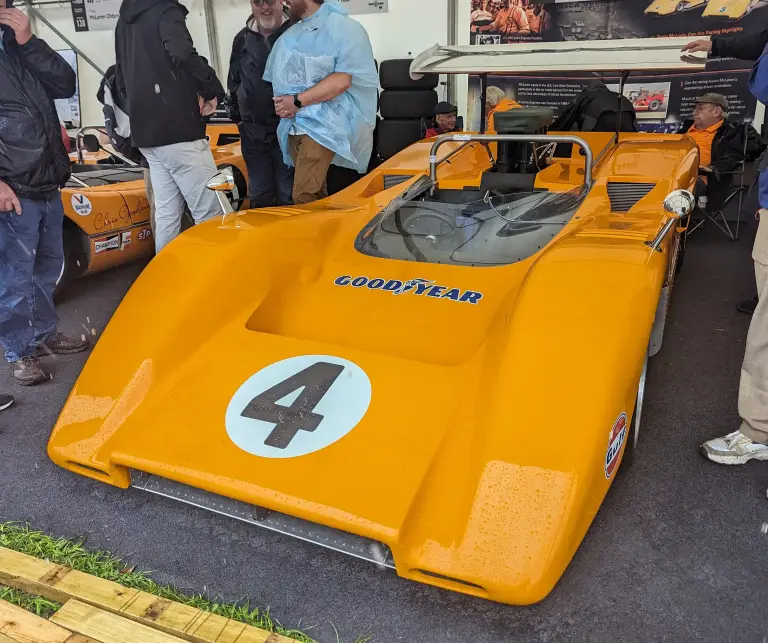
The M23 came from the M16 and was replaced by the M26, after the M14A had started the line in 1970. More cars are in the McLaren collection.
Video: Fittipaldi and the McLaren M23 reunited
Video by YouTube on YouTube.
Sources
- McLaren M23, English Wikipedia: design, seasons, results