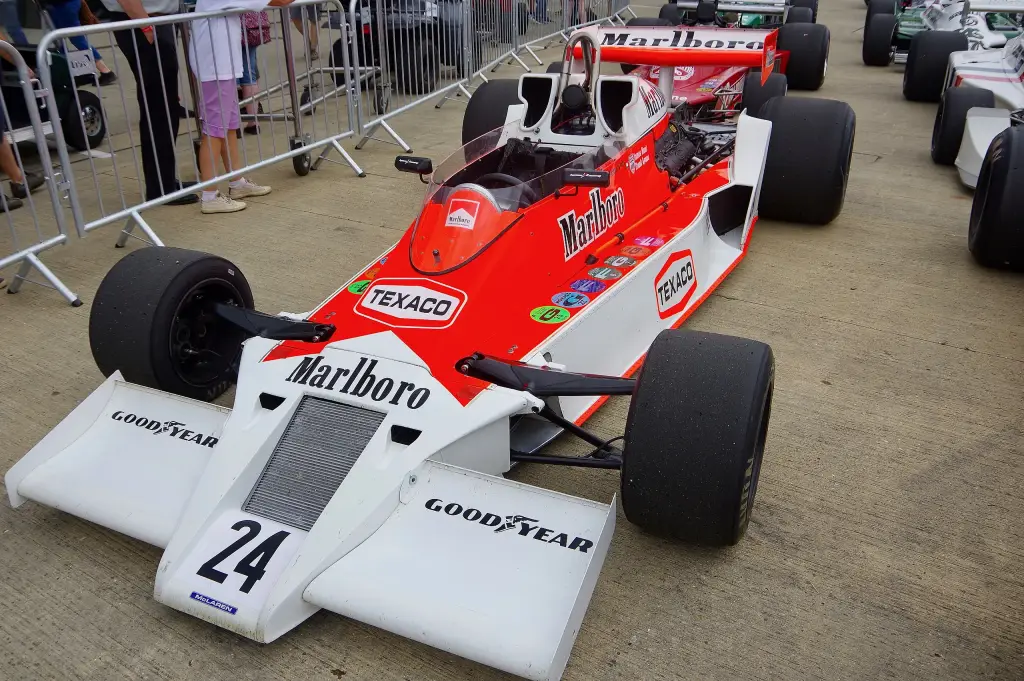
The McLaren M26 was a Formula One car designed by Gordon Coppuck to replace the ageing M23. It was lighter and lower than its predecessor, with a smaller frontal area and a narrower monocoque, and James Hunt won three races with it in 1977.
McLaren M26 at a glance
| Type | Formula One racing car |
|---|---|
| Years | 1976–1979 |
| Designer | Gordon Coppuck |
| Replaced | McLaren M23 |
| Design aims | lighter and lower, smaller frontal area, narrower monocoque |
| Debut | 1976 Dutch Grand Prix, Jochen Mass |
| First full season | 1977, from the Spanish Grand Prix |
| 1977 wins | three, all James Hunt |
| Best championship | 1977, third with 69 points |
| Career total | three wins and 86 points |
based on one source (English Wikipedia).
History of the McLaren M26
Coppuck began design work in early 1976 with the aim of introducing the car in the middle of the season. On his first tests Jochen Mass found cooling problems, and Coppuck had to redesign the radiator installation for better airflow. The M26 then debuted at the 1976 Dutch Grand Prix in Mass’s hands, but after that race the team decided the nose and other areas needed more work, and the car was not used again that year.
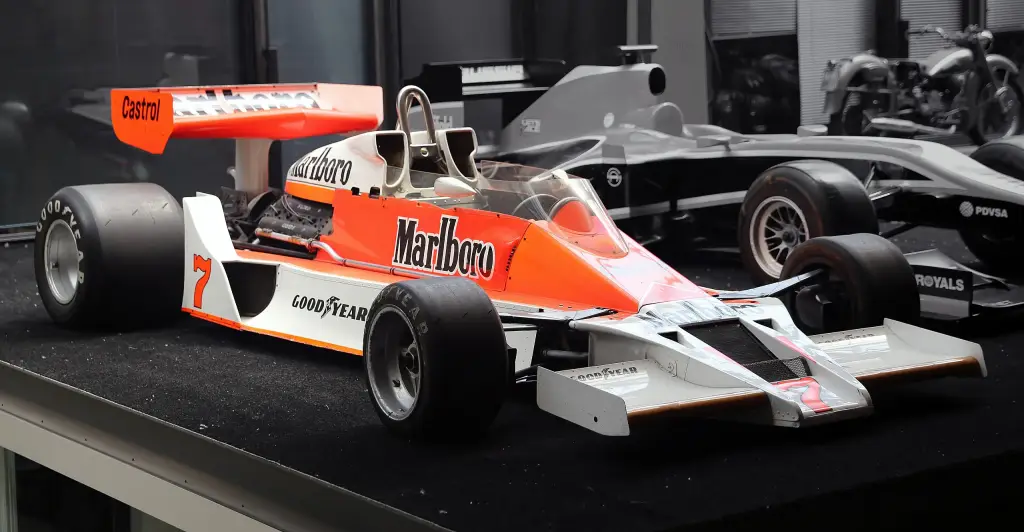
McLaren relied on the M23 for the rest of 1976 and the first races of 1977, until the older car’s fading performance made the M26 necessary. The redesigned car returned at the Spanish Grand Prix and proved a solid, if unspectacular, performer. James Hunt, who initially disliked the car, worked on its race pace and reliability and won three times, with two more podiums in the second half of the season; two further wins were lost in Austria to reliability and in Canada to a collision with his own teammate Mass while being lapped. McLaren finished the year third with 69 points.
For 1978 the M26 was updated and Patrick Tambay replaced Mass. Hunt started well, but Lotus introduced the Lotus 79 and the M26 was immediately obsolete. A mid-season redesign turned it into a partial ground-effect car, the M26E, with larger sidepods for the venturis, new suspension and smaller wings, but there was no improvement. The M26 was retired after a couple of runs in early 1979, and McLaren did not win again until 1981.
In 1980 the constructor Tiga rebuilt an M26 as a full ground-effect car with a five-litre Chevrolet engine for Formula 5000, and Alfredo Costanzo won the 1981 Australian Drivers’ Championship with it. In 2009 Bobby Verdon-Roe won the FIA Historic Formula One Championship in an M26.
Design and features
- Smaller and lighter: a narrower monocoque and lower body than the M23, aimed at less drag.
- Revised cooling: the radiator layout was redesigned after the first tests showed overheating.
- Solid rather than spectacular: reliable enough for Hunt to take three wins and finish the 1977 season strongly.
- Ground-effect attempt: the M26E added large sidepods and smaller wings, though without gaining performance.
- Second life: rebuilt by Tiga for Formula 5000 and still raced in historic Formula One today.
McLaren M26 versions
- M26 (1976): the original car, which ran only one race that year.
- M26 (1977 specification): the redesigned car with which Hunt won three races.
- M26E (1978): the partial ground-effect version.
- Tiga Formula 5000 car (1980): a rebuilt M26 with a five-litre Chevrolet engine.
The M26 replaced the M23 and was followed by the M28 and M29. More cars are in the McLaren collection.
Video: James Hunt’s 1977 McLaren M26 in Dubai
Video by YouTube on YouTube.
Sources
- McLaren M26, English Wikipedia: design, seasons, results