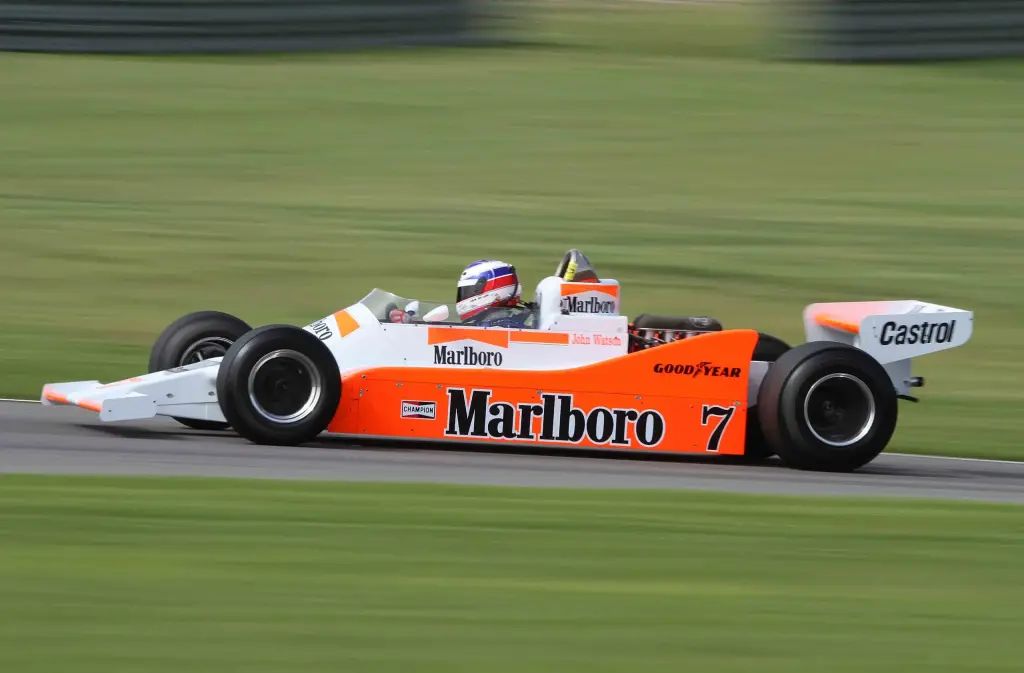
The McLaren M28 was the Formula One car McLaren built and ran in the 1979 World Championship. Designed and wind-tunnel tested in the second half of 1978, it turned out to be bulky and ineffective, and the team replaced it as soon as a better design was ready.
McLaren M28 at a glance
| Type | Formula One racing car |
|---|---|
| Season | 1979 |
| Engine | naturally aspirated Ford Cosworth 3-litre V8 |
| Design and testing | second half of 1978, with wind tunnel work |
| Chassis | narrow aluminium and Nomex honeycomb monocoque |
| Built | three chassis |
| Drivers | John Watson, Patrick Tambay |
| First appearance | test at Watkins Glen, October 1978 |
| Best result | third, 1979 Argentine Grand Prix |
| Other points finishes | sixth in Belgium, fourth in Monaco |
based on one source (English Wikipedia).
History of the McLaren M28
After a disastrous 1978 season James Hunt left for Walter Wolf Racing and was to be replaced by Ronnie Peterson, who was killed at the 1978 Italian Grand Prix. With few drivers available McLaren signed John Watson for 1979. The M28 was designed and wind-tunnel tested during the latter half of 1978 and first appeared on track in October that year in a test at Watkins Glen.
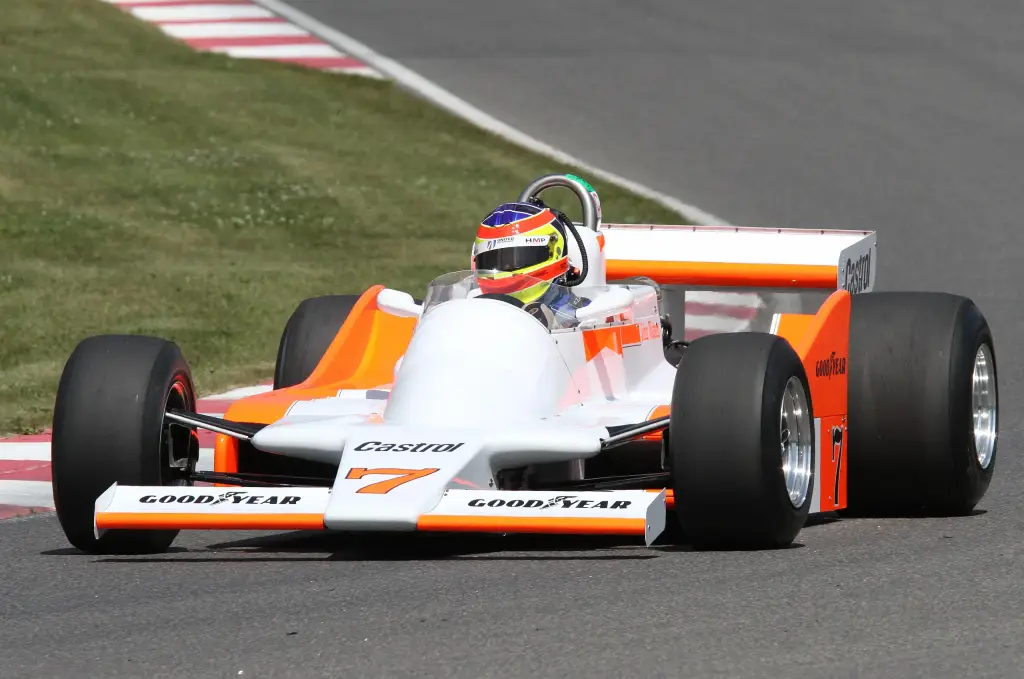
The car was noticeably larger than its rivals and looked much bulkier, which hit top speed hard: it was one of the slowest cars through the speed traps. Its ground-effect design did not work well and grip was poor, and the chassis lacked torsional rigidity. Watson described the car as a disaster, and after the first round of tests the chassis was drooping and had lost its strength; later he called the M28 the worst Formula One car he had driven. Patrick Tambay was even less impressed.
Coppuck had designed a very narrow monocoque of aluminium and Nomex honeycomb to make the chassis stiff and leave as much underfloor area as possible for ground effect, but the result was a large frontal area and plenty of drag. McLaren’s boss Teddy Mayer was shocked by the lack of performance. The car was completely redesigned, with the B specification appearing in Belgium, but it did not improve and the changes only made the M28 heavier and slower. It was still better than the old M26, so it was used through the first half of 1979: Watson finished third in the opening Argentine Grand Prix, sixth in Belgium and fourth in Monaco, while Tambay drove the second car.
The M28 also raced in the colours of the German brewer Löwenbräu at the 1979 United States Grand Prix West, alongside the team’s usual red and white Marlboro livery.
Design and features
- Narrow monocoque: aluminium and Nomex honeycomb, intended to free up underfloor area for ground effect.
- Wind-tunnel developed: one of the team’s first designs shaped with tunnel testing, though the results did not follow.
- Bulky bodywork: a large frontal area that made the car one of the slowest through the speed traps.
- Weak ground effect: poor grip and a chassis that lost rigidity in testing.
- Short career: replaced during 1979 once McLaren had a better car.
McLaren M28 versions
- M28 (1979): the original car from the start of the season.
- M28B (1979): the redesigned version that appeared in Belgium without improving performance.
- Löwenbräu car: a one-off livery at the 1979 United States Grand Prix West.
The M28 followed the M26 and was replaced by the M29; its successor’s line led to the MP4/4. More cars are in the McLaren collection.
Sources
- McLaren M28, English Wikipedia: development, design problems, 1979 results